Choosing a Virtual Cardiac Rehab Vendor: An Evaluation Guide


Key Takeaways
Virtual cardiac rehab vendors differ far more than their marketing suggests, and the differences that matter are clinical and regulatory rather than technological. Seven criteria separate them: the clinical supervision model, verified completion rates, program breadth including intensive cardiac rehab and pulmonary, documentation and compliance rigor, coverage and enrollment support, referral and EHR integration, and geographic reach. Completion rate is the most important and the most gameable of these, so ask every vendor to define exactly how they calculate it. A vendor with a real number will welcome the question.
Virtual cardiac rehabilitation has moved from pilot to procurement. Systems evaluating vendors now are not asking whether remote delivery works, since systematic reviews have found comparable improvements in functional capacity and quality of life against center-based programs. They are asking which partner to trust with a regulated clinical service delivered under their name. This guide sets out the criteria that genuinely distinguish vendors, and the questions that surface the difference between a strong program and a good deck.
Start With the Model Decision, Not the Vendor List
Before evaluating vendors, be clear about what you are buying and why. Center-based, home-based, virtual, and hybrid models carry different trade-offs in access, cost, supervision, and completion, and our review of cardiac rehab delivery models compares them directly. Be equally clear on your objective.
A system solving capacity constraints will weight throughput and geography; one focused on readmission penalty exposure will weight completion and clinical integration. Those two briefs produce different shortlists, and the mismatch between objective and selection is a common source of disappointing partnerships.
Seven Criteria for Evaluating Virtual Cardiac Rehab Vendors
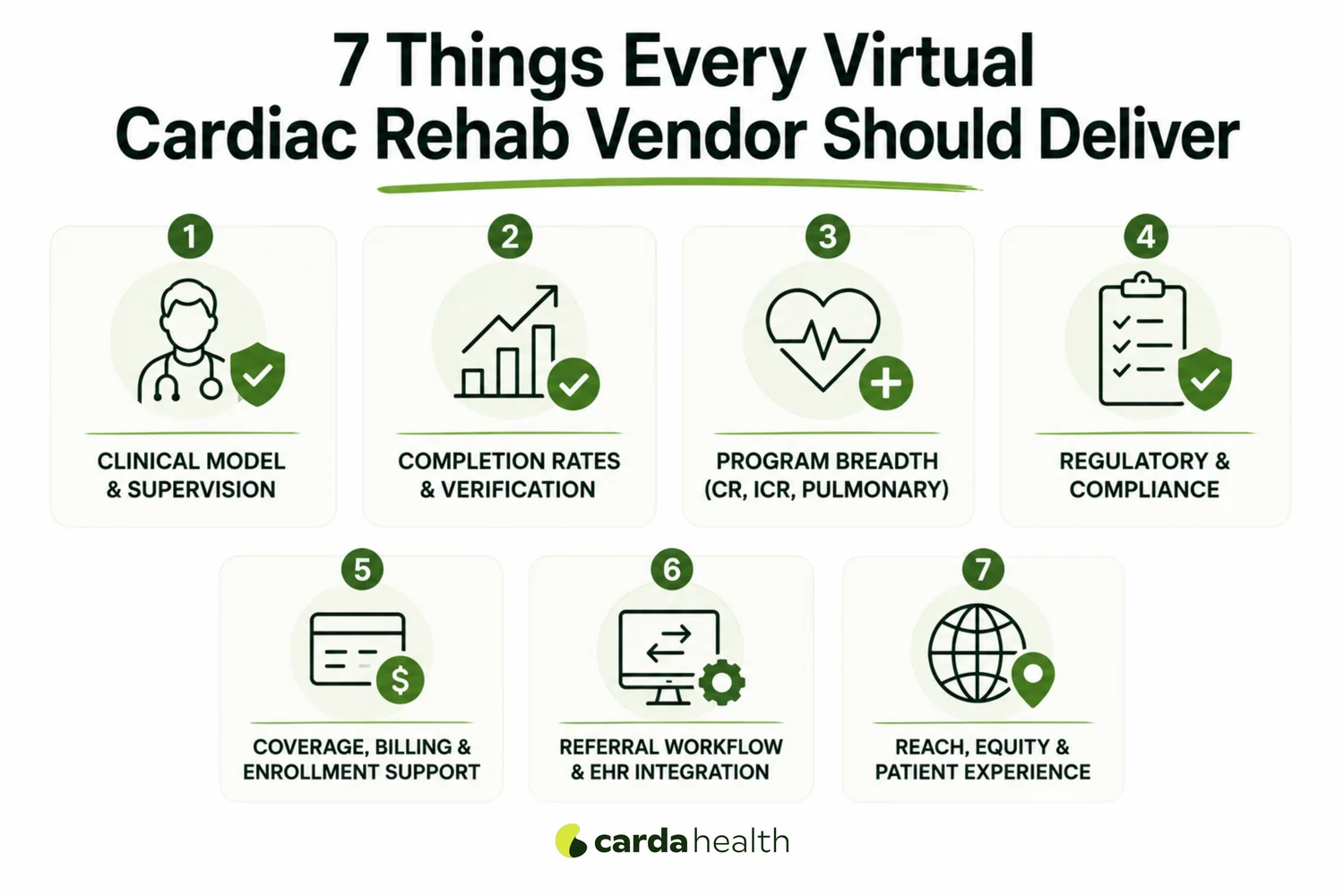
1. Clinical Model and Supervision
Confirm that a credentialed clinician supervises each session live, with real-time vitals and a written escalation pathway. This comes first because it carries clinical and regulatory consequences. Ask: who is on the other end of the session, what are their credentials, and is it live or asynchronous? There is a meaningful difference between a platform shipping an app and a dashboard, and a program in which a clinical exercise physiologist supervises a live one-to-one session with real-time vitals. Ask what is monitored, how often, and what the escalation pathway is when a reading falls outside parameters. Then ask how their arrangement satisfies the physician supervision requirements under 42 CFR 410.49, and how they apply the CY2026 Physician Fee Schedule final rule, which permanently allows direct supervision through real-time audio-video (not audio-only) for cardiac, intensive cardiac, and pulmonary rehab. Our overview of telehealth cardiac rehab in 2026 covers that backdrop.
2. Completion Rates, and How to Verify Them
Get the completion rate in writing with its definition, denominator, cohort, and reporting period attached. Completion matters most because the benefit of rehab is dose-dependent, and it is the most inconsistently reported figure in the category. In a study of Medicare fee-for-service beneficiaries aged 65 and older with a qualifying event in 2016, 26.9% of participants completed at least 36 sessions, with utilization measured through 2017. Vendor-reported figures for virtual programs run considerably higher, but they generally come from single-program evaluations with their own inclusion criteria, and they may reflect motivated enrollment or program-specific design rather than population-representative norms. Treat any headline number, from any vendor, as a claim to be tested. Our analysis of why patients don't complete cardiac rehab sets out what actually drives dropout, which is the context a completion figure has to be read against.
Questions to Verify a Vendor's Completion Rate
- What is the denominator? Patients referred, patients enrolled, or patients who attended a first session? The difference can double a reported rate.
- What counts as completion? All 36 sessions, a set percentage, or a clinical milestone? Ask for the threshold in writing.
- Over what population? All comers, or a subset excluding early dropouts and patients who never started?
- Can we see it by subgroup? Completion broken out by age, sex, rurality, and payer tells you whether the number will hold for your population.
- Will you report it to us on our patients? Contractual reporting on your own cohort is worth more than any published figure.
3. Program Breadth: Standard CR, ICR, and Pulmonary
Confirm whether the vendor delivers standard cardiac rehab, intensive cardiac rehab, and pulmonary rehab, because breadth determines how much of your eligible population one contract covers. Three questions matter. First, does the vendor deliver intensive cardiac rehabilitation as well as standard cardiac rehab? ICR is a separate Medicare benefit permitting up to 72 sessions over 18 weeks, and only three ICR programs are approved nationally: Ornish, Pritikin, and Benson-Henry. This is a structural differentiator, not a feature checkbox, and it matters clinically because the switch is one-directional: a beneficiary may move from ICR to CR once, keeping only the sessions remaining in the 36-session allowance, but may not move from CR to ICR at all. Starting a patient on standard CR therefore forecloses ICR. Second, does the vendor also deliver pulmonary rehabilitation? Many eligible populations overlap, and a single partner covering both simplifies contracting and referral logic, as our guide to cardiopulmonary rehabilitation explains. Third, which conditions can they take? Confirm they can serve your heart failure population within the applicable coverage criteria, not only post-procedure patients.
4. Regulatory and Documentation Compliance
Verify who creates the individualized treatment plan, who obtains the physician signature, and how the review cadence is tracked, using a redacted sample record and the vendor's denial rate and audit history as evidence. This is where partnerships create risk quietly, because cardiac rehab is an active audit target. Our guides to documenting eligibility for Medicare and the ICD-10 codes for referral set out what a compliant record contains and double as a checklist for interrogating a vendor's process. Ask also whether their program holds or meets AACVPR certification standards.
Then ask what the delivery model depends on legally, keeping two separate CMS policies apart. Virtual direct supervision, covered under criterion 1, is now permanent and governs how clinicians may supervise remotely. In-home delivery is a different and temporary provision: the Consolidated Appropriations Act, 2026 allows CR, ICR and PR to be delivered to hospital outpatients in their homes by real-time audio-video through December 31, 2027, and CMS has issued billing guidance for it, including use of the 95 modifier. Ask which authority the vendor's arrangement relies on, how claims are billed under it, and what happens to your patients if the provision lapses without a permanent fix.
5. Coverage, Billing, and Enrollment Support
Get in writing who verifies eligibility, handles prior authorization, and manages enrollment after a referral. Whatever the vendor does not do lands on your staff. Which payers do they contract with, and how do they handle Medicare Advantage plans, which vary considerably? Ask how they support patients through coverage questions, since cost uncertainty is a common reason patients decline. Our guide to Medicare coverage for cardiac rehab and the pulmonary equivalent outline the coverage rules the vendor should navigate confidently.
Ask specifically how they handle copays. A 2026 analysis of the AACVPR registry covering 59,838 patients found that having any copay was associated with 4.9 fewer sessions attended. Among patients with copays who dropped out and had a recorded dropout reason, 22.9% cited copay issues. A vendor without a clear answer on cost sharing will lose patients to it.
6. Referral Workflow and EHR Integration
Judge integration by the referral workflow rather than the interface claim. Most partnerships underperform at the referral step, not the clinical one. Ask what the referral looks like to a hospitalist at discharge, and how many clicks it takes. Ask whether the vendor supports automated or opt-out referral in your electronic record, since default-on referral is the best-evidenced way to raise referral rates, as our cardiac rehab enrollment playbook sets out stage by stage. Ask what closes the loop: how and when your clinicians learn whether the patient enrolled, progressed, and completed. Our guide to when to refer to cardiac rehab describes the clinical triggers that referral logic should encode.
7. Reach, Equity, and Patient Experience
Confirm the vendor can reach the patients your current program cannot. Ask where it is licensed and staffed, and whether coverage reaches the rural counties in your service area, since geographic access is precisely the gap virtual delivery should close. Ask what equipment is provided and whether the patient needs their own device or broadband, because a program assuming both will exclude the patients with greatest need. Ask about language access, and whether outcomes are reported by subgroup so you can tell whether the partnership narrows disparities or reproduces them.
| Criterion | What to verify | Why it matters | Evidence to request |
|---|---|---|---|
| Clinical model | Who supervises sessions and with what credentials | Determines safety, and whether supervision meets CMS requirements | Staff credentials, monitoring specification, and the written escalation protocol |
| Completion rate | The definition, denominator, and source of the number | Benefit is dose-dependent; the metric is easily inflated | A sample outcomes report showing definition, denominator, cohort, and period |
| Program breadth | Standard CR, ICR, and pulmonary rehab capability | Determines how much of your eligible population one contract covers | Program list with ICR approval status and covered diagnoses |
| Compliance | ITP creation, physician signature, 30-day review, audit history | Documentation failures create denials and takeback exposure | A redacted sample record, plus denial rate and audit history |
| Coverage support | Eligibility verification, prior authorization, payer contracts | Determines administrative load on your staff | A billing-responsibility document and payer contract list |
| Integration | Referral pathway and EHR workflow, not just an interface claim | Referral friction is where most patients are lost | Implementation plan, referral workflow demo, and data-security documentation |
| Reach and equity | Coverage of rural counties, device provision, language access | Determines whether the partnership closes gaps or mirrors them | Licensure by state, device and connectivity policy, language support, and subgroup outcomes |
Virtual Cardiac Rehab Vendor Red Flags
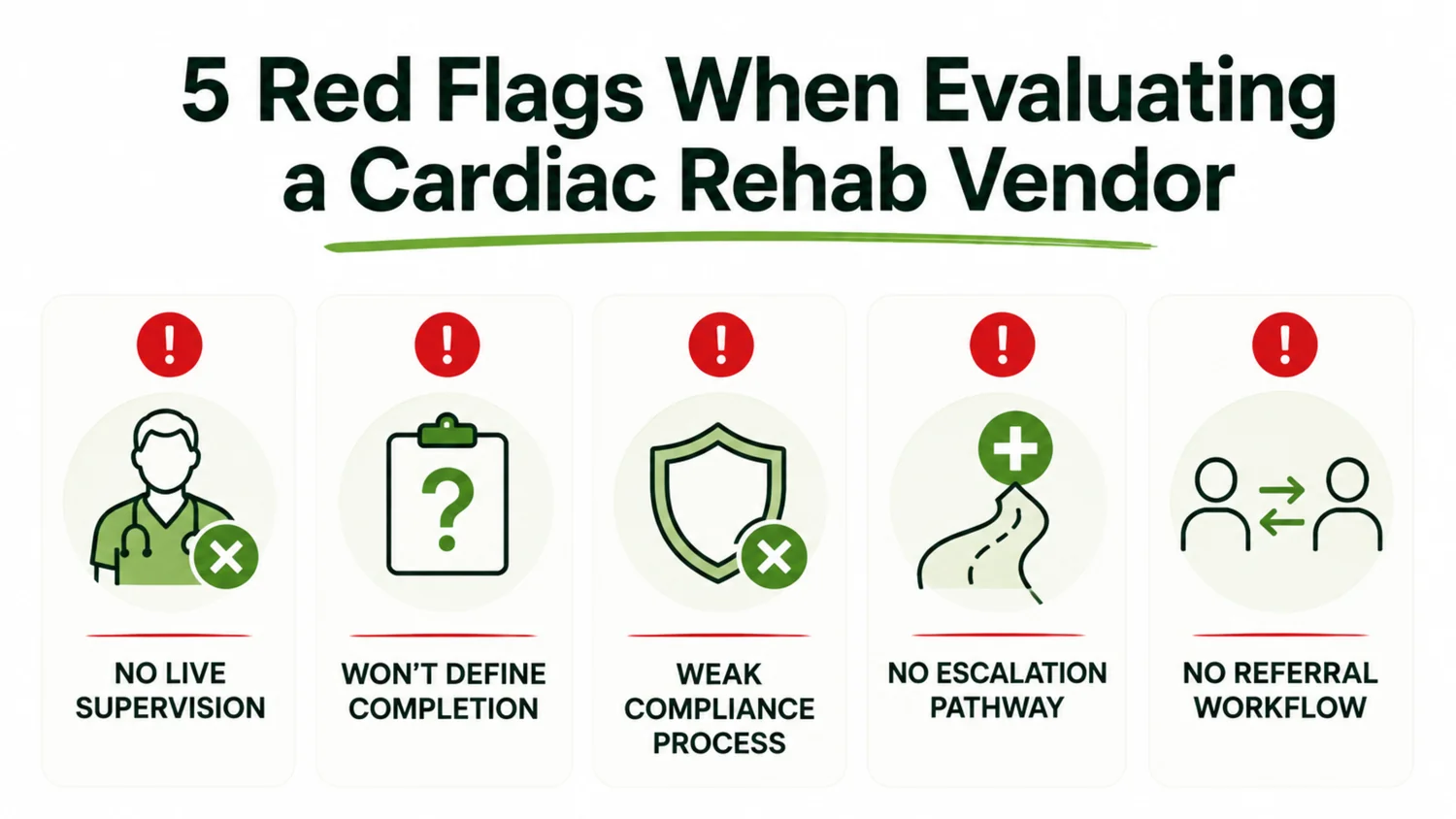
- No live clinical supervision, meaning an app and a dashboard rather than a supervised session.
- Refusal to define completion or to report outcomes on your own patients contractually.
- Vague answers on the individualized treatment plan, physician signature, and review cadence.
- No named escalation pathway for clinical events during a session.
- Integration described only as an interface with no referral or results workflow behind it.
How Carda Health Answers These Questions
For transparency, here is where Carda Health sits against the same framework. Carda Health delivers live one-to-one supervised sessions with a clinical exercise physiologist and real-time vitals monitoring, supported by a care team of physicians, nurse practitioners, and exercise physiologists. Patients receive a kit containing a tablet, blood pressure monitor, and heart rate monitor, so participation does not depend on owning equipment.
Carda reports that its patients attend an average of 32 of 36 prescribed sessions, about 89%. That is an attendance average, not the share of patients who finish all 36 sessions, so it should not be compared directly with the 26.9% completion figure from the 2016 Medicare cohort above. Apply the same test to Carda that this guide recommends for every vendor: ask for the cohort, the denominator, and the reporting period, and for contractual reporting of the same measure on your own patients. On breadth, Carda covers both cardiac and pulmonary rehabilitation and is the exclusive provider of the Ornish program delivered entirely online, one of only three ICR programs approved nationally. Carda also verifies eligibility and handles much of the enrollment and coverage paperwork after referral. The right test is not whether a vendor answers these questions well in a deck, but whether they will commit to them in a contract.
The Bottom Line
The technology in this category has largely converged. What still varies considerably is the clinical model behind it, the rigor of the documentation, the breadth of programs offered, and whether the vendor will stand behind its outcomes on your patients. Evaluate supervision first, interrogate the completion number hard, confirm ICR and pulmonary capability if your population needs it, and make outcome reporting contractual rather than promotional. Ask every vendor the same questions, including the one you are leaning toward.
See how Carda Health partners with health systems
Frequently Asked Questions
What should we look for in a virtual cardiac rehab vendor?
Seven things: the clinical supervision model and staff credentials, verified completion rates, program breadth including intensive cardiac rehab and pulmonary, documentation and compliance rigor, coverage and enrollment support, referral and EHR integration, and geographic reach with equitable device and language access.
How do we verify a vendor's completion rate?
Ask for the denominator, the threshold that counts as completion, the population it covers, a breakdown by subgroup, and a contractual commitment to report the same measure on your own patients. Published figures often come from single-program evaluations and may not represent your population.
Who supervises patients during virtual cardiac rehab sessions?
It varies by vendor, which is why it is the first question to ask. Strong programs provide live sessions supervised by a clinical exercise physiologist with real-time vitals monitoring and a defined escalation pathway. Confirm how the arrangement satisfies physician supervision requirements under 42 CFR 410.49 and the CY2026 Physician Fee Schedule rule, which permanently allows virtual direct supervision through real-time audio-video. In-home delivery is a separate question: hospital programs may deliver sessions at home through December 31, 2027 under the Consolidated Appropriations Act, 2026.
Can virtual vendors deliver intensive cardiac rehab (ICR)?
Only some can. ICR is a separate Medicare benefit allowing up to 72 sessions over 18 weeks, and only three ICR programs are approved nationally: Ornish, Pritikin, and Benson-Henry. It also matters clinically, since the switch runs one way only: a beneficiary may switch once from ICR to CR, limited to the sessions remaining, but may not switch from CR to ICR.
What compliance questions should be in the RFP?
Who creates the individualized treatment plan, who obtains the physician signature, how the required review cadence is tracked, what a sample record looks like, the vendor's denial rate and audit history, whether the program meets recognized certification standards, and how its in-home delivery would continue if the current authority lapses after December 31, 2027.
How should integration be evaluated?
Beyond an interface claim. Ask what the referral looks like for a hospitalist at discharge, whether automated or opt-out referral is supported in your electronic record, and how results flow back so clinicians know whether the patient enrolled, progressed, and completed.
References
- Code of Federal Regulations. 42 CFR 410.49, Cardiac rehabilitation program and intensive cardiac rehabilitation program.
- Centers for Medicare & Medicaid Services. MLN MM14315: Medicare Physician Fee Schedule Final Rule Summary, CY 2026.
- Centers for Medicare & Medicaid Services. Virtual Cardiac Rehabilitation (CR), Intensive Cardiac Rehabilitation (ICR) and Pulmonary Rehabilitation (PR) Furnished by Hospital Outpatient Departments (HOPDs) FAQ. April 9, 2026.
- Centers for Medicare & Medicaid Services. Intensive Cardiac Rehabilitation (ICR) Programs, approved program and facility list.
- Centers for Medicare & Medicaid Services. NCD 20.31.2, Ornish Program for Reversing Heart Disease.
- Centers for Medicare & Medicaid Services. NCD 20.31.3, Benson-Henry Institute Cardiac Wellness Program.
- Centers for Medicare & Medicaid Services. Billing and Coding: Frequency and Duration for Cardiac Rehabilitation and Intensive Cardiac Rehabilitation, article A53775.
- American Association of Cardiovascular and Pulmonary Rehabilitation. Program certification and clinical standards.
- Virtual healthcare solutions for cardiac rehabilitation: a literature review. Eur Heart J Digit Health. 2023.
- Ritchey MD, Maresh S, McNeely J, et al. Tracking Cardiac Rehabilitation Participation and Completion Among Medicare Beneficiaries to Inform the Efforts of a National Initiative. Circ Cardiovasc Qual Outcomes. 2020;13(1):e005902.
- Thapa S, Naser M, Farah M, et al. Association Between Copayments and Attendance in Cardiac Rehabilitation: A Nationwide Analysis From the AACVPR Registry. J Am Heart Assoc. 2026;15(7):e049082.