Cardiac Rehab Access Barriers for Rural Patients and Women


Key Takeaways
Cardiac rehab access is limited by structure before it is limited by patient motivation. A 2025 analysis of 3,113 US counties found that at least half contain no hospital offering cardiac rehab, and access worsens as social vulnerability rises, with the effect more than twice as strong in rural counties. Women face a different mechanism: they are referred less often than men, and traditional program design often does not meet their psychosocial needs. The two best-supported responses are automated referral, which addresses referral bias directly, and virtual or hybrid delivery, which addresses geography. Evidence for women-only programs specifically remains mixed.
Conversations about cardiac rehab participation often start with the patient: are they motivated, will they attend, do they understand the benefits? For two large groups, that framing puts the question in the wrong place. Rural patients and women are underrepresented for reasons that largely precede any decision the patient makes, and understanding those mechanisms separately is what makes the fixes obvious.
Why Cardiac Rehab Access Is a Supply Problem First
Nationally, participation among eligible Medicare beneficiaries has hovered around a quarter, and completion among those who start is lower still. Programs typically respond by working on engagement, and our enrollment playbook covers what the evidence supports there. That is worth doing, but engagement strategies assume a program exists within reach and that the patient was referred to it. For much of the country, neither assumption holds.
Why Rural Patients Have Less Access to Cardiac Rehab
How Many US Counties Have No Cardiac Rehab Program?
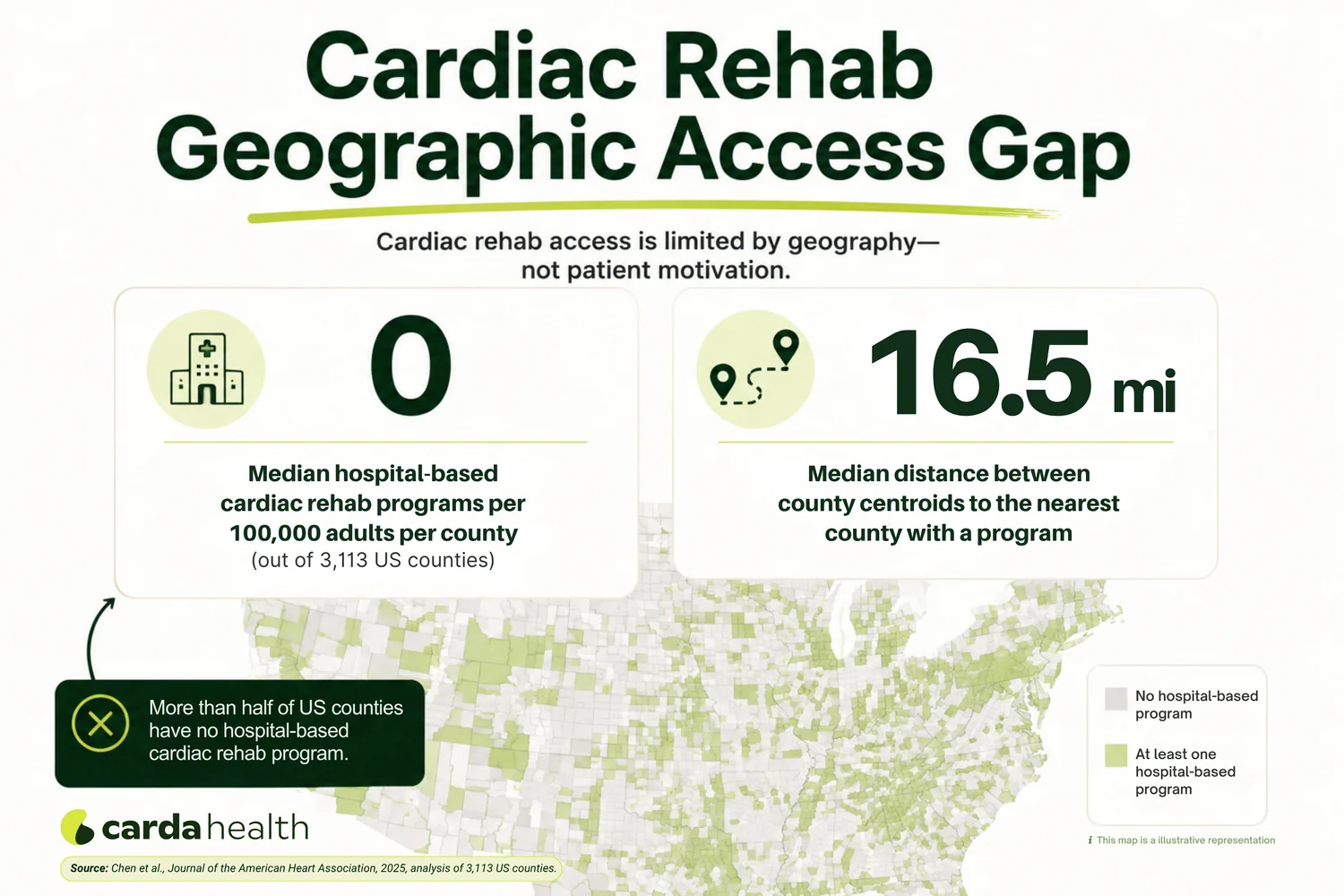
A 2025 study in the Journal of the American Heart Association examined geographic access across 3,113 US counties and found that the median number of hospitals offering cardiac rehab per 100,000 adults per county was zero. In plain terms, at least half of US counties contain no hospital-based cardiac rehab program. The median distance to the nearest county with one was 16.48 miles. That measure counts hospital programs by county, not every facility and not individual travel distance.
How Travel Distance Affects Cardiac Rehab Participation
Distance does not merely inconvenience patients; it selects them. Earlier studies summarized in a 2025 Tennessee analysis by Tran and colleagues show the pattern. In Nebraska, mean distance to the nearest outpatient program was about 10.7 miles for patients who participated, against 27.3 miles for those referred but not participating. Among Veterans Affairs patients, 63.1% of urban patients faced a journey of 30 minutes or less, against only 13.1% of rural patients. Broader work in JAMA Cardiology has documented urban-rural disparities in both eligibility and center-based use. Distance effects do vary by region: the Tennessee analysis itself found mean travel of around half an hour and no significant rural-urban difference within that state. Across the country, though, rural residents carry a higher burden of coronary disease, heart failure, and stroke, so the population with the greatest need has the least access.
How Social Vulnerability Affects Cardiac Rehab Access
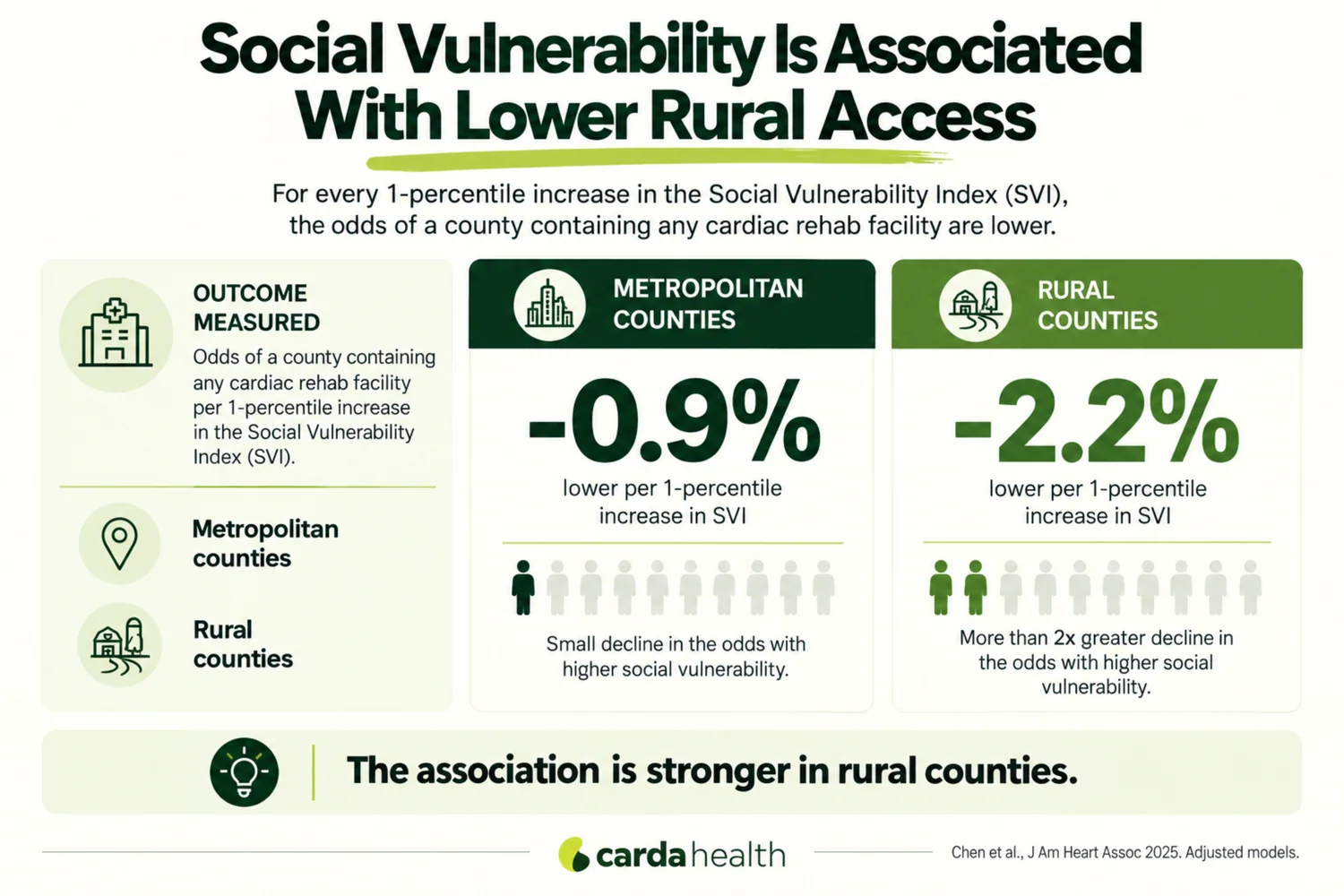
The JAHA analysis layered the Social Vulnerability Index over geography. Each one-percentile increase in social vulnerability was associated with 1.2% fewer hospitals offering cardiac rehab per 100,000 adults. Stratified by setting, the odds of a county containing a facility were 0.9% lower per percentile in metropolitan counties but 2.2% lower per percentile in rural counties. The two associations compound rather than simply adding. The authors called for virtual or hybrid models as the practical response.
Why Women Are Underrepresented in Cardiac Rehab
Women face a different problem. Programs are often available, but women are less often sent to them, and when they arrive the program frequently does not fit. In October 2025 the American Heart Association published a dedicated scientific statement on cardiac rehabilitation in women, which describes considerable sex and gender disparities across access, engagement, and outcomes.
Women Are Referred to Cardiac Rehab Less Often Than Men
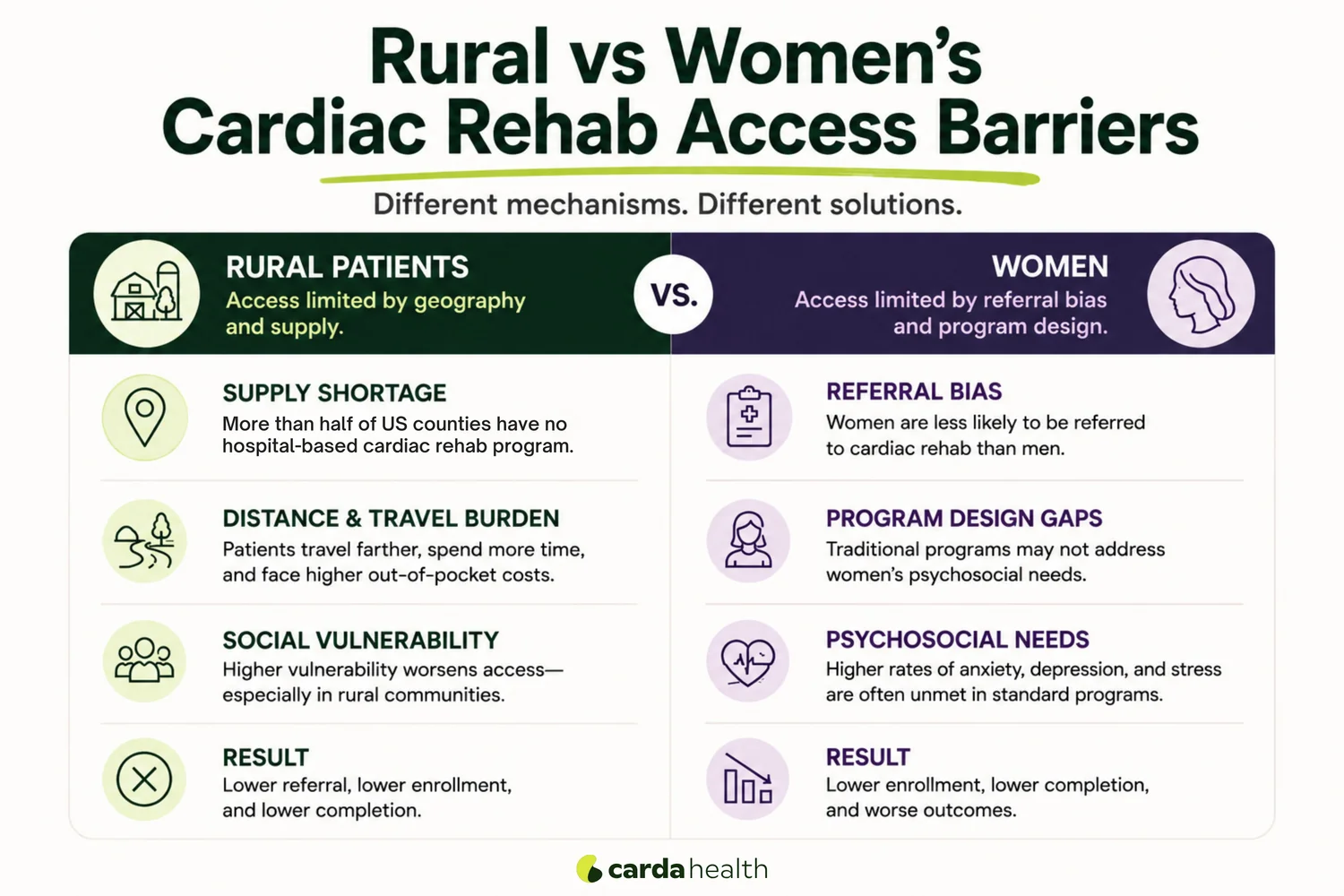
Women are referred to cardiac rehab less often than men, and referral is the first point where the gap opens. The AHA statement identifies lower referral rates as a driver of women's underrepresentation, alongside comorbidities, societal roles, and financial constraints, with racial and ethnic disparities compounding all of it. Enrollment is a separate, downstream measure, and the gap carries through to it: in a meta-analysis of 26 studies covering 297,719 patients, 38.5% of women enrolled against 45.0% of men, giving women 36% lower odds of enrolling (OR 0.64, 95% CI 0.57–0.72).
This matters because participation appears to benefit women at least as much as men. The AHA statement reports that women who participate see a greater reduction in mortality than men do. That evidence is observational, and observational survival estimates may overstate the true effect, since patients who attend differ systematically from those who do not and residual confounding cannot be excluded. Read the direction rather than the magnitude. Even discounted, under-referral removes an option rather than sparing a burden.
How Program Design Misses Women's Psychosocial Needs
The statement also notes that women have greater needs around mental health support and social integration, and that traditional programs often fail to address them adequately. Reported barriers include time constraints, caregiving responsibilities, transportation, cost, and discomfort in mixed group exercise settings.
Women also tend to enter rehab with lower fitness than men and to gain less in fitness, which has prompted calls for exercise prescriptions tailored accordingly. For the psychosocial dimension, our patient-facing guide to cardiac anxiety after a heart event is a useful resource to share with these patients.
What the Evidence Says About Women-Only Cardiac Rehab
It would be convenient to conclude that women-only programs are the answer, but the evidence does not support that cleanly. One trial found women randomized to a motivationally enhanced, sex-tailored program attended more exercise and educational sessions than those in a traditional mixed-sex program.
A second randomized trial comparing mixed-sex, women-only, and home-based rehab found no differences in adherence or functional capacity in per-protocol analysis, and a separate cohort analysis found women-only participation was not advantageous as expected. The AHA statement describes the aggregate evidence as mixed.
The defensible position today is that tailoring elements of a program to women's stated preferences is reasonable, but a women-only format is not a proven fix, and it should not be treated as a substitute for fixing referral.
Rural vs. Women's Cardiac Rehab Barriers Compared
| Rural patients | Women | |
|---|---|---|
| Primary mechanism | Supply: no local program, long travel | Referral: sent less often, program fit poorer |
| Where the loss occurs | Before and during enrollment; fewer sessions attended | At referral, then at enrollment and completion |
| Compounding factor | Social vulnerability, with effect more than doubled versus metro counties | Racial and ethnic disparities, caregiving and financial constraints |
| Best-supported response | Virtual or hybrid delivery | Automated referral, plus tailoring program elements |
| Evidence caution | Access gains still require completion support | Women-only formats show mixed results |
How to Close Cardiac Rehab Access Gaps
Automated Referral
Making referral the default in the electronic record removes the step where bias and forgetfulness operate. The chair of the AHA statement described automated referral as the lowest-hanging fruit, noting evidence that automated systems can multiply referrals substantially. Because the mechanism is structural rather than persuasive, it helps precisely the patients a clinician is least likely to think of. For the clinical triggers, see our guide to when to refer to cardiac rehab.
Virtual and Hybrid Cardiac Rehab Delivery
For geography, the response has to change where care happens, which is the conclusion the JAHA authors reached directly. It also addresses several barriers women report, since remote delivery removes travel, eases scheduling around caregiving, and avoids the group-setting discomfort some patients describe. In a study of Medicare fee-for-service beneficiaries aged 65 and older with a qualifying event in 2016, only 26.9% of those who participated completed at least 36 sessions, with utilization measured through 2017. Remote programs report higher attendance: Carda Health reports that its patients attend an average of 32 of 36 prescribed sessions. That is a single program's attendance average rather than a population completion rate, so it is not directly comparable to the national figure.
Coverage now supports this from hospital programs as well as office-based ones. The Consolidated Appropriations Act, 2026 allows cardiac, intensive cardiac and pulmonary rehab to be delivered to hospital outpatients in their homes by real-time audio-video through December 31, 2027, and CMS has issued billing guidance for hospitals using it. The provision expires unless Congress extends it.
Virtual delivery is not a fix for every patient. It still requires a suitable device, a reliable connection, enough digital confidence to join a live session, materials and coaching in the patient's language, and clinical suitability for exercising at home, which some higher-risk patients will not have. Programs that ship equipment, help patients get connected, offer interpreter services, and keep a center-based option for patients who need one will close more of the gap than programs that assume patients arrive ready.
This is the gap Carda Health was built for. Carda delivers live one-to-one sessions supervised by a clinical exercise physiologist with real-time vitals monitoring at home. For patients in counties with no facility, or for whom a three-times-weekly commute is not realistic, it converts an unavailable service into a completed one.
Our comparison of home-based versus center-based cardiac rehab, review of cardiac rehab delivery models, and overview of virtual cardiac rehab cover the options, and our guide to telehealth cardiac rehab in 2026 covers the reimbursement backdrop.
Measure Cardiac Rehab Access by Subgroup
None of this is visible in an aggregate participation rate. Report referral, enrollment, and completion separately by sex, rurality of residence, and race and ethnicity, and compare against your eligible population rather than your enrolled one. A program can post a respectable overall number while missing most of its eligible women and nearly all of its patients from outlying counties. Measuring the gap is the precondition for closing it.
The Bottom Line
For rural patients, cardiac rehab is often unavailable rather than declined, since at least half of US counties have no hospital offering it and access deteriorates further where social vulnerability is high. For women, the loss begins at referral and continues through a program that may not fit their needs. These are different problems with different fixes: automated referral addresses the referral gap, and virtual or hybrid delivery addresses the geography. Women-only formats, despite their intuitive appeal, have shown mixed results and should not be relied on as the primary answer. Measure participation by subgroup, and the priorities will identify themselves.
See how Carda Health partners with health systems
Frequently Asked Questions
Why do rural patients participate in cardiac rehab less often?
Primarily because programs are not there. A 2025 analysis of 3,113 US counties found that at least half contain no hospital-based cardiac rehab program, with a median distance of about 16 miles to the nearest county that does. That measure counts hospital programs by county, not every facility and not individual travel distance. Travel burden then selects further: one Veterans Affairs analysis found 63.1% of urban patients faced a journey of 30 minutes or less, compared with 13.1% of rural patients.
Does social vulnerability affect cardiac rehab access?
Yes, and the association compounds rurality. After adjustment, each one-percentile increase in social vulnerability was associated with 1.2% fewer hospitals offering cardiac rehab per 100,000 adults. On a separate outcome, the odds of a county containing any cardiac rehab facility were 0.9% lower per percentile in metropolitan counties and 2.2% lower per percentile in rural counties.
Why are women referred to cardiac rehab less often than men?
Referral depends on clinicians and hospital processes, and the 2025 AHA scientific statement identifies lower referral of women as a driver of the gap, alongside comorbidities, societal roles including caregiving, and financial constraints, with racial and ethnic disparities compounding these. Automated referral at discharge is the main fix for the referral step. Enrollment is a separate, downstream measure: in a meta-analysis of 297,719 patients, 38.5% of women enrolled against 45.0% of men, giving women 36% lower odds of enrolling.
Do women benefit as much from cardiac rehab?
At least as much. The 2025 AHA statement reports a greater reduction in mortality among women who participate than among men. That evidence is observational and may overstate the true effect, since patients who attend differ systematically from those who do not. Women do tend to enter with lower fitness and gain less in fitness, which has prompted calls for tailored exercise prescriptions.
Do women-only cardiac rehab programs work?
The evidence is mixed. One trial found a motivationally enhanced sex-tailored program increased sessions attended, while a randomized comparison of mixed-sex, women-only, and home-based programs found no difference in adherence or functional capacity, and another analysis found women-only participation was not advantageous as expected. Tailoring program elements to women's preferences is reasonable, but a women-only format is not a proven fix.
Does virtual cardiac rehab reduce access disparities?
It directly addresses the geographic mechanism, and the authors of the 2025 geographic access study explicitly called for virtual or hybrid models to reduce barriers in socially vulnerable and rural communities. Remote programs report higher attendance. Carda Health, for example, reports an average of 32 of 36 prescribed sessions attended per patient, an attendance average that is not measured the same way as the 26.9% of participants who completed at least 36 sessions in a 2016 Medicare cohort. Medicare currently allows in-home virtual delivery from hospital programs through December 31, 2027 under the Consolidated Appropriations Act, 2026, and eligibility and coverage should still be confirmed for each patient.
References
- Cardiac Rehabilitation in Women: A Scientific Statement From the American Heart Association. Circulation. 2025.
- Chen EW, Wu WC, Han L, et al. Disparities in Geographic Access to Cardiac Rehabilitation Among Socially Vulnerable Communities. J Am Heart Assoc. 2025.
- American Heart Association Newsroom. Women face barriers in accessing, participating in cardiac rehab despite proven benefits. October 2025.
- Van Iterson EH, Laffin LJ, Bruemmer D, Cho L. Geographical and urban-rural disparities in cardiac rehabilitation eligibility and center-based use in the US. JAMA Cardiol. 2023;8(1):98–100.
- Tran PM, Fogelson B, Sorey AB, Heidel RE, Baljepally R. An Examination of Geographic Proximity to Outpatient Cardiac Rehabilitation in Rural Versus Urban Tennessee Counties. J Cardiovasc Nurs. 41(2):120–124.
- Women's outcomes following mixed-sex, women-only, and home-based cardiac rehabilitation participation and comparison by sex. PMC.
- Ritchey MD, Maresh S, McNeely J, et al. Tracking Cardiac Rehabilitation Participation and Completion Among Medicare Beneficiaries to Inform the Efforts of a National Initiative. Circ Cardiovasc Qual Outcomes. 2020;13(1):e005902.
- Centers for Medicare & Medicaid Services. Virtual Cardiac Rehabilitation (CR), Intensive Cardiac Rehabilitation (ICR) and Pulmonary Rehabilitation (PR) Furnished by Hospital Outpatient Departments (HOPDs) FAQ. April 9, 2026.