When to Refer to Cardiac Rehab: A Quick-Reference Guide for Hospitalists and PCPs


Key Takeaways
Referral to cardiac rehab is a Class 1 guideline recommendation after a heart attack, PCI, CABG, valve surgery, or heart transplant, and for stable angina and stable HFrEF, yet referral rates remain low and a clinician’s recommendation is one of the strongest predictors of whether a patient ever enrolls. Hospitalists own the highest-yield moment, which is referral at discharge. PCPs are the safety net for patients who were missed or who qualify from an outpatient diagnosis. The simplest fix is to make referral automatic, and virtual programs remove the common barrier of no rehab program near the patient. When in doubt about eligibility, refer and let the program confirm coverage.
Cardiac rehab is one of the best-supported interventions in cardiovascular medicine and is reimbursed for a clear set of conditions. The problem is not whether it works. It is that eligible patients are routinely never referred. This is a fast reference for the two specialties that most often hold the referral decision: which patients qualify, when to refer, and how to keep the eligible patient in front of you from slipping through.
Why Referral Is the Bottleneck
Referral to an outpatient cardiac rehab program is a Class 1 recommendation in clinical guidelines for the major qualifying conditions, as summarized by the AACVPR/ACC/AHA performance measures on cardiac rehab referral. Despite that, referral rates have historically run well below half of eligible patients. The most actionable lever is the referring clinician: physician recommendation is among the strongest predictors of enrollment, and an unreferred patient is very unlikely to find rehab alone. The bottleneck is upstream, at the moment of referral, which is exactly where hospitalists and PCPs move the needle.
Which Patients Qualify: The Referable Conditions
Medicare and most payers cover cardiac rehab for a defined list of conditions. The codes that capture each one live in our companion guide to the ICD-10 codes for cardiac rehab referral; below is what to recognize clinically.
Coronary Events and Procedures
Acute MI (Within the Past 12 Months)
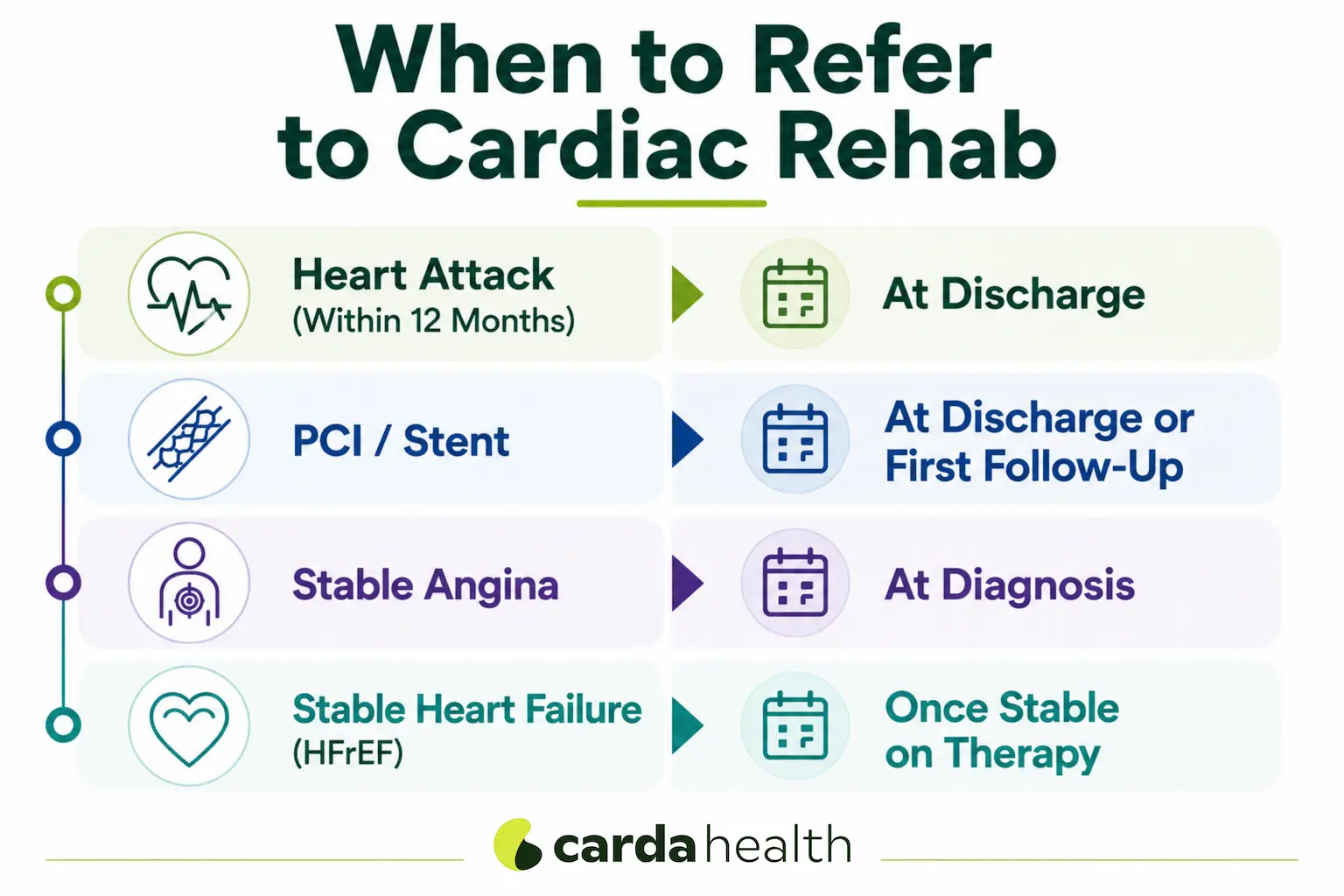
Any patient with an acute MI in the preceding 12 months qualifies. This is the highest-yield, best-studied indication, and these patients should essentially always leave the hospital with a referral in place. See our context on cardiac rehab after a heart attack.
PCI or Coronary Stenting
Patients who have undergone PCI or coronary stenting qualify, whether the procedure was elective or part of an acute presentation. Referral rates after PCI are notably low, so this group deserves particular attention.
CABG Surgery
Coronary artery bypass graft surgery is a clear qualifying indication, and these patients are among the most likely to benefit from supervised, monitored exercise during recovery.
Other Qualifying Conditions
Stable Angina Pectoris
Current, stable angina qualifies even without a recent event or procedure. This is a commonly missed outpatient indication, because there is no hospitalization to trigger the referral, which makes it a natural catch for PCPs.
Heart Valve Repair or Replacement
Patients who have had surgical or transcatheter heart valve repair or replacement qualify and should be referred during their recovery.
Heart or Heart-Lung Transplant
Heart and heart-lung transplant recipients are eligible, and structured rehab is an established part of their recovery pathway.
Stable, Chronic Heart Failure (HFrEF)
Stable, chronic heart failure qualifies, but with specific criteria: a left ventricular ejection fraction of 35% or less and NYHA class II to IV symptoms despite at least six weeks of optimal therapy, in a clinically stable patient. Document the ejection fraction and NYHA class. For the clinical case and what rehab involves here, see our guide to cardiac rehab for heart failure.
Indications and Timing at a Glance
When to Refer: Timing Matters
The right time to refer depends on where you sit in the patient’s journey, and the two key roles are complementary.
For Hospitalists: Refer at Discharge
The index hospitalization is the highest-yield referral moment there is. Inpatient referral at discharge is one of the strongest predictors of enrollment, and a miss at this stage is rarely recovered. The most effective fix is structural: build cardiac rehab referral into the discharge order set so eligible patients are referred by default. If your patient is heading to a short-term skilled or inpatient rehab stay first, still refer to outpatient cardiac rehab during the index hospitalization, and let the next setting reinforce it.
For PCPs: Catch the Missed and the Outpatient-Diagnosed
Primary care is the essential safety net. Many eligible patients are never referred at discharge, and others qualify from a condition diagnosed in the outpatient setting, such as stable angina or stable HFrEF, where no hospitalization ever prompts a referral. A reliable habit: at the first post-event visit, or any visit where a qualifying diagnosis surfaces, ask whether the patient has been referred to cardiac rehab, and place the referral yourself if no one else has. Do not assume the hospital already did.
Who Should Not Be Referred Yet
Eligibility assumes the patient is clinically stable. Referral should wait until conditions such as unstable angina, decompensated or unstable heart failure, severe symptomatic or uncontrolled arrhythmias, severe outflow obstruction, or another acutely unstable cardiovascular state are controlled. This is a timing point, not a permanent exclusion: once the patient is stabilized and meets a qualifying indication, the referral should be made. When you are unsure whether a patient is ready, the program’s clinical team can help determine appropriateness.
Making Referral Easier
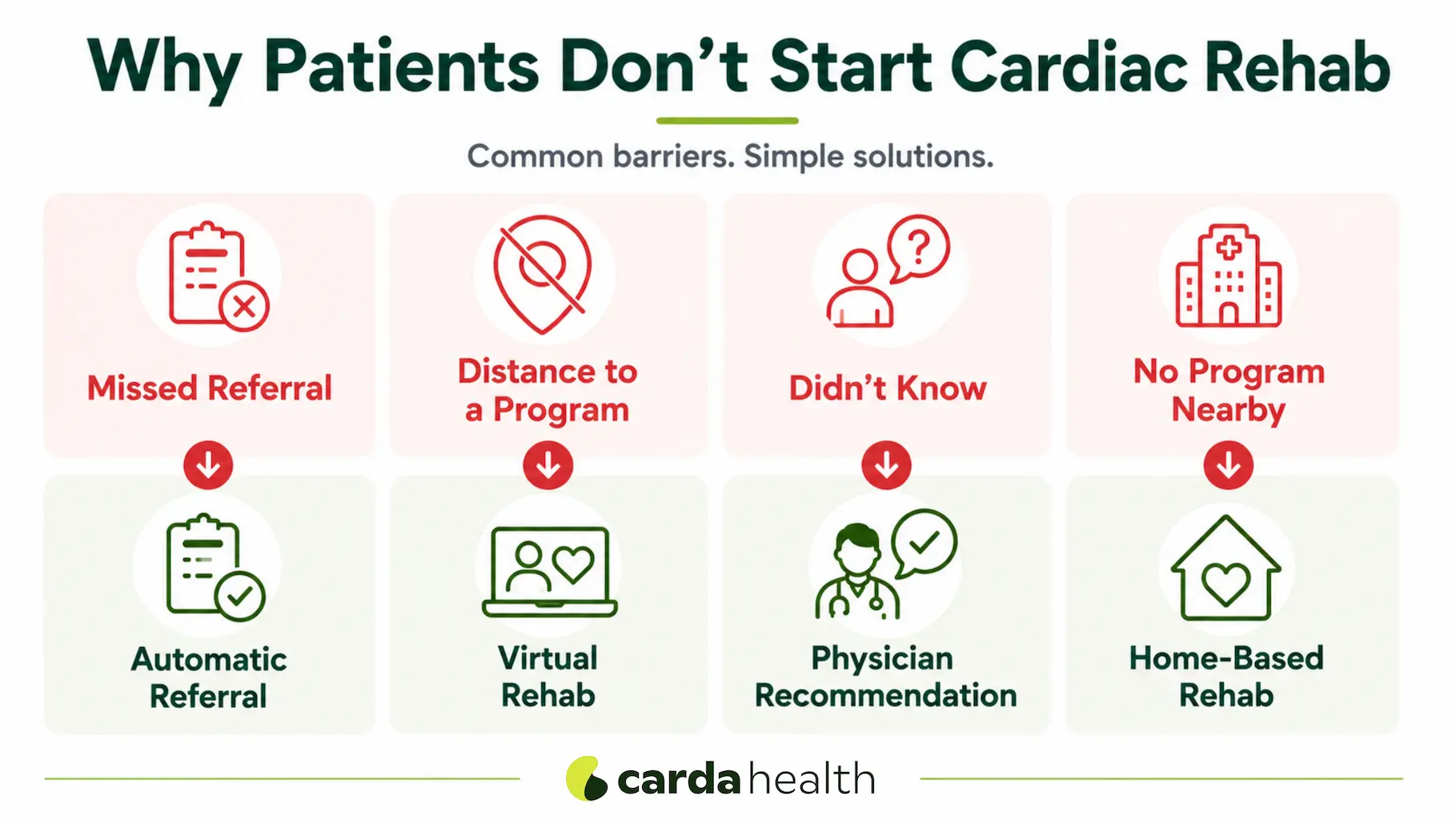
Two changes close most of the referral gap. The first is making referral automatic: opt-out and default-on order sets consistently raise referral rates compared with relying on individual clinicians to remember. The second is removing the patient’s most common reason for never starting, which is access. When there is no cardiac rehab program within a reasonable distance, or when travel, work, or caregiving make a center impractical, a referral to a virtual cardiac rehab program keeps the option alive.
This is where Carda Health fits naturally into a referral workflow. Carda delivers supervised, monitored cardiac rehab into the patient’s home, widening the set of patients you can confidently refer, and handles eligibility verification after referral. For the 2026 coverage and supervision backdrop, see our overview of telehealth cardiac rehab in 2026.
The Bottom Line
Referring to cardiac rehab is a Class 1 action that too many eligible patients never receive. Recognize the qualifying conditions, refer at the right moment, hospitalists at discharge and PCPs as the safety net, make the referral automatic where you can, and use virtual options when access is the barrier. The eligible patient in front of you is the one to refer today. To document and code the referral correctly, see our companion guides on ICD-10 codes and documenting eligibility.
Frequently Asked Questions
Which conditions qualify a patient for cardiac rehab?
Acute MI within 12 months, PCI or coronary stenting, CABG surgery, current stable angina, heart valve repair or replacement, heart or heart-lung transplant, and stable chronic heart failure with an LVEF of 35% or less and NYHA class II to IV. Confirm coverage details against current CMS and payer policy.
When is the best time to refer?
At hospital discharge for inpatients, since discharge referral is one of the strongest predictors of enrollment. For outpatient-diagnosed conditions like stable angina or HFrEF, refer at the visit where the qualifying diagnosis is established. Earlier is better.
Is cardiac rehab referral actually a guideline recommendation?
Yes. Referral to an outpatient program is a Class 1 recommendation for the major qualifying conditions, reflecting strong evidence that rehab reduces hospitalizations and mortality and improves quality of life.
Should I refer heart failure and stable angina patients, not just post-MI?
Yes. Stable HFrEF (with the LVEF and NYHA criteria) and current stable angina both qualify. These are commonly missed precisely because there may be no hospitalization to trigger the referral, which makes them an important catch in primary care.
Who is responsible for the referral, the hospitalist or the PCP?
Both, at different moments. Hospitalists should refer at discharge, and PCPs should catch patients who were missed or who qualify from an outpatient diagnosis. Unclear ownership is a known cause of missed referrals, so the safest assumption is that it is your responsibility unless you have confirmed otherwise.
What if there is no cardiac rehab program near my patient?
Lack of a nearby program is a leading reason eligible patients never start. Virtual and home-based cardiac rehab removes that barrier by delivering supervised, monitored rehab at home, so the patient can still receive guideline-recommended care.
Are there patients who should not be referred?
Referrals should wait while a patient is unstable, for example with unstable angina, decompensated heart failure, or uncontrolled arrhythmia. This is a timing issue: once stabilized and qualifying, the patient should be referred.
References
- Thomas RJ, King M, Lui K, et al. AACVPR/ACCF/AHA 2010 Update: Performance Measures on Cardiac Rehabilitation for Referral to Cardiac Rehabilitation/Secondary Prevention Services. Circulation. 2010.
- Centers for Medicare & Medicaid Services. NCD 20.10, Cardiac Rehabilitation Programs.
- Agency for Healthcare Research and Quality (AHRQ). TAKEheart: Automatic Referral to Cardiac Rehabilitation.
- CDC Heart Disease and Stroke Best Practices Clearinghouse. Improving Cardiac Rehabilitation Referral.
- Pack QR, Squires RW, Lichtman SW, et al. Cardiac rehabilitation and the referral gap. Cleve Clin J Med. 2018;85(7):551-558.