CMS Readmission Penalties and Cardiac Rehab: What Hospitals Should Know in 2026


Key Takeaways
The Hospital Readmissions Reduction Program penalizes hospitals up to 3% of Medicare inpatient payments across every fee-for-service discharge, not just readmissions. Roughly three in four eligible hospitals are penalized in a typical year, and the average penalty among penalized hospitals was 0.64% in FY2022. Four of the six penalized conditions, heart attack, heart failure, CABG, and COPD, are also cardiac or pulmonary rehabilitation conditions, and rehab participation is associated with meaningfully lower readmissions.
Yet only about 24% of eligible patients ever participate. Beginning with FY2027, CMS adds Medicare Advantage beneficiaries to all six readmission measures and shortens the performance window from three years to two, which makes recent performance matter faster.
Most hospitals treat readmission penalties as a care transition and documentation problem. Both matter. But a structural overlap often goes unexploited: the conditions CMS penalizes are, to a striking degree, the same conditions cardiac and pulmonary rehabilitation were built to serve, and rehab remains one of the most underused interventions in American medicine. This guide covers how the penalty works, what changes next year, and where the practical opportunity sits.
How the Hospital Readmissions Reduction Program Works
The Hospital Readmissions Reduction Program (HRRP) is a Medicare value-based purchasing program established under the Affordable Care Act, with penalties beginning 1 October 2012. It reduces payments to subsection (d) hospitals with excess 30-day risk-standardized unplanned readmissions. Psychiatric, rehabilitation, long-term care, children’s, cancer, and critical access hospitals are exempt, as are Maryland hospitals.
The Six Penalized Conditions
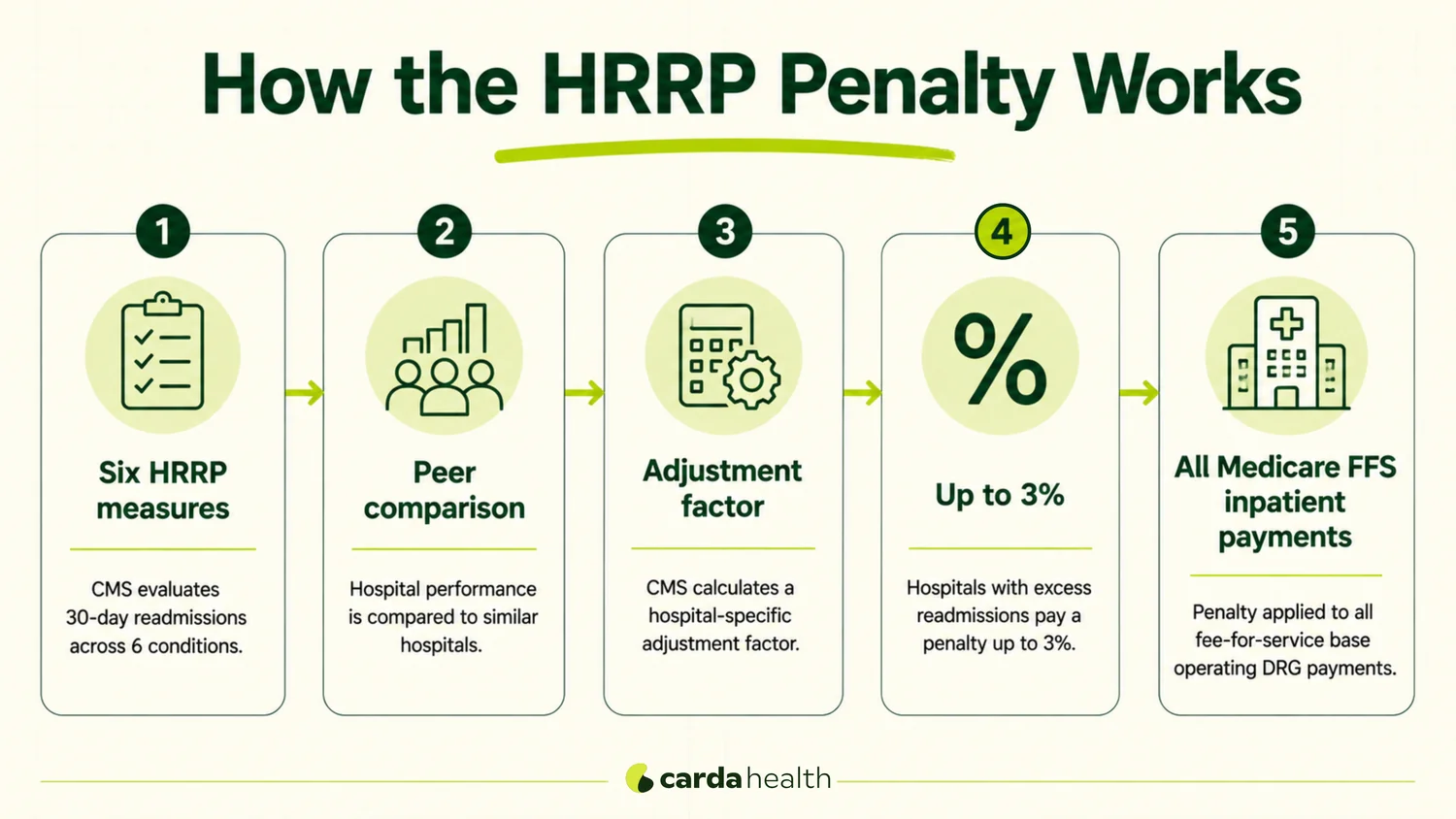
CMS measures 30-day unplanned readmissions following an index admission for six conditions or procedures: acute myocardial infarction, heart failure, pneumonia, chronic obstructive pulmonary disease, coronary artery bypass graft surgery, and elective total hip or knee arthroplasty. Readmissions count regardless of the reason or which acute care hospital the patient returns to, with certain planned readmissions excluded.
How the Penalty Is Calculated
This is frequently misunderstood, and it is where the financial stakes become clear. CMS calculates a payment adjustment factor from a weighted average of performance across the six measures during the applicable period. The reduction is capped at 3% and applied to all Medicare fee-for-service base operating DRG payments for the entire fiscal year, not only to the readmissions themselves and not only to the six measured conditions. A modest percentage applied to a full year of inpatient Medicare revenue is a substantial number for most institutions.
Since FY2019, hospitals are compared within peer groups based on their proportion of dual-eligible patients, a change intended to account for socioeconomic differences between institutions. FY2026 penalties are based on discharges from 1 July 2021 through 30 June 2024.
Why Hospitals Get Penalized Even When Readmissions Fall
Hospital leaders often ask why a penalty persists despite genuine improvement. The program is scored relative to peer performance rather than against a fixed target. As KFF has documented, national Medicare readmission rates began falling in 2012 and kept declining, yet average penalties did not fall with them, because a share of hospitals always sits below the comparison group. Roughly three in four eligible hospitals have been penalized each year since FY2015. In KFF's analysis published in November 2021, the average penalty among the 2,499 hospitals penalized in FY2022 was 0.64%, with 39 hospitals losing the maximum 3%.
(Across the program's lifetime, 2,920 of the 3,139 general acute hospitals subject to HRRP evaluation, or 93%, have been penalized at least once.)
The strategic implication: the goal is not simply to improve, but to improve faster than your peer group.
What Changes in FY2027: Medicare Advantage and a Shorter Window
The FY2026 IPPS final rule finalized two changes to HRRP effective with the FY2027 program year, and both deserve attention now because the performance data is already accruing.
- Medicare Advantage beneficiaries are added to all six readmission measures. The cohort expands from fee-for-service only to beneficiaries enrolled in FFS and/or MA. CMS did not finalize including MA payment data in the aggregate payments calculation, so penalty dollars still compute on fee-for-service payments. Hospitals need not submit additional data.
- The applicable performance period shrinks from three years to two. FY2027 penalties will be based on discharges from 1 July 2023 through 30 June 2025.
CMS is also removing COVID-19 exclusions from all six measures. The practical effect: a materially larger share of your discharged population is now measured, and a shorter window means recent performance moves your adjustment factor faster, in both directions. For hospitals with significant Medicare Advantage volume, this is the change to brief your quality committee on.
The Overlap Hospitals Overlook
Set the six penalized conditions beside the conditions that qualify for Medicare-covered cardiac or pulmonary rehabilitation and the overlap is hard to miss.
| HRRP condition | Rehab-eligible? | Relevant program |
|---|---|---|
| Acute myocardial infarction | Yes | Cardiac rehab (MI within 12 months) |
| Heart failure | Yes, with criteria | Cardiac rehab (LVEF 35% or less, NYHA II to IV) |
| CABG surgery | Yes | Cardiac rehab |
| COPD | Yes | Pulmonary rehab (moderate to very severe) |
| Pneumonia | No | Not a rehab-qualifying condition |
| Elective hip or knee replacement | No | Orthopedic pathway |
Four of the six penalized conditions map directly onto a Medicare-covered rehabilitation benefit that most eligible patients never receive. For the specific qualifying criteria and codes, see our guides to the ICD-10 codes for cardiac rehab referral and Medicare coverage for cardiac rehab.
Does Cardiac Rehab Actually Reduce Readmissions?
The evidence is consistent and clinically meaningful, though largely observational rather than from randomized readmission trials, so read it as a strong association rather than a guaranteed penalty offset.
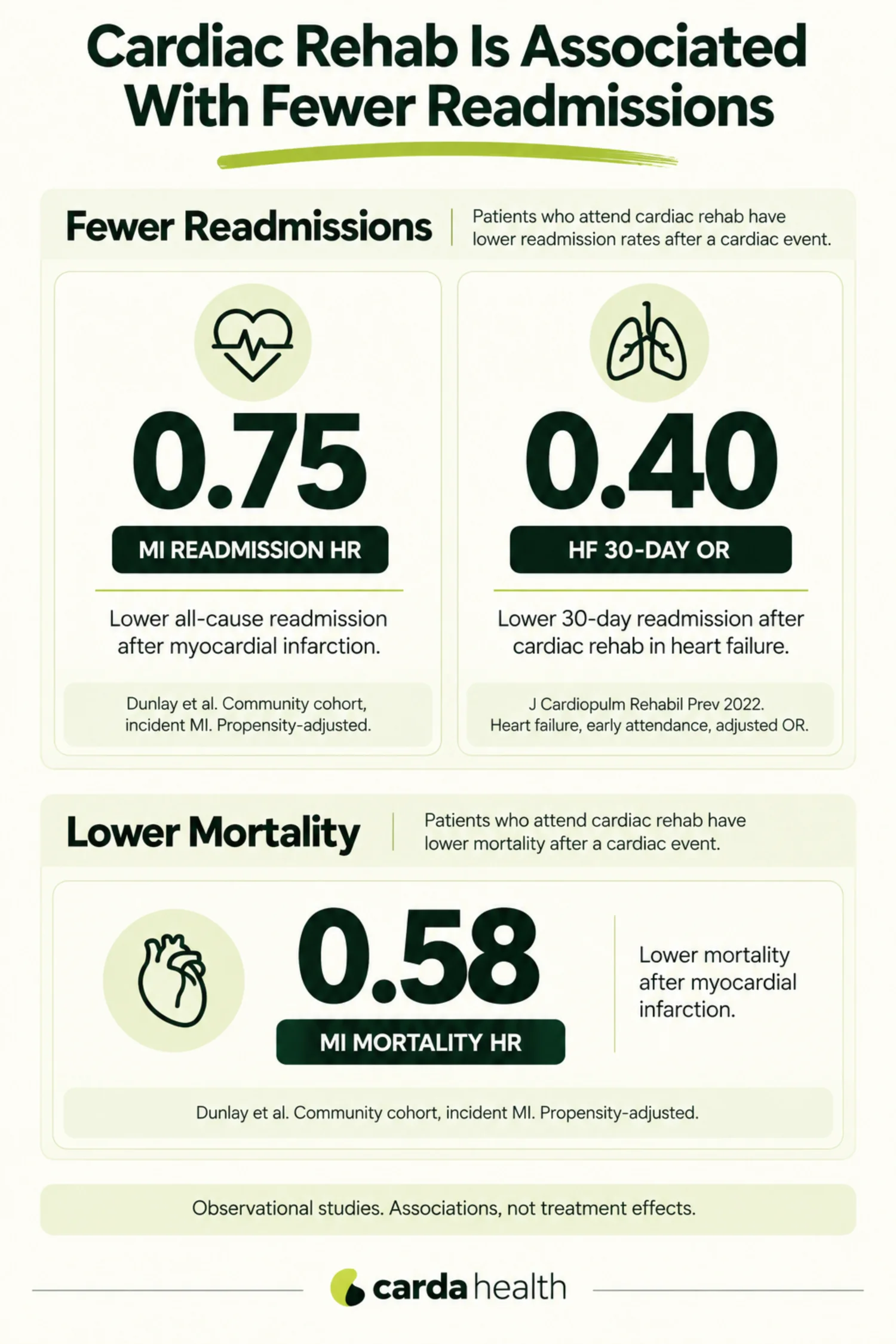
In a community cohort of patients with incident myocardial infarction, cardiac rehabilitation participation was associated with lower all-cause readmission (hazard ratio 0.75, 95% CI 0.65 to 0.87), lower cardiovascular readmission (HR 0.80), and lower mortality (HR 0.58) after adjustment for propensity to participate. In heart failure, the hardest of the four conditions to move and the subject of our guide to reducing heart failure readmissions, a study early cardiac rehabilitation attendance found reduced 30-day all-cause readmissions (adjusted odds ratio 0.4, 95% CI 0.2 to 0.7) and reduced six-week readmissions (adjusted OR 0.5). A separate 2024 systematic review and meta-analysis of post-discharge outpatient follow-up, a broader intervention than rehab, found it associated with a 21% lower risk of 30-day all-cause readmission and a 27% relative reduction in heart failure.
Rehab is one form of structured post-discharge contact, so that finding is supportive context rather than direct evidence for rehab itself.
For the clinical case in heart failure specifically, including safety and program structure, see our guide to cardiac rehab for heart failure.
Where the Opportunity Is Lost: The Referral and Participation Gap
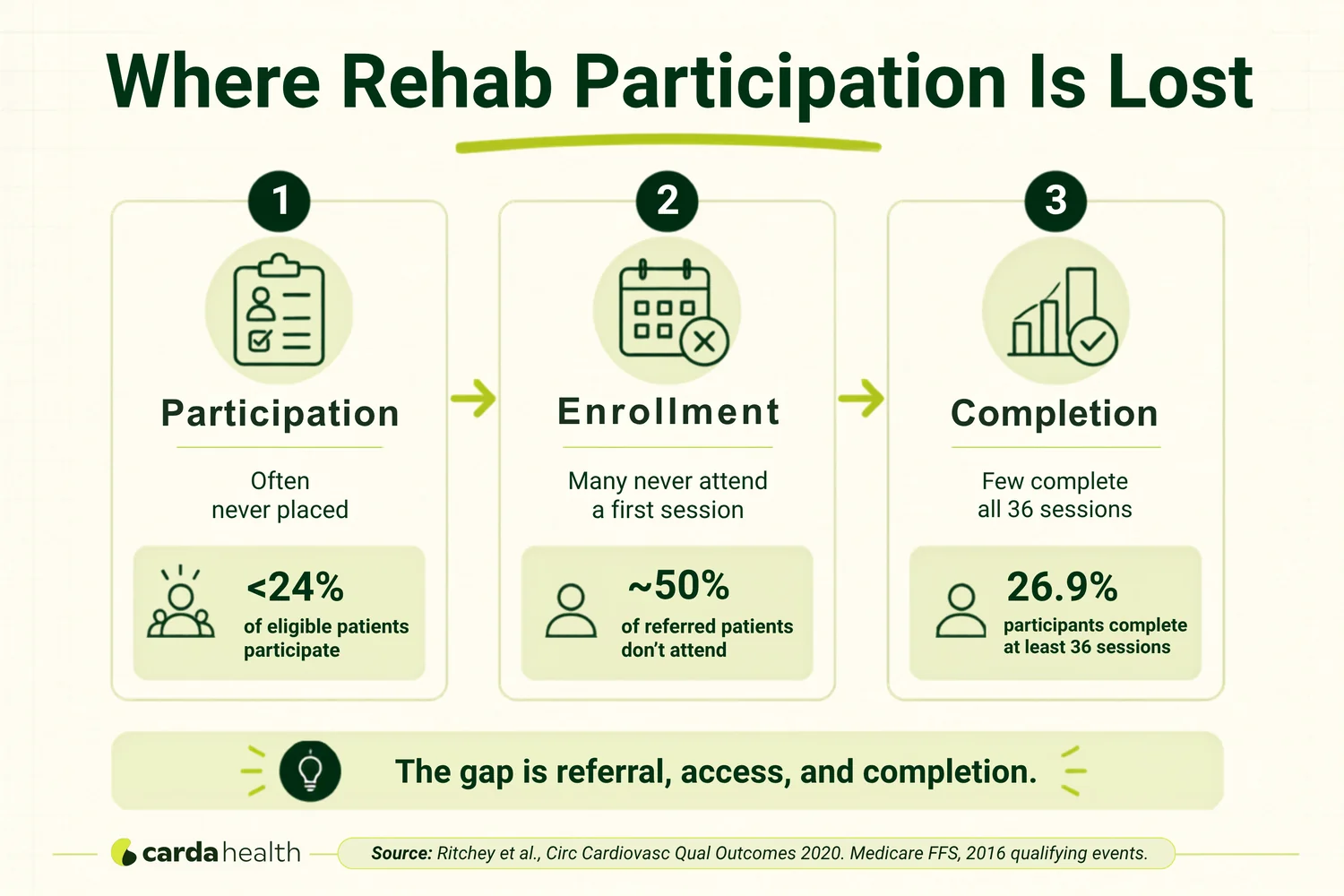
If rehab is covered, guideline-recommended, and associated with fewer readmissions, why is it not already moving penalty performance? Most eligible patients never get there. About 24% of eligible patients participate in cardiac rehab nationally, about half of referred patients never attend a first session, and among those who do participate, 26.9% complete at least 36 sessions. The Million Hearts national target of 70% participation has not been met.
Losses compound at three points: the referral is never placed, it is placed but the patient never enrolls, or the patient enrolls and drops out before completing enough sessions to benefit. A rehab-based readmission strategy has to address all three, not just the first.
Turning Rehab Into Readmission Reduction
Refer at Discharge, by Default
Inpatient referral at discharge is the strongest single predictor of enrollment, and a referral missed at the index hospitalization is rarely recovered. The most reliable fix is structural rather than educational: build cardiac and pulmonary rehab referral into the discharge order set for the qualifying conditions so eligible patients are referred by default rather than by recall. Our companion guides cover when to refer to cardiac rehab and documenting eligibility for Medicare.
Remove the Access Barrier
Referral only converts if the patient can realistically attend. Travel, scheduling, work, and caregiving are why enrollment and completion fall away, and this is where the delivery model matters. Nationally, 26.9% of participants complete at least 36 sessions. Programs delivering remotely report higher completion, though those are program-reported figures on different denominators.
Carda Health offers virtual cardiac and pulmonary rehabilitation, delivering live one-to-one sessions supervised by a clinical exercise physiologist with real-time vitals monitoring at home.
For a model-by-model comparison, see our review of cardiac rehab delivery models, and for the reimbursement backdrop, our overview of telehealth cardiac and pulmonary rehab in 2026.
On the pulmonary side, our guide to reducing COPD readmissions with technology covers the parallel strategy.
The Bottom Line
HRRP applies a penalty of up to 3% across a full year of Medicare fee-for-service inpatient payments, is scored against your peer group rather than a fixed target, and from FY2027 will measure a larger population over a shorter window. Four of the six penalized conditions already have a covered, guideline-recommended rehabilitation benefit attached, with consistent evidence of lower readmissions among participants. The gap is not the evidence. It is referral and completion. Hospitals that make referral automatic and remove the access barrier are working a lever with strong observational support for better patient outcomes, in exactly the populations the penalty measures.
See how Carda Health partners with health systems
Frequently Asked Questions
How much can a hospital lose to HRRP penalties?
The payment reduction is capped at 3% of Medicare fee-for-service base operating DRG payments, applied to all such discharges for the entire fiscal year rather than only to readmissions. In practice, most penalized hospitals fall well below the cap, with the average penalty among penalized hospitals at 0.64% in FY2022.
Which conditions does HRRP penalize?
Six: acute myocardial infarction, heart failure, pneumonia, COPD, CABG surgery, and elective total hip or knee arthroplasty. Readmissions are counted as 30-day all-cause unplanned readmissions to any applicable acute care hospital, with certain planned readmissions excluded.
Why is our hospital still penalized when our readmission rate improved?
Because performance is assessed relative to a peer group rather than against a fixed target. National readmission rates have fallen without average penalties falling, since a share of hospitals will always sit below the comparison point. Improving faster than your peer group is what changes the adjustment factor.
What is changing with HRRP in FY2027?
CMS is adding Medicare Advantage beneficiaries to all six readmission measures and shortening the performance period from three years to two, with FY2027 penalties based on discharges from July 2023 through June 2025. COVID-19 exclusions are also being removed. MA payment data was not finalized for the aggregate payments calculation, so penalty dollars still compute on fee-for-service payments.
Does cardiac rehab reduce readmissions?
Observational evidence consistently associates participation with lower readmissions. After myocardial infarction, participation was associated with a hazard ratio of 0.75 for all-cause readmission, and early attendance in heart failure was associated with an adjusted odds ratio of 0.4 for 30-day all-cause readmission. These are strong associations rather than randomized proof of a penalty offset.
What is the fastest way to improve rehab participation after discharge?
Two moves account for most of the gain: make referral automatic in the discharge order set for qualifying conditions so it does not depend on individual recall, and offer a delivery model the patient can realistically complete. Programs delivering remotely report higher completion than center-based programs, largely because they remove travel and scheduling barriers.
References
- Centers for Medicare & Medicaid Services. Hospital Readmissions Reduction Program (HRRP).
- Medicare Program; Hospital Inpatient Prospective Payment Systems for Acute Care Hospitals and FY 2026 Rates (CMS-1833-F). Federal Register, 4 August 2025.
- KFF. Aiming for Fewer Hospital U-turns: The Medicare Hospital Readmission Reduction Program.
- Dunlay SM, Pack QR, Thomas RJ, et al. Participation in Cardiac Rehabilitation, Readmissions, and Death After Acute Myocardial Infarction. Am J Med / PMC.
- Early Cardiac Rehabilitation to Reduce Heart Failure Readmissions. J Cardiopulm Rehabil Prev. 2022.
- Bilicki DJ, Reeves MJ. Outpatient Follow-Up Visits to Reduce 30-Day All-Cause Readmissions. Prev Chronic Dis. 2024.
- Ritchey MD, Maresh S, McNeely J, et al. Tracking Cardiac Rehabilitation Participation and Completion Among Medicare Beneficiaries to Inform the Efforts of a National Initiative. Circ Cardiovasc Qual Outcomes. 2020;13(1):e005902.