

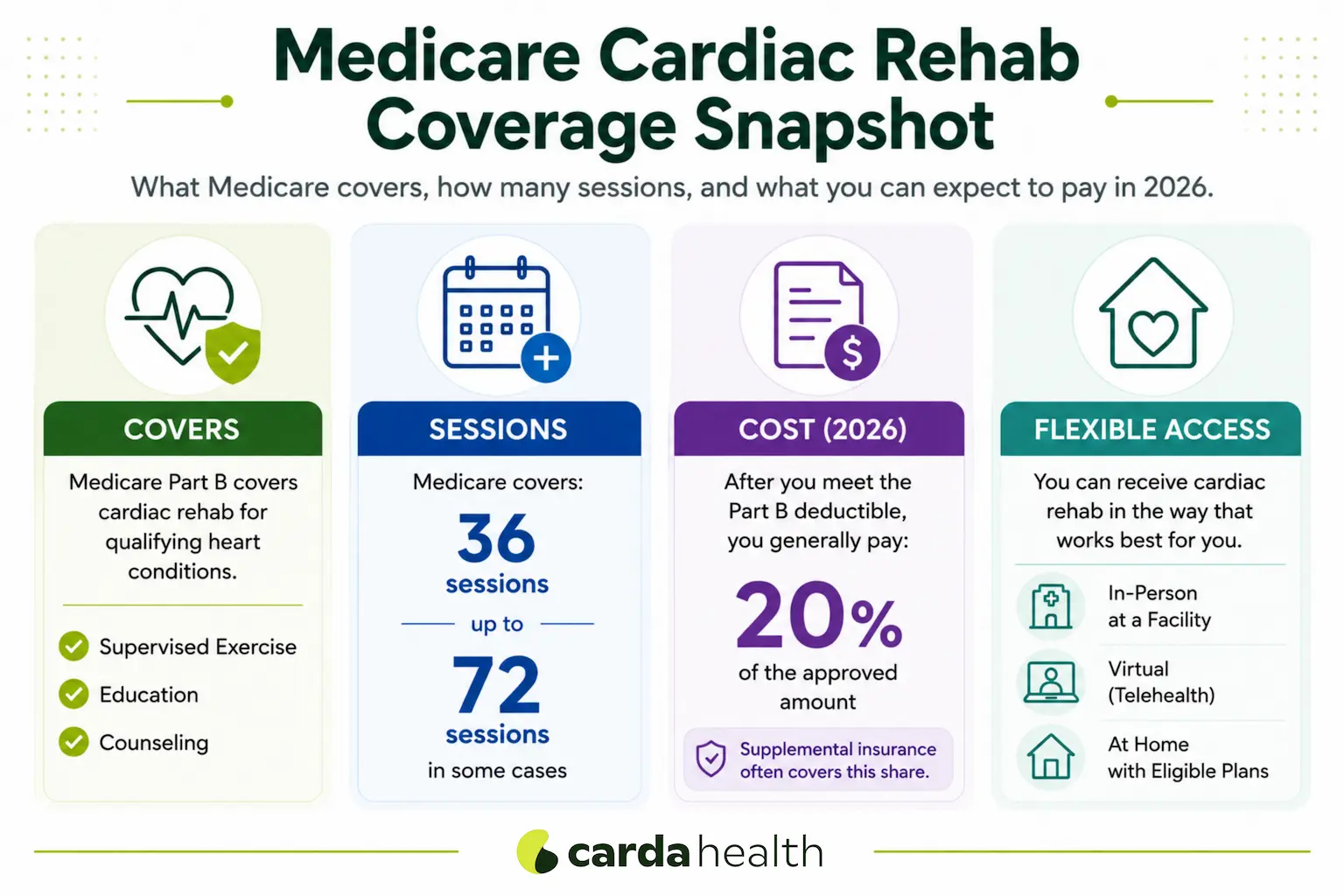
Key Takeaways: Yes. Medicare Part B covers cardiac rehab for people with qualifying heart conditions, including a heart attack in the past 12 months, bypass surgery, stenting or angioplasty, stable angina, heart valve repair or replacement, a heart or heart-lung transplant, and stable chronic heart failure with a reduced ejection fraction. Medicare covers up to 36 sessions, and up to 72 in some cases. After you meet the Part B deductible, you generally pay 20% of the approved amount, although supplemental insurance often covers that share. Medicare Advantage plans cover cardiac rehab too, and qualifying Humana members can access Carda's virtual cardiac rehab at no additional cost.
If you or someone you love has a heart condition, cardiac rehab is one of the most valuable steps you can take, and a common first question is whether Medicare will pay for it. The reassuring answer is yes, for a defined set of conditions. This guide explains exactly what Medicare covers, how many sessions you get, what you can expect to pay in 2026, and how to take part from home.
The Short Answer: Yes, for Qualifying Conditions
Medicare covers cardiac rehab. Medicare Part B (medical insurance) covers both standard and intensive cardiac rehabilitation programs for people who have had a qualifying heart event or diagnosis and who are referred by their doctor. Coverage includes the supervised exercise, education, and counseling that make up a rehab program. The two things that determine your situation are which condition you have and where you receive care, so let us walk through both.
What Heart Conditions Qualify for Coverage
Medicare covers cardiac rehab when it is medically necessary and you have one of the following qualifying conditions:
- A heart attack (myocardial infarction) within the past 12 months
- Coronary artery bypass graft (CABG) surgery
- Coronary angioplasty or stenting (percutaneous coronary intervention)
- Current stable angina (chest pain)
- Heart valve repair or replacement
- A heart or heart-lung transplant
- Stable, chronic heart failure with a reduced ejection fraction (more on this below)
If you have had a heart attack or a procedure, our patient guides to cardiac rehab after a heart attack and the benefits of cardiac rehabilitation explain what to expect from the program itself.
A Note on Heart Failure
You may read online that Medicare does not cover cardiac rehab for heart failure. That is outdated. Medicare added coverage for stable, chronic heart failure, and Medicare's own coverage list now names heart failure among the qualifying conditions. Coverage applies specifically to heart failure with a reduced ejection fraction, defined as a left ventricular ejection fraction of 35% or less, with ongoing symptoms (NYHA class II to IV) despite at least six weeks of optimal therapy. If this is you, do not assume you are excluded, and see our guide to cardiac rehab for heart failure.
How Many Sessions Does Medicare Cover?
For standard cardiac rehab, Medicare covers up to 36 one-hour sessions, generally up to two per day, and in some cases up to 72 sessions if your doctor documents that more are medically necessary. A more rigorous option called intensive cardiac rehabilitation (ICR) covers up to 72 sessions over an 18-week period for most of the same conditions, although ICR does not cover stable chronic heart failure. Most people attend two to three sessions a week over about 12 weeks.
How Much Does Cardiac Rehab Cost With Medicare in 2026?
What you pay depends on your plan and where you go. Here is a 2026 overview.
Original Medicare (Part B)
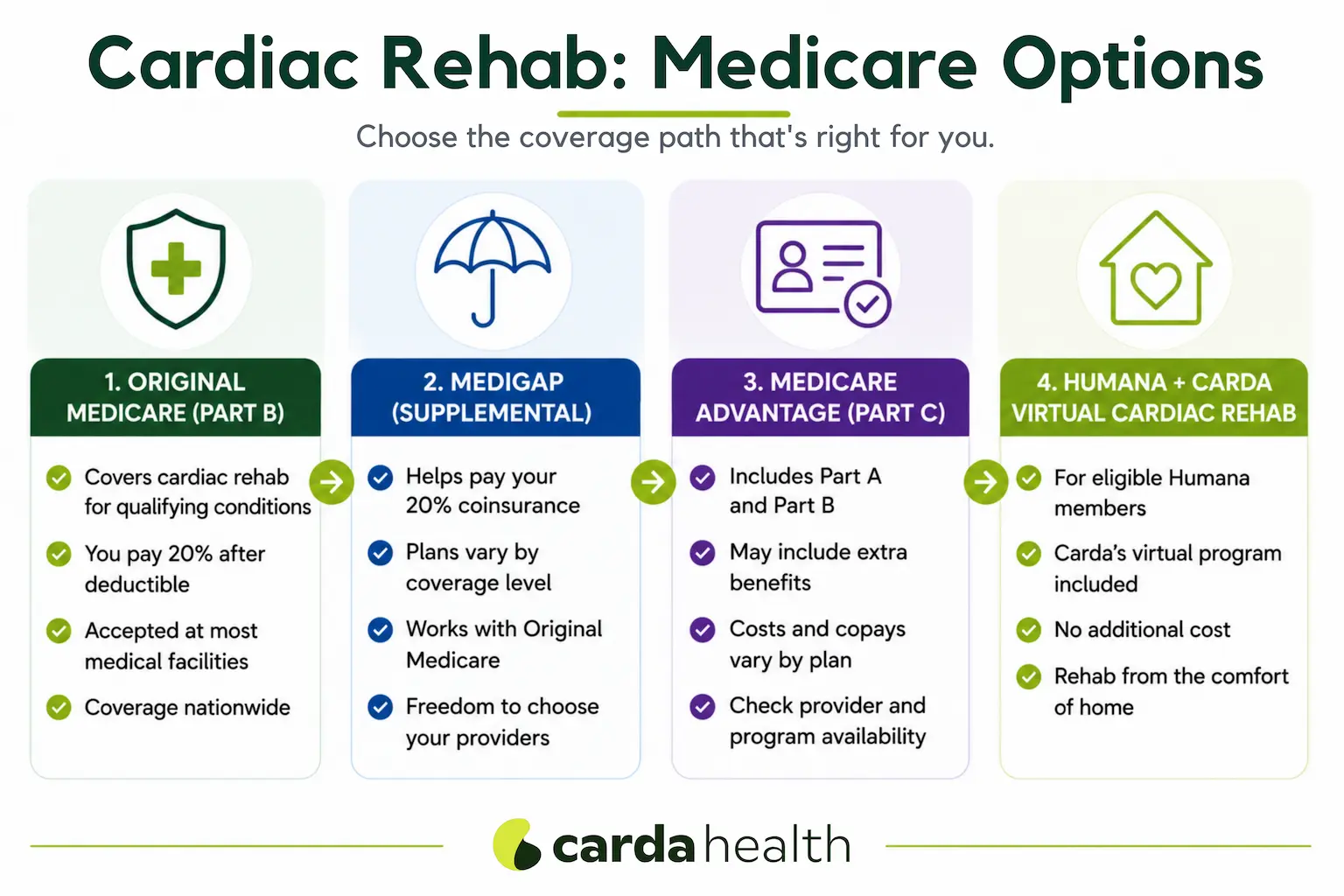
Cardiac rehab is an outpatient service, so it falls under Part B. After you meet the Part B deductible ($283 in 2026), you pay 20% of the Medicare-approved amount in a doctor's office. In a hospital outpatient department, you pay the deductible plus a per-session copayment, which by rule cannot exceed the Part A hospital deductible ($1,736 in 2026). Costs per session also vary by facility, so it is reasonable to ask your program for an estimate.
Medigap (Supplemental Insurance)
If you have a Medigap policy, it often covers the 20% coinsurance that Original Medicare leaves to you. For many people with supplemental insurance, this brings the out-of-pocket cost of cardiac rehab close to zero.
Medicare Advantage (Part C)
Medicare Advantage plans are required to cover at least what Original Medicare covers, so cardiac rehab is included. What differs is the cost sharing: copays, provider networks, and prior-authorization rules vary from plan to plan. Check your plan's details or call the number on your member card to confirm your costs and any requirements.
Does Medicare Cover Cardiac Rehab at Home?
This is where the details matter. Original Medicare lists a doctor's office or a hospital outpatient department as the settings for covered cardiac rehab, so on its own it does not broadly cover rehab done at home. Access to home-based and virtual cardiac rehab generally comes through two routes: the expanding telehealth pathways, which we cover in our overview of telehealth cardiac rehab in 2026, and specific health plan partnerships. If traveling to a center is difficult, it is well worth checking whether you qualify through one of these routes rather than assuming home rehab is off the table.
Humana Members: Cardiac Rehab at No Additional Cost
If you have a Humana plan, there is good news. In January 2026, Humana and Carda Health announced a partnership to expand access to virtual cardiac rehab for Humana members, and Carda's virtual cardiac rehab program is provided to qualifying Humana members at no additional cost through their plan. That means eligible members can complete their full program from home, with live, supervised sessions and real-time heart monitoring, without an added bill. Eligibility depends on your specific plan and clinical situation, so the simplest next step is to confirm whether you qualify.
How to Get Started With Carda Health
Beginning cardiac rehab with Carda Health is straightforward:
- Check your eligibility by answering a few questions about your health history, which takes about five minutes.
- A physician reviews your information to confirm cardiac rehab is appropriate and safe for you.
- Carda ships the equipment you need and walks you through the setup.
- You are matched with a dedicated clinical exercise physiologist who supervises your sessions in real time.
The Bottom Line
Medicare covers cardiac rehab for a clear list of heart conditions, including heart failure, and pays for up to 36 sessions or more when medically necessary. After the Part B deductible you generally owe 20%, which supplemental insurance often covers, and Medicare Advantage plans include the benefit as well. If you have a Humana plan, you may be able to do your entire program from home through Carda at no additional cost. The hardest part of cardiac rehab is starting, and cost should not be the reason you do not. The best way to know what applies to you is to check.
{{get-started}}
Frequently Asked Questions
Does Medicare cover cardiac rehab?
Yes. Medicare Part B covers standard and intensive cardiac rehabilitation for people with a qualifying heart condition who are referred by their doctor. Coverage includes supervised exercise, education, and counseling.
How many cardiac rehab sessions does Medicare cover?
Up to 36 one-hour sessions for standard cardiac rehab, generally up to two per day, and up to 72 in some cases if medically necessary. Intensive cardiac rehab covers up to 72 sessions over an 18-week period.
How much will I pay out of pocket?
After the Part B deductible ($283 in 2026), you generally pay 20% of the approved amount in a doctor's office, or a per-session copay in a hospital outpatient setting. Medigap often covers the 20%, Medicare Advantage costs vary by plan, and qualifying Humana members pay no additional cost through Carda.
What conditions qualify for Medicare-covered cardiac rehab?
A heart attack in the past 12 months, bypass surgery, angioplasty or stenting, current stable angina, heart valve repair or replacement, a heart or heart-lung transplant, and stable chronic heart failure with a reduced ejection fraction.
Does Medicare cover cardiac rehab for heart failure?
Yes. Despite some outdated information online, Medicare covers cardiac rehab for stable, chronic heart failure with a left ventricular ejection fraction of 35% or less and NYHA class II to IV symptoms despite at least six weeks of optimal therapy.
Does Medicare Advantage or my Humana plan cover cardiac rehab?
Medicare Advantage plans must cover at least what Original Medicare covers, though cost sharing varies. If you have a Humana plan, qualifying members can access Carda's virtual cardiac rehab at no additional cost through the Humana and Carda partnership.
Does Medicare cover cardiac rehab at home?
Original Medicare lists a doctor's office or hospital outpatient department as the covered settings, so home-based and virtual rehab generally come through telehealth pathways or health plan partnerships, such as Carda's program for Humana members. Check whether you qualify.
References
- Medicare.gov. Cardiac Rehabilitation Program Coverage.
- Medicare Interactive (Medicare Rights Center). Cardiac rehabilitation programs.
- Centers for Medicare & Medicaid Services. NCD 20.10, Cardiac Rehabilitation Programs.
- Centers for Medicare & Medicaid Services. NCD 20.10.1, Cardiac Rehabilitation Programs for Chronic Heart Failure.
- Humana. Humana and Carda Health Partner to Expand Access to Virtual Cardiac Rehabilitation. January 2026.