Can Heart Disease Be Reversed? What the Evidence Actually Shows


Key Takeaways
Partly. Coronary artery disease can measurably move backwards on repeat imaging, and two very different approaches have shown it: lowering LDL cholesterol aggressively, and intensive lifestyle change. The effect is real but modest. In the drug trials it is usually a single-digit percentage change in plaque volume over one to two years, not clean arteries.
Much of the benefit of treating coronary disease is thought to come from stabilizing plaque so it is less likely to rupture, rather than from shrinking it. Medication and lifestyle change work together rather than as alternatives. Calcified plaque does not dissolve with treatment, heart muscle scarred by a heart attack does not grow back, and a calcium score can rise even while treatment is working. Coronary disease can be pushed backwards, but it is not cured.
Ask two hospitals and you will get two answers. Some patient organizations state flatly that coronary artery disease cannot be reversed. A Mayo Clinic cardiologist says the narrowing of the arteries is precisely the thing that can be reversed. Few of these answers point to the trials behind them.
They are both partly right, and the disagreement comes down to what the word reversed is being asked to mean. Cardiologists have been measuring this for thirty years using ultrasound probes inside the coronary arteries, and the trials give a clear answer that sits between the two claims.
Here is what those trials found, how much reversal is realistic, and which parts of heart disease do not reverse at all.
Can Heart Disease Be Reversed? The Short Answer
Partly. Coronary artery disease, the plaque buildup that narrows the arteries feeding your heart, can measurably regress. That is the question this article answers, because it is the one with direct imaging evidence behind it. Repeat imaging trials have shown it with cholesterol-lowering drugs and with intensive lifestyle change. What no treatment does is erase atherosclerosis or return an artery to the state it was in before.
So the honest phrasing is that coronary disease can be pushed backwards, not undone. That distinction matters, because coronary artery disease is a lifelong condition either way, and treatment does not stop when a scan looks better.
The two routes covered below, lowering LDL with medication and intensive lifestyle change, are not competing choices. For most people with coronary disease they work together, and the trials show what each can add.
If your question is about heart failure rather than the arteries, that is a different condition with a different answer, and our guides to whether heart failure can be reversed and congestive heart failure reversal cover it.
What Reversal Actually Means in the Research
In cardiology, reversal has a narrow technical meaning: a measurable reduction in disease on repeat imaging of the same artery, months or years apart. Two different things get measured, and they are not interchangeable. Plaque volume, measured by an ultrasound probe inside the artery, is how much plaque sits in the vessel wall. Arterial narrowing, measured by angiography, is how tight the remaining channel is. A trial that moved one has not necessarily moved the other. Neither is a cure, and neither is the same as clearing a blockage.
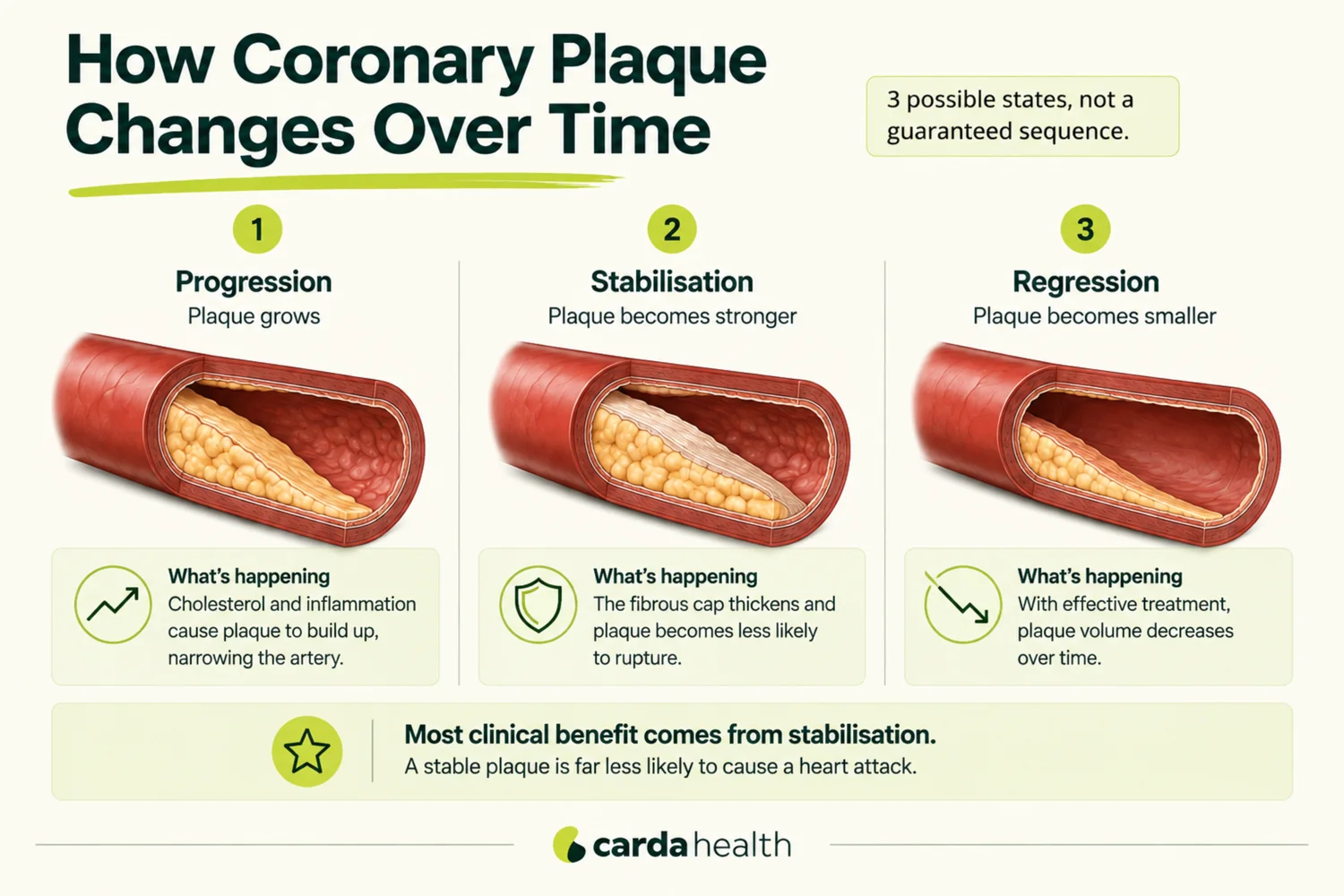
Progression, Stabilization and Regression Are Three Different Things
Untreated coronary disease progresses. Plaque grows, and the arteries narrow further. That is the default.
Stabilization means the plaque stops growing and its composition changes. Soft, lipid-rich plaque, the kind most likely to rupture and cause a heart attack, gives way to denser, more fibrous, more stable tissue. Nothing shrinks, but the risk of rupture is thought to fall substantially.
Regression means the plaque is measurably smaller than it was. This is what people mean by reversal.
Worth sitting with: most of the survival benefit from treating coronary disease appears to come from the middle one, not the third. A plaque that has stopped growing and turned stable is doing most of the work of keeping you alive, even if the numbers on a scan barely move.
How Plaque Actually Gets Measured
The strongest evidence comes from intravascular ultrasound, in which a probe is threaded into the coronary artery and the plaque burden measured directly. The main metric is percent atheroma volume, the proportion of the artery segment occupied by plaque. Coronary CT angiography and quantitative coronary angiography are used too, the latter measuring how narrow the channel is rather than how much plaque sits in the wall.
These techniques do not all measure the same thing, which is one reason studies disagree at the edges.
Route One: Lowering LDL Far Enough That Plaque Shrinks
The first route with solid trial evidence is driving LDL cholesterol down much further than routine targets. The relationship is dose-dependent: the lower the LDL achieved, the more likely plaque is to regress rather than simply stop growing.
The ASTEROID trial, published in JAMA in 2006, gave 507 patients high-dose rosuvastatin and imaged their coronary arteries with intravascular ultrasound at baseline and again after two years. Average LDL fell from 130.4 to 60.8 mg/dL, a reduction of 53.2%. Among the 349 patients with usable repeat scans, median total atheroma volume fell by 6.8%.
Ten years later the GLAGOV trial added evolocumab, a PCSK9 inhibitor, on top of statin therapy in 968 patients. Time-weighted mean LDL reached 36.6 mg/dL against 93.0 mg/dL on statin alone. After 76 weeks, the trial's primary measure, percent atheroma volume, fell by 0.95 percentage points on evolocumab while rising 0.05 points on statin alone. Total atheroma volume fell 5.8 mm³ against 0.9 mm³. Plaque regressed in 64.3% of the evolocumab group against 47.3% on statin alone.
The consistent finding across this literature is that regression becomes common once LDL is pushed below roughly 70 mg/dL, and more so below 60. What these trials did not show is any threshold at which arteries return to normal.
Route Two: Intensive Lifestyle Change
The second route is comprehensive lifestyle change, and the evidence for it is older, smaller and in one respect more striking, because it produced regression without any lipid-lowering drugs at all.
The Lifestyle Heart Trial randomized 48 patients with moderate to severe coronary disease to either usual care or an intensive program combining a very low-fat plant-based diet, moderate exercise, stress management training and group support. Coronary lesions were measured by quantitative angiography.
At one year, reported in the Lancet in 1990, 82% of the intervention group showed some regression. At five years, reported in JAMA in 1998, the intervention group had improved further while the control group's arterial narrowing had progressed by 27.7%, and controls experienced cardiac events at more than twice the rate, a risk ratio of 2.47 with a confidence interval of 1.48 to 4.20. Adherence tracked closely with the degree of change, which is the most persuasive detail in the study.
The caveat is size. Forty-eight patients randomized, thirty-five with complete five-year imaging. It is a small trial, and much of the reversal claim still rests on it. It was, however, enough for Medicare, which reviewed the evidence and approved the program as a covered intensive cardiac rehabilitation benefit in 2010.
How Much Reversal Is Realistic?
Set the two routes side by side and the honest scale of the effect becomes clear.
| Approach | Endpoint measured | What Changed | Over What Period |
|---|---|---|---|
| High-dose statin (ASTEROID) | Plaque volume by intravascular ultrasound | Total atheroma volume down 6.8% (median) | 24 months |
| PCSK9 inhibitor added (GLAGOV) | Percent atheroma volume by intravascular ultrasound | PAV down 0.95 points vs up 0.05 points; regression in 64.3% vs 47.3% of patients | 76 weeks |
| Intensive lifestyle (Lifestyle Heart Trial) | Arterial narrowing by quantitative angiography | Regression in 82% of participants at 1 year | 1 and 5 years |
Three different measurements sit in that table and they are not on a common scale. ASTEROID reports a percentage change in plaque volume, GLAGOV reports percentage points of the artery occupied by plaque, and the lifestyle trial reports the share of participants whose narrowing improved at all. None of them can be ranked against the others. What they have in common is the size of the effect: small, measurable, and in the opposite direction to where untreated disease goes. Nobody in any of these trials finished with arteries that looked untouched by disease. What they finished with was less plaque than they started with, at a time when the expected trajectory was more.
Against a disease that otherwise moves in one direction only, that is a meaningful result. It is also a good deal less than the word reversal suggests to most people reading it on the internet.
Why Your Calcium Score Can Rise While You Are Getting Better
This one catches people out, and it is worth understanding before your next scan.
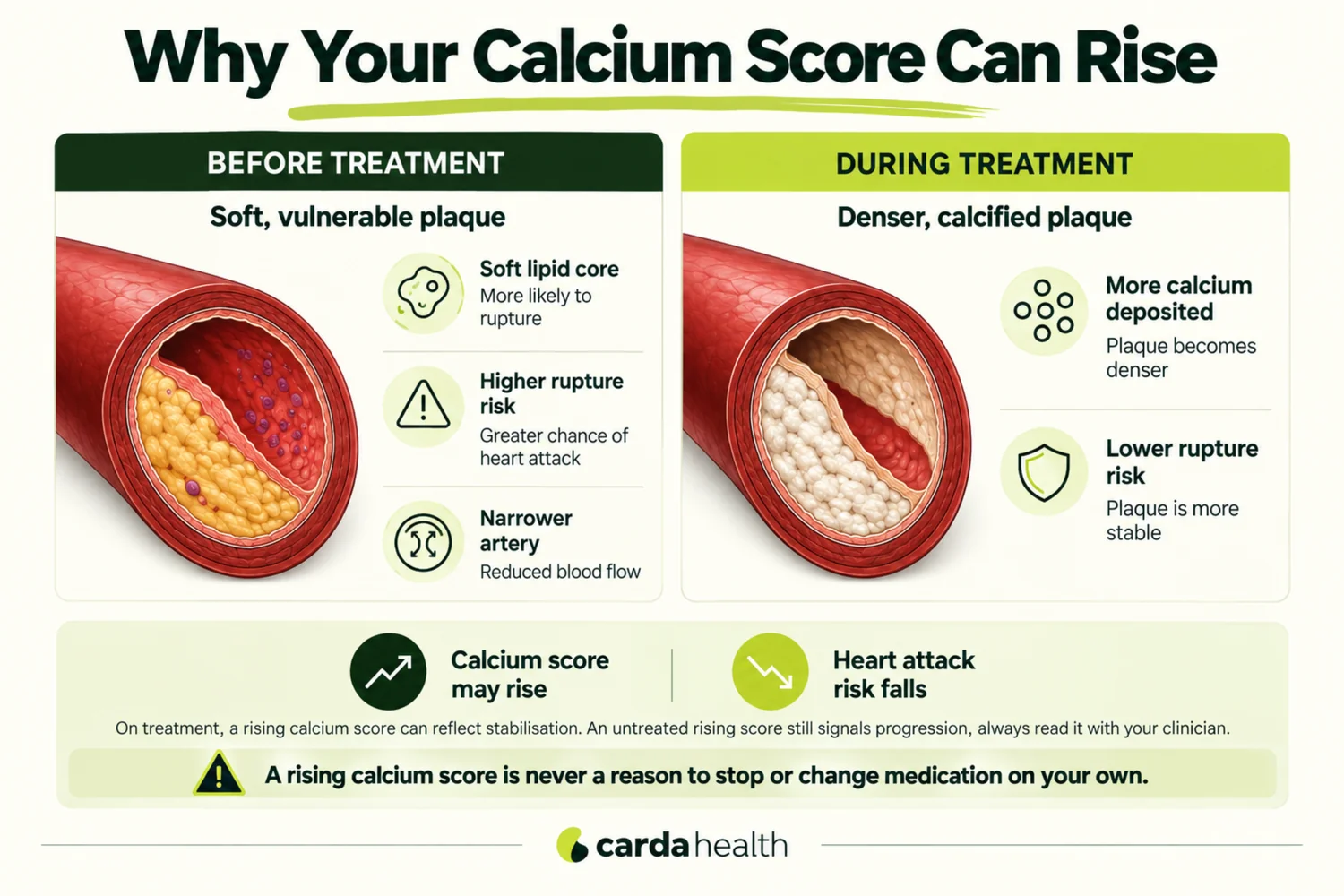
A coronary artery calcium score measures calcified plaque. Patients often assume that a rising score means the disease is winning. On treatment, that assumption is frequently wrong.
Intensive lipid lowering converts soft, lipid-rich plaque into dense calcified plaque. Serial CT angiography studies have shown exactly this pattern in statin-treated patients: less low-attenuation plaque, the type associated with heart attacks, and more dense calcium. Dense calcified plaque is associated with a lower risk of events, and very dense plaque barely progresses at all.
So a calcium score can go up while plaque burden falls and outcomes improve. The score reflects composition, not just quantity, and on treatment a rise can mean healing rather than harm.
That said, a rising calcium score is never a reason to stop or change medication on your own. Serial calcium scoring is not a validated way to judge whether treatment is working, and interpreting the number is a conversation for your cardiologist, not a decision to make at home.
What Cannot Be Reversed
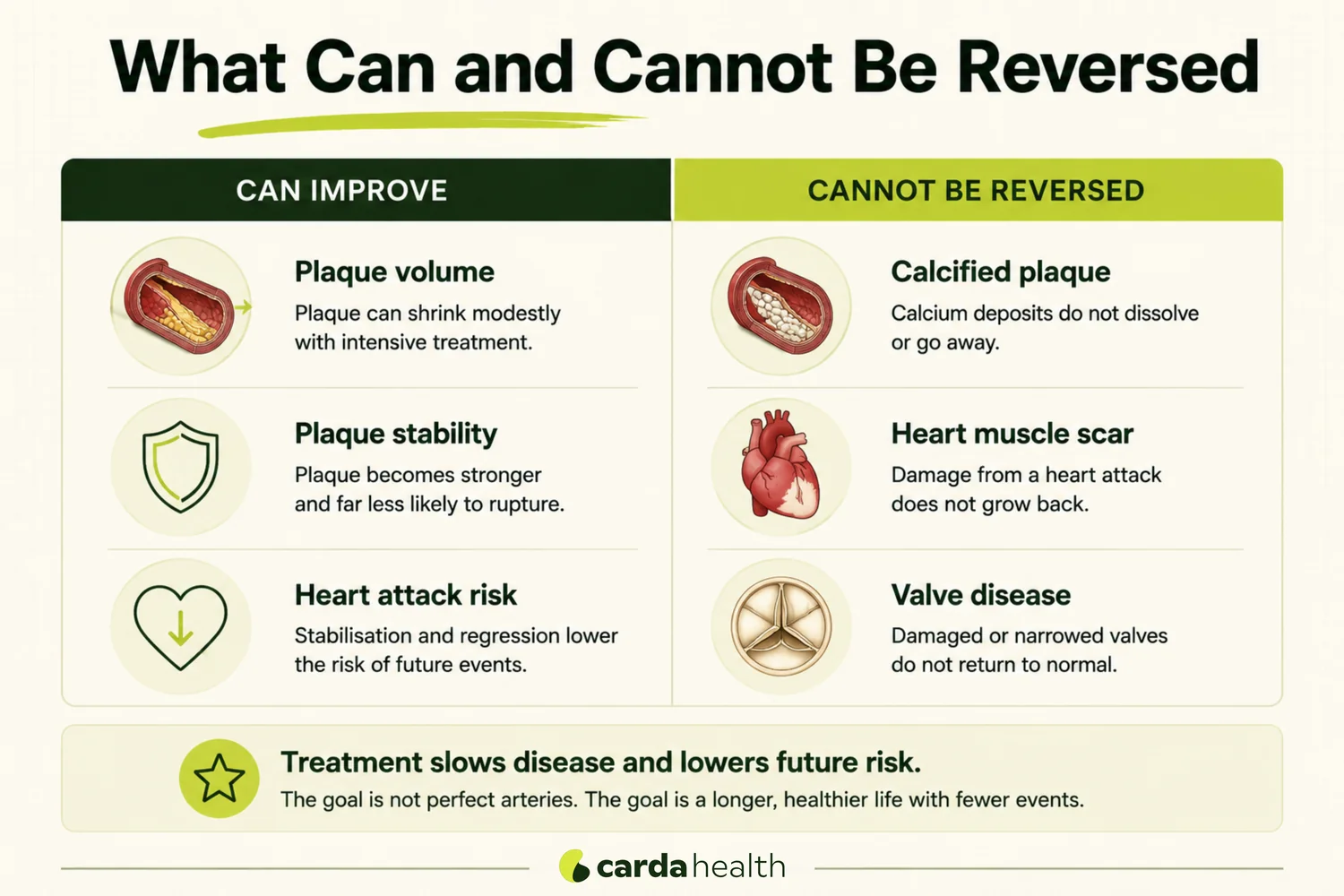
Three things do not come back, and any honest account of reversal has to say so.
- Calcified plaque. Calcium deposits in the artery wall do not dissolve with medication or lifestyle change. They can be stabilized and can stop growing. During stenting, procedures such as atherectomy or intravascular lithotripsy can break up or remove calcium in a heavily calcified segment, but nothing returns the artery wall to normal.
- Scarred heart muscle. Tissue that died during a heart attack is replaced by scar, and scar does not contract. This is why time to treatment during a heart attack matters so much.
- Structural valve disease. A significantly narrowed or leaking valve is a structural problem. Medication can help manage symptoms and related conditions, but severe structural valve disease is usually treated by repair or replacement rather than reversed by lifestyle or medication.
Procedures do not reverse the disease either. A stent or a bypass restores blood flow through one segment, and during a heart attack that is life-saving, but it does not treat the underlying disease, which can continue to progress elsewhere in the coronary arteries. Our explainer on what percentage of blockage requires a stent goes into where procedures do and do not help.
What This Means for Your Own Treatment Plan
If You Have Coronary Artery Disease
The realistic goal is not a clean scan. It is lowering the chance that a plaque ruptures in the next ten years, and both routes above do that.
- Know your LDL number and your target. Regression becomes likely at levels well below the ones many people are told are acceptable. Ask what yours is and what it should be.
- Treat adherence as the active ingredient. In the lifestyle trial, the degree of change tracked the degree of regression. Medication only works while you are taking it.
- Get supervised, not self-directed. Exercise is part of both routes, and after a cardiac event the safest way to start is a monitored program. The benefits of cardiac rehabilitation are well established, and Carda delivers virtual cardiac rehab with a clinical exercise physiologist and real-time monitoring from home.
- Ask about intensive cardiac rehab before you start standard rehab. The Ornish program, which Carda delivers virtually, is a Medicare-covered version of the lifestyle route above. Medicare does not let a patient switch into it once standard cardiac rehab has started, so raise it at referral.
If You Are the Referring Clinician
Patients arrive having read that heart disease is reversible, and the two available replies, a flat no or an enthusiastic yes, both cost you credibility. The regression literature gives you a third option that is accurate and still motivating: plaque responds to what we do, measurably, and the size of the response tracks how far we push LDL and how completely the patient changes their habits.
For patients whose primary interest is the lifestyle route, the Ornish program is the only one of the three Medicare-approved intensive cardiac rehab programs whose supporting research rests on regression of coronary atherosclerosis, and it is delivered as a distinct benefit rather than as standard rehab. Carda is its exclusive virtual provider, so eligible patients can complete it from home. Because a patient who starts standard cardiac rehab cannot later switch to ICR, the decision belongs at referral. Criteria sit in our guide to when to refer to cardiac rehab.
The Bottom Line
Coronary plaque can shrink. The trials are real, the imaging is direct, and two very different approaches have both produced it. The effect is measured in single-digit percentages over a year or two, and it happens alongside the change that matters more, which is plaque becoming stable and far less likely to rupture.
Reversed and cured are not the same word. Your arteries will not become new. But the direction of travel is not fixed, and how far it shifts depends largely on decisions that are still yours to make.
Check your eligibility at Carda Health
Frequently Asked Questions
Can plaque in your arteries be dissolved?
No. No treatment dissolves plaque or clears it out of the artery wall. What treatment can do is reduce the volume of plaque modestly and change its composition so it becomes denser and less likely to rupture. Calcified deposits in particular do not go away.
How long does it take to reverse plaque buildup?
The trials discussed here measured change over one to five years. ASTEROID imaged patients at 24 months, GLAGOV at 76 weeks, and the Lifestyle Heart Trial at one year and again at five. Changes in cholesterol and symptoms happen much faster, sometimes within weeks, but measurable change in plaque volume, or in how narrow the artery is, takes a year or more.
Can you reverse heart disease with diet alone?
The Lifestyle Heart Trial produced regression without lipid-lowering drugs, but diet was one of four components alongside exercise, stress management and group support, and adherence had to be high and sustained. Diet on its own, at ordinary levels of change, has not been shown to reverse coronary disease. Most people do best combining lifestyle change with medication rather than choosing between them.
Does exercise reverse heart disease?
Exercise alone has not been shown to shrink coronary plaque. It does improve survival, exercise capacity and symptoms after a cardiac event, and it was part of the lifestyle program that did produce regression. Think of it as one necessary component rather than the mechanism on its own.
Does a stent or bypass reverse heart disease?
No. Both restore blood flow through a specific blocked segment, and in a heart attack that is life-saving. Neither treats the underlying disease, which is why medication and lifestyle change remain essential after a procedure.
Is reversing heart disease the same as curing it?
No, and the difference matters. Reversal in the research means a measurable reduction in plaque volume on repeat imaging. Cure would mean the disease is gone and treatment can stop. Coronary artery disease is a lifelong condition, and stopping treatment after a good scan allows it to progress again.
What LDL level is needed to reverse plaque?
There is no single cutoff, but in the imaging trials regression became common once LDL fell below roughly 70 mg/dL, and more so below 60. In GLAGOV, patients averaging 36.6 mg/dL on statin plus evolocumab saw plaque regress in 64.3% of cases. Your own target depends on your overall risk, so set it with your doctor.
Can a coronary calcium score go down?
Rarely. Calcium deposits do not dissolve, and on statin therapy the score often rises as soft plaque turns into dense, more stable calcified plaque. A rising score on treatment does not by itself mean the disease is getting worse, but your cardiologist should interpret it.
Does Medicare cover a program for reversing heart disease?
Yes. Dr. Ornish's Program for Reversing Heart Disease has been covered by Medicare as intensive cardiac rehabilitation since 2010, with up to 72 sessions over 18 weeks for patients with a qualifying cardiac diagnosis. Carda Health is its exclusive virtual provider. It has to be chosen before standard cardiac rehab begins.
References
- Coronary Atherosclerotic Plaque Regression: JACC State-of-the-Art Review. Journal of the American College of Cardiology. doi:10.1016/j.jacc.2021.10.035
- Nissen SE, Nicholls SJ, Sipahi I, et al. Effect of very high-intensity statin therapy on regression of coronary atherosclerosis: the ASTEROID trial. JAMA. 2006;295(13):1556-1565.
- Nicholls SJ, Puri R, Anderson T, et al. Effect of evolocumab on progression of coronary disease in statin-treated patients: the GLAGOV randomized clinical trial. JAMA. 2016;316(22):2373-2384.
- Ornish D, Brown SE, Scherwitz LW, et al. Can lifestyle changes reverse coronary heart disease? The Lifestyle Heart Trial. Lancet. 1990;336(8708):129-133.
- Ornish D, Scherwitz LW, Billings JH, et al. Intensive lifestyle changes for reversal of coronary heart disease. JAMA. 1998;280(23):2001-2007.
- Statin Effects on Vascular Calcification. Arteriosclerosis, Thrombosis, and Vascular Biology. American Heart Association.
- Reconciling Coronary Artery Calcification in the Lipid-Lowering Era. National Library of Medicine, PMC.
- Centers for Medicare & Medicaid Services. Decision Memo CAG-00419N, Intensive Cardiac Rehabilitation Program, Dr. Ornish’s Program for Reversing Heart Disease.
- Mayo Clinic. Mayo Clinic Minute: Reversing versus preventing heart disease.