What Is Intensive Cardiac Rehabilitation (ICR)? How It Differs From Standard Cardiac Rehab


Key Takeaways
Intensive cardiac rehabilitation is a separate Medicare benefit, not a premium version of cardiac rehab. ICR covers up to 72 one-hour sessions across up to 18 weeks, with as many as six sessions in a single day. Standard cardiac rehab covers up to 36 sessions across up to 36 weeks, capped at two per day.
Both draw on the same list of qualifying conditions under 42 CFR 410.49, so if you qualify for one you almost always qualify for the other. Only three ICR programs are approved by Medicare nationally: Dr. Ornish’s Program for Reversing Heart Disease, the Pritikin Program, and the Benson-Henry Institute Cardiac Wellness Program. Medicare will not let a patient move from standard rehab into ICR once the first program has started, though the reverse switch is allowed once, which makes this a decision to settle at referral rather than afterward.
Medicare pays for two kinds of cardiac rehabilitation. Most patients are only ever offered one.
Intensive cardiac rehabilitation, usually shortened to ICR, has been a distinct Medicare benefit since January 2010. It covers twice the sessions of standard cardiac rehab, compresses them into half the calendar time, and treats nutrition, stress management and psychosocial support as core clinical components rather than as education attached to the end of an exercise session.
What follows is the benefit as it actually works: how ICR differs from standard cardiac rehab on paper and in practice, who qualifies, why only three programs in the country are approved to deliver it, and the one Medicare rule that turns this into a decision you only get to make once.
What Is Intensive Cardiac Rehabilitation?
Intensive cardiac rehabilitation is a physician-supervised outpatient program that furnishes cardiac rehabilitation services more frequently and more rigorously than a standard program. Medicare covers it under its own benefit category, created by the Medicare Improvements for Patients and Providers Act of 2008 and effective from January 1, 2010. The governing rules sit in 42 CFR 410.49.
The word intensive describes the structure, not the exercise. Nobody is pushed harder on a treadmill. Patients simply spend far more hours inside the program, across a shorter run of weeks, following a curriculum that gives equal weight to what they eat, how they handle stress, and who is around them while they do it.
That last part is what clinicians most often underestimate. An ICR session is not a standard rehab session with a nutrition handout stapled to it.
One honest caveat before going further. No randomized trial has ever compared ICR head to head against standard cardiac rehab on mortality. What the three approved programs did have to prove is a different and quite specific thing, covered further down.

ICR vs Standard Cardiac Rehab: What Actually Differs
The differences are structural before they are philosophical. ICR covers up to 72 one-hour sessions across up to 18 weeks, with a ceiling of six sessions in one day. Standard cardiac rehab covers up to 36 sessions across up to 36 weeks, with a ceiling of two per day. Each is billed under its own codes, and the two benefits cannot be mixed.
| Feature | Standard Cardiac Rehab | Intensive Cardiac Rehab |
|---|---|---|
| Covered sessions | Up to 36 | Up to 72 |
| Time window | Up to 36 weeks | Up to 18 weeks (126 days) |
| Maximum per day | 2 one-hour sessions | 6 one-hour sessions |
| Billing codes | 93797, 93798 | G0422, G0423 |
| Program approval | Any Medicare-certified program | Only 3 CMS-approved programs |
| Emphasis | Exercise-led, education alongside | Exercise, nutrition, stress, support weighted equally |
Read across the table and the pattern is consistent: ICR gives a patient roughly double the clinical contact hours, delivered in half the calendar time, through one of only three approved curricula.
Session Count and Timeline
Standard cardiac rehab can reach 72 sessions, but only as an exception. Sessions 37 to 72 are at the Medicare contractor's discretion and require the KX modifier, which attests that documentation of medical necessity is on file. ICR starts at 72.
The six-sessions-per-day allowance is the detail almost nobody explains, and it changes the entire shape of a program. It is why an Ornish program runs as four-hour blocks twice a week and finishes in nine weeks, while a standard program runs one hour three times a week and takes twelve.
Medicare limits ICR to 72 one-hour sessions over up to 18 weeks. Claims beyond 72 sessions or after 126 days are rejected unless the provider adds the KX modifier to attest that the sessions meet medical policy.
What a Session Contains
Both programs must include the same statutory components: physician-prescribed exercise, cardiac risk factor modification, psychosocial assessment, outcomes assessment, and an individualized treatment plan reviewed at least every 30 days. The regulation is identical on this point.
The difference is proportion. In standard rehab the hour is built around monitored exercise, with risk factor education fitted around it. In ICR, nutrition, stress management and group support each occupy protected time in the curriculum rather than competing for the last ten minutes.
How Each One Is Billed
ICR is billed under HCPCS G0422 (with exercise) and G0423 (without exercise). Standard cardiac rehab uses CPT 93797 and 93798. The two code sets are not interchangeable, so ICR sessions must be billed under the G codes. Diagnosis coding is where many referrals run into trouble, and the ICD-10 codes that qualify a patient for cardiac rehab referral apply to both benefits.
Who Qualifies for Intensive Cardiac Rehab?
The same diagnoses qualify a patient for both benefits. Under 42 CFR 410.49, Medicare Part B covers cardiac rehabilitation and intensive cardiac rehabilitation for patients who have experienced any one of seven qualifying events or conditions.
- Acute myocardial infarction within the preceding 12 months
- Coronary artery bypass graft surgery
- Current stable angina pectoris
- Heart valve repair or replacement
- Percutaneous coronary intervention or coronary stenting
- Heart or heart-lung transplant
- Stable chronic heart failure, defined as LVEF of 35% or less with NYHA class II to IV symptoms despite at least six weeks of optimal therapy
One asymmetry between the two lists is easy to miss. The heart failure indication took effect for standard cardiac rehab on February 18, 2014, but not for ICR until February 9, 2018, four years later, a distinction written into 42 CFR 410.49 itself. The regulation also permits CMS to use the national coverage determination process to exclude a specific cardiac condition from ICR where the clinical evidence does not support it.
So the two eligibility lists match today, but they are not permanently welded together. If you are weighing whether a particular patient should be sent at all, the referral thresholds for hospitalists and PCPs are the place to start.
Why Only Three Programs Are Medicare-Approved
A program cannot simply describe itself as intensive and bill accordingly. To be approved it has to clear an evidence bar written into the Social Security Act, and in the sixteen years since the benefit opened, exactly three have cleared it.
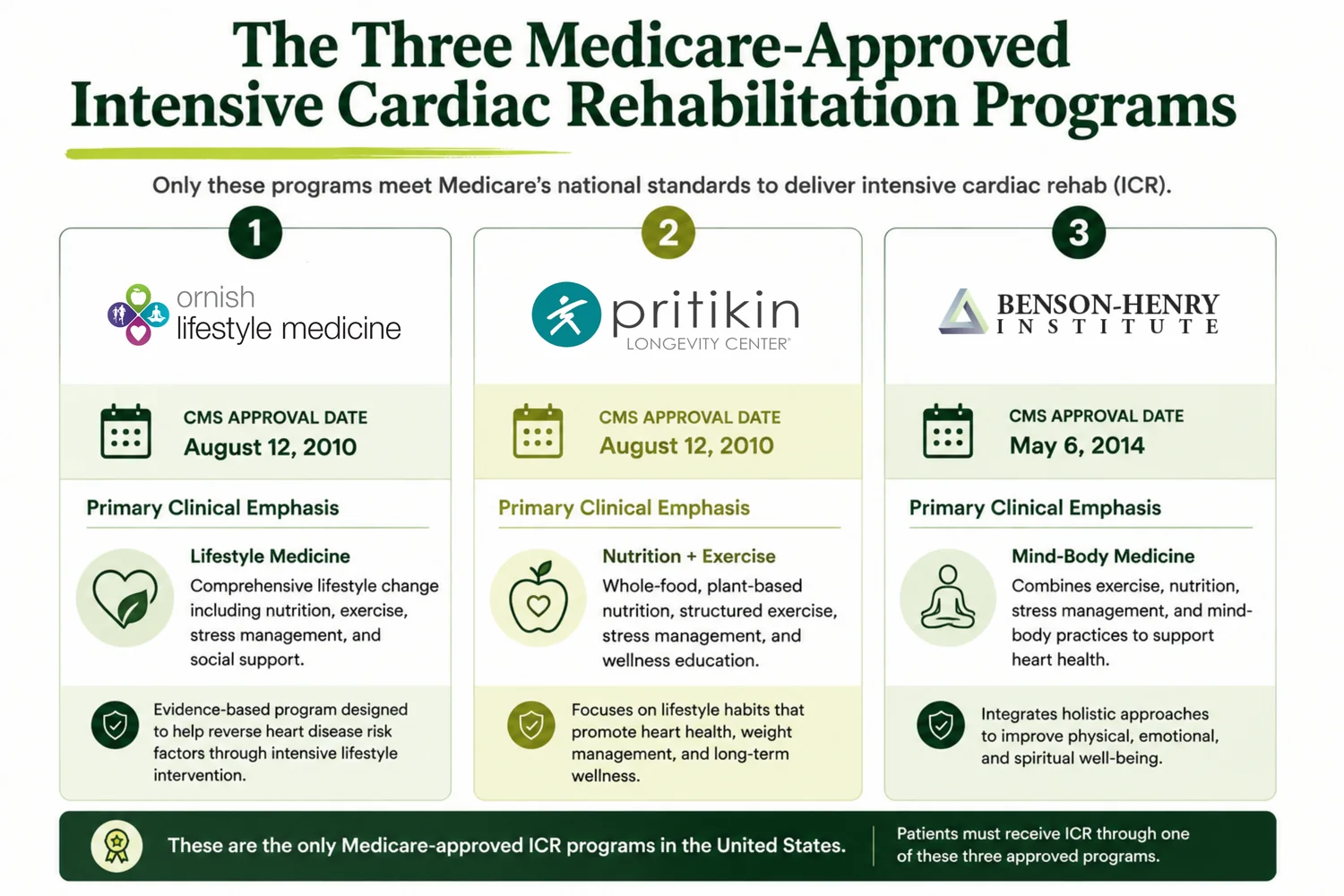
Three approved programs does not mean three locations. Each approved curriculum is delivered by a number of licensed sites, and CMS maintains the current list of those facilities. The constraint on a given patient is which approved site they can actually reach.
Under section 1861(eee)(4)(A) and 42 CFR 410.49(c), a program must demonstrate through peer-reviewed published research that it accomplished at least one of the following for its patients: positively affected the progression of coronary heart disease, reduced the need for coronary bypass surgery, or reduced the need for percutaneous coronary interventions. It must also show a statistically significant reduction in five or more specified clinical measures.
In practice, the approved programs cleared that bar in different ways. Ornish's evidence includes angiographic regression of coronary plaque, and CMS approved Benson-Henry on lower hospitalization rates in a Medicare demonstration with matched controls. Each approval required published outcome data tied to one specific curriculum, which is a large part of why the list is so short.
| Approved Program | CMS Effective Date | Distinguishing Approach |
|---|---|---|
| Dr. Ornish’s Program for Reversing Heart Disease | August 12, 2010 | Plant-based nutrition, exercise, stress management and group support, weighted equally |
| Pritikin Program | August 12, 2010 | Pritikin eating plan with supervised exercise and education |
| Benson-Henry Institute Cardiac Wellness Program | May 6, 2014 | Mind-body medicine and the relaxation response, developed at Massachusetts General Hospital |
All three carry the same Medicare session allowance and the same reimbursement codes. What differs is the method, and which of them a given patient can actually reach.
Dr. Ornish’s Program for Reversing Heart Disease
Approved August 12, 2010. Four elements carry equal weight: a whole-food plant-based diet, moderate exercise, stress management, and group support. It is the only one of the three whose evidence includes angiographic regression of coronary atherosclerosis. The Lifestyle Heart Trial reported that 82% of intervention patients showed an average change toward regression at one year, and at five years the usual-care group had about 2.5 times as many cardiac events. That trial randomized 48 patients, which is small, and the reversal finding still rests largely on it.
Benson-Henry Institute Cardiac Wellness Program
Approved May 6, 2014, nearly four years after the other two. Developed at the Benson-Henry Institute at Massachusetts General Hospital, it places mind-body medicine and the relaxation response at the center of each session rather than treating stress management as an adjunct.
You Can Only Switch One Way: ICR to CR
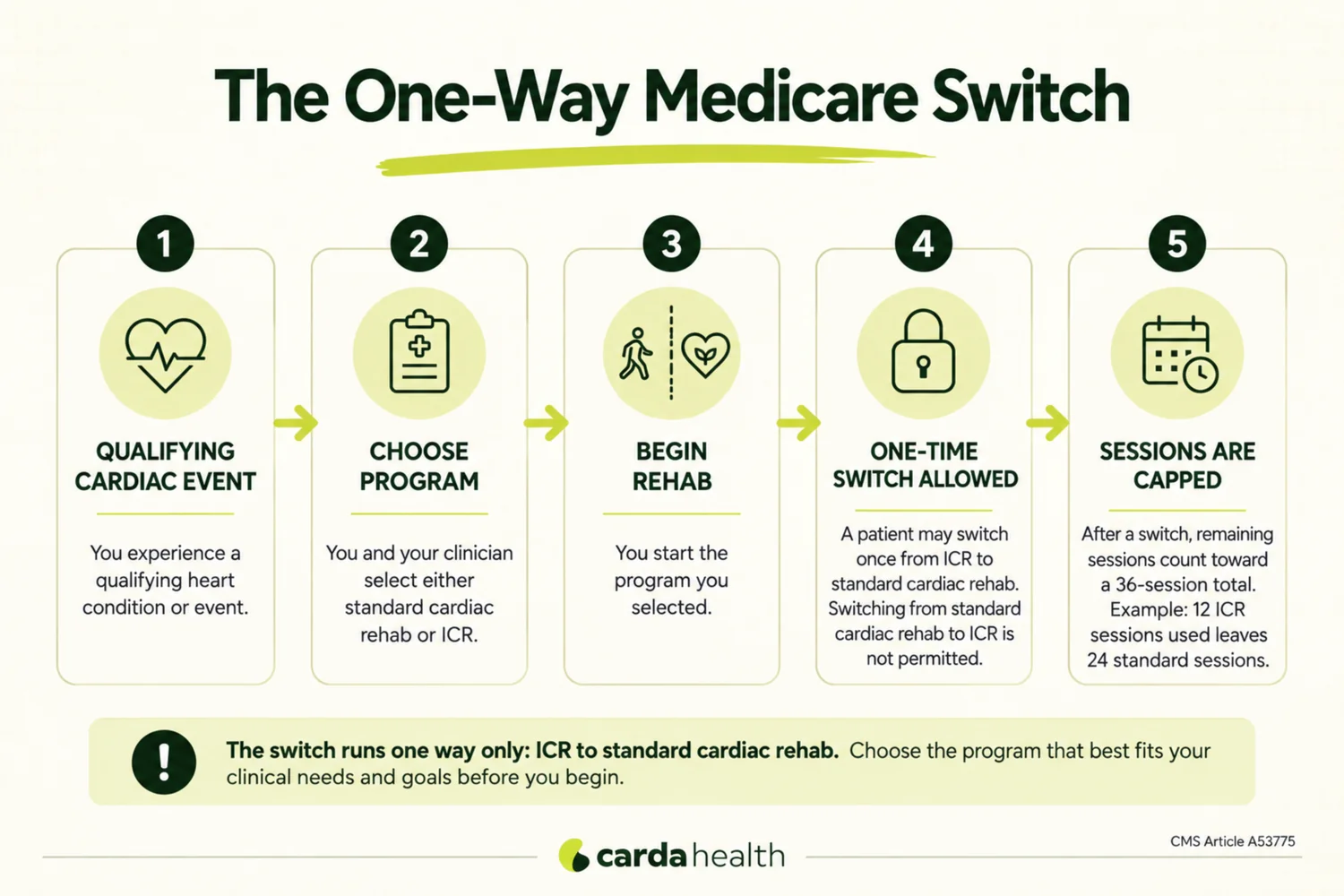
The rule is asymmetric, and the asymmetry runs against the patient. Under the Medicare Claims Processing Manual (Chapter 32, §140.2.2), a beneficiary may switch from ICR to standard cardiac rehab, once only, and is then limited to the sessions remaining in the 36-session allowance. A patient who switches after 12 ICR sessions has 24 CR sessions left. Moving the other way is not permitted: “Beneficiaries may not switch from CR to ICR.”
So starting in ICR preserves an exit. Starting in standard cardiac rehab closes ICR off for that course of rehab.
That single rule turns the referral into a one-time decision. A patient discharged after a stent who begins a standard 36-session program in week three has, in practical terms, spent the benefit attached to that event without ever being told a second option existed.
Most of the time nobody raises it, because most referring clinicians route patients into whatever program their hospital runs. For health systems weighing which programs to offer, our vendor evaluation guide treats ICR capability as a structural differentiator rather than a feature.
Can You Do Intensive Cardiac Rehab at Home?
Yes, for some programs. Virtual delivery of cardiac rehabilitation expanded substantially under the 2026 Medicare rules, and the Ornish program is now delivered entirely online. Carda Health is the exclusive provider of the Ornish program delivered virtually.
Patients choose between a nine-week intensive schedule of four hours twice a week and a twelve-week schedule of two hours three times a week. Sessions are live rather than recorded, run by a clinical exercise physiologist, with heart rate and blood pressure monitored in real time. A welcome kit ships to the house with a tablet, a blood pressure monitor and a heart rate monitor, so nothing has to be bought.
Reimbursement for virtual rehab shifted twice during 2026, once through the Physician Fee Schedule and once through the Consolidated Appropriations Act, and the rules differ depending on whether a program is office-based or hospital outpatient. Our breakdown of the 2026 telehealth rules for cardiac and pulmonary rehab covers where that currently stands.
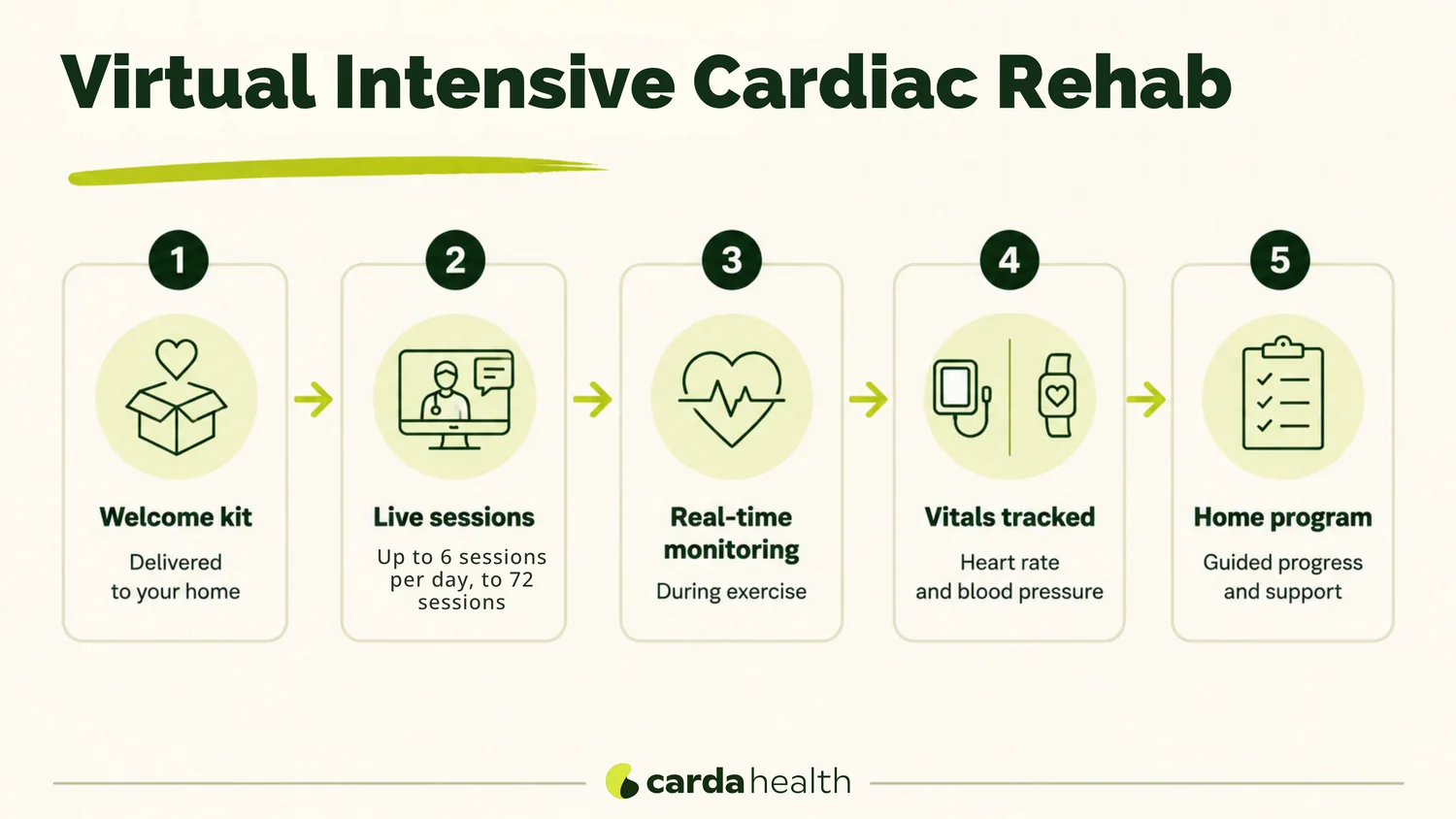
Access is the honest argument for virtual delivery here. Only three ICR curricula are approved nationally, and the sites licensed to deliver them are limited in number, so many patients have no ICR site within a reasonable drive. Twice-weekly four-hour blocks are also difficult to sustain when each one carries a two-hour round trip on top.
What Intensive Cardiac Rehab Costs With Medicare
ICR is covered under Medicare Part B. A patient pays the annual Part B deductible, which is $283 in 2026, then 20% coinsurance on the Medicare-approved amount for each session, unless supplemental coverage picks that up. In a hospital outpatient department there may also be a facility copayment.
Medicare Advantage plans have to cover the benefit but set their own networks, prior authorization requirements and cost sharing, so the real number varies by plan. Because ICR runs to 72 sessions rather than 36, total coinsurance across a full program is higher. The two benefits are also billed under different codes, so the Medicare-approved amount per session is not necessarily the same for ICR as for standard cardiac rehab, and it varies by setting.
Full detail sits in our guide to what Medicare covers for cardiac rehab.
How to Get Started With Intensive Cardiac Rehab
ICR requires a referral, exactly as standard cardiac rehab does. What it also requires is that somebody mentions it.
If You Are the Patient
- Ask before you start anything. The question is simply whether you qualify for intensive cardiac rehabilitation, not just cardiac rehab. Ask it before the first session of any program is booked.
- Ask which program. There are only three approved nationally, and they are not interchangeable in method or in how they are delivered.
- Check coverage before you enroll. Confirm the deductible position for the year and, if you are on Medicare Advantage, whether the program sits in network.
If You Are the Referring Clinician
- Establish the qualifying diagnosis and its date. The 12-month window on myocardial infarction and the six-week optimal therapy requirement on heart failure are the two time-based requirements easiest to miss.
- Raise ICR explicitly at discharge. If the patient starts standard rehab first, the ICR option closes for that course of rehab.
- Document to the ICR standard. The individualized treatment plan, its signature, and the 30-day review cadence are where audits land. Our guide to documenting cardiac rehab eligibility for Medicare sets out what has to be on file.
If a patient in front of you qualifies for cardiac rehabilitation, they almost certainly qualify for intensive cardiac rehabilitation too. The question worth putting to them, before anything gets booked, is which of the two they would realistically finish and which one matches what you are actually trying to change. That decision only comes around once.
Patients: check your eligibility at Carda Health
Clinicians: refer a patient to Carda Health
Frequently Asked Questions
Is intensive cardiac rehab better than regular cardiac rehab?
Not automatically, and no randomized trial has compared the two head to head on mortality. ICR gives roughly double the clinical contact hours and a broader curriculum covering nutrition, stress and group support. Whether that suits a given patient depends on whether they can commit to four-hour blocks and whether the lifestyle-change emphasis matches what needs to change. For a patient who mainly needs supervised, monitored exercise after a stent, standard rehab may fit better.
How many sessions of intensive cardiac rehab does Medicare cover?
Up to 72 one-hour sessions, with a maximum of six sessions in any single day, across a period of up to 18 weeks. Standard cardiac rehab covers up to 36 sessions over up to 36 weeks at a maximum of two per day. Claims beyond 72 sessions or after 126 days are rejected unless the provider adds the KX modifier to attest that the sessions meet medical policy.
Does Medicare cover intensive cardiac rehab?
Yes. ICR is covered under Medicare Part B for patients with a qualifying condition, when it is delivered through one of the three CMS-approved programs. In 2026 the patient pays the $283 Part B deductible, then 20% of the Medicare-approved amount for each session unless supplemental coverage picks it up. Medicare Advantage plans must cover ICR but set their own networks, prior authorization rules, and cost sharing.
What is HCPCS code G0422?
G0422 is the Medicare billing code for an hour of intensive cardiac rehabilitation with exercise. G0423 covers an ICR session without exercise. Standard cardiac rehab is billed under different codes, CPT 93797 and 93798, and the two sets cannot be used interchangeably.
Which intensive cardiac rehab programs are approved by Medicare?
Three, and only three. Dr. Ornish’s Program for Reversing Heart Disease and the Pritikin Program were both approved on August 12, 2010, and the Benson-Henry Institute Cardiac Wellness Program was approved on May 6, 2014. CMS maintains the current list of approved ICR programs on its own site.
Do I qualify for ICR if I qualify for cardiac rehab?
In almost every case, yes. The two benefits share the same list of seven qualifying conditions under 42 CFR 410.49. The one historical difference is that stable chronic heart failure became an ICR indication on February 9, 2018, four years after it applied to standard cardiac rehab. CMS can also use the national coverage determination process to exclude a specific condition from ICR in the future.
Can I switch from cardiac rehab to intensive cardiac rehab?
No, and this is the direction that is blocked. CMS guidance states that beneficiaries may not switch from cardiac rehabilitation to ICR. The reverse is allowed: a beneficiary may switch once from ICR to standard cardiac rehab, keeping only the sessions remaining within a 36-session total. This is why the choice needs to be made at the point of referral, before the first session.
Is intensive cardiac rehab available virtually?
Yes, for the Ornish program, which Carda Health delivers entirely online with live sessions and real-time vitals monitoring. Virtual coverage rules changed during 2026 and differ by whether a program is office-based or hospital outpatient, so eligibility should be verified for the specific program and plan.
References
- Centers for Medicare & Medicaid Services. Intensive Cardiac Rehabilitation (ICR) Programs. Approved facilities, trials and registries.
- Electronic Code of Federal Regulations. 42 CFR § 410.49, Cardiac rehabilitation program and intensive cardiac rehabilitation program: Conditions of coverage.
- Centers for Medicare & Medicaid Services. National Coverage Determination (NCD) 20.31: Intensive Cardiac Rehabilitation (ICR) Programs. Medicare Coverage Database.
- Centers for Medicare & Medicaid Services. CMS Manual System, Transmittal R3848CP. Pub. 100-04 Medicare Claims Processing Manual, Chapter 32.
- Medicare Administrative Contractor Local Coverage Article A53775: Billing and Coding, Frequency and Duration for Cardiac Rehabilitation and Intensive Cardiac Rehabilitation.
- Social Security Act § 1861(eee)(4)(A). Cardiac rehabilitation program and intensive cardiac rehabilitation program.
- Ornish D, Scherwitz LW, Billings JH, et al. Intensive lifestyle changes for reversal of coronary heart disease. JAMA. 1998;280(23):2001-2007.
- Ornish D, Brown SE, Scherwitz LW, et al. Can lifestyle changes reverse coronary heart disease? The Lifestyle Heart Trial. Lancet. 1990;336(8708):129-133.
- Medicare.gov. Medicare costs 2026: Part B deductible and coinsurance. Centers for Medicare & Medicaid Services.