

Key Takeaways
Aortic stenosis is a narrowing of the valve between your heart and the rest of your body. It builds silently across years, then changes quickly. Symptoms are the turning point. Once breathlessness, chest pain or fainting appear in severe stenosis, the outlook drops sharply: in the PARTNER trial, more than half of patients too unwell for surgery died within a year without valve replacement. No medication treats the valve itself, and three randomized trials of statins found no benefit. Replacing the valve, either through a catheter or with open surgery, is the only treatment that improves both symptoms and survival. Call 911 for chest pain lasting more than a few minutes, for fainting, or for breathlessness at rest.
Aortic stenosis is slow for twenty years and then fast.
The valve narrows gradually, the heart compensates, and most people feel nothing at all. Then something shifts. The stairs need a pause halfway. A walk that used to be routine becomes something you plan around. That change is not aging, and it is the single thing your cardiologist most wants to hear about.
Here is what aortic stenosis is, what the stages mean, what the numbers on your echocardiogram are measuring, and when a valve needs replacing.
What Is Aortic Stenosis?
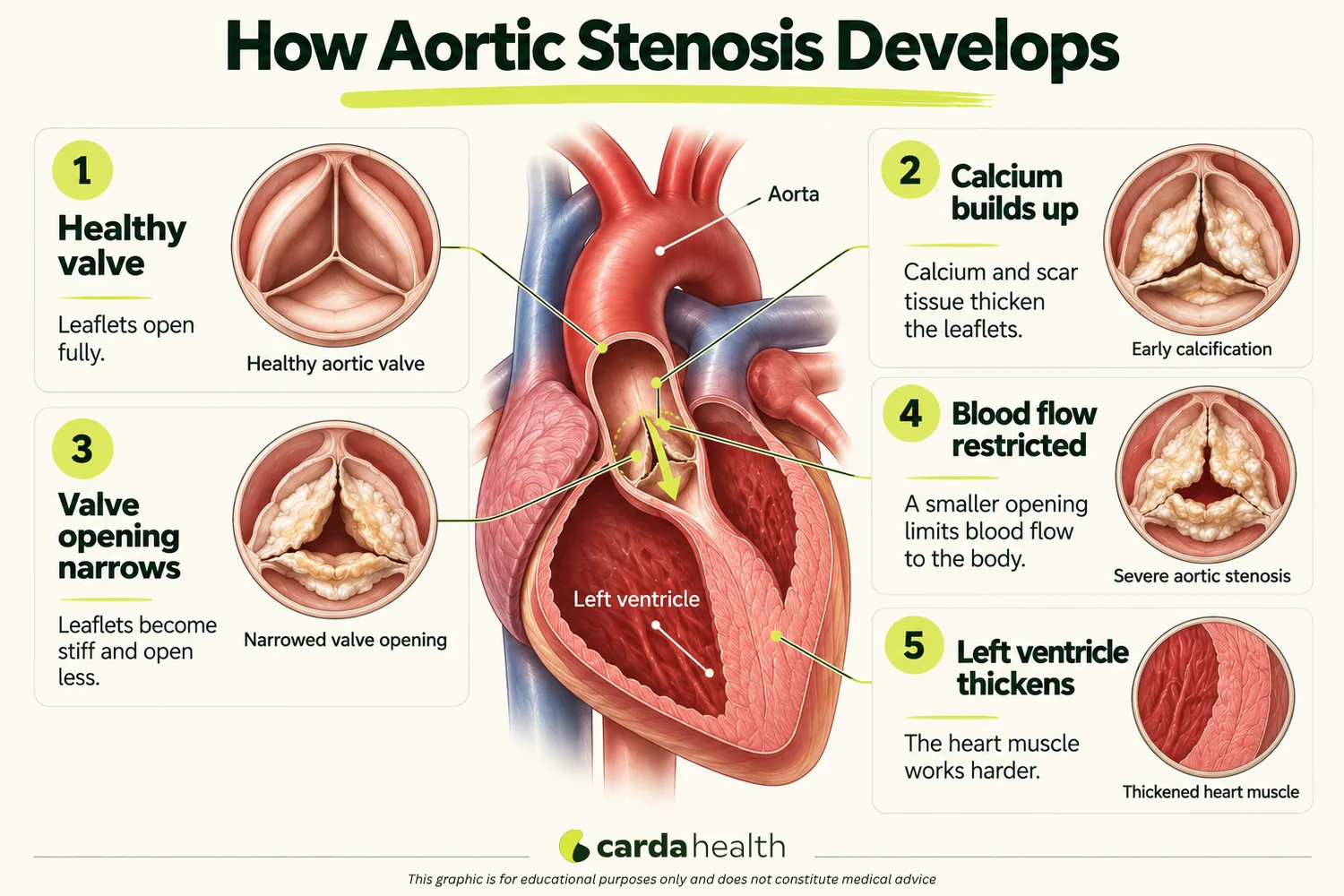
Aortic stenosis is a narrowing of the aortic valve, the one-way door between your heart’s main pumping chamber and the rest of your body. Calcium and scar tissue stiffen the valve leaflets so they no longer open fully, and the heart has to push harder against the obstruction to move the same amount of blood.
Most cases are age-related. The valve collects calcium over decades, and significant narrowing usually appears in the seventies or eighties. It is the most common valve disease in the western world.
Some people start earlier. If you were born with a bicuspid valve, meaning two leaflets rather than the usual three, the valve wears faster and narrowing can become significant in your fifties or sixties.
The heart is good at hiding all this. It thickens its walls to generate more force, and that compensation works for years. It is also why aortic stenosis is usually found through a stethoscope before it is felt by the person who has it.
Symptoms of Aortic Stenosis
The three classic symptoms are breathlessness on exertion, chest pain or tightness, and dizziness or fainting. They tend to appear during activity first, when the heart needs to move more blood than the narrowed valve allows, and only later at rest. Fatigue and a shrinking tolerance for exercise usually arrive before any of them.
When to Get Help Urgently
Some symptoms of aortic stenosis are emergencies and should not wait for your next appointment.
Call 911 if you have chest pain or pressure lasting more than a few minutes, if you faint or lose consciousness, or if you become breathless at rest or cannot lie flat.
Fainting deserves particular attention here. In aortic stenosis it usually signals that the narrowing has become severe, and it carries one of the worst outlooks of any symptom in this condition. It should never be written off as heat, dehydration or standing up too quickly until a cardiologist has ruled out the valve.
The Symptoms People Put Down to Aging
This is the part that costs people time. Slowing down, tiring easily, stopping on a hill, losing interest in activities you used to enjoy. All of it gets read as getting older, and all of it can be the earliest signal that the valve is failing.
Two questions are worth answering honestly. Has anything you could do comfortably a year ago become difficult? And have you started avoiding activity rather than finding it hard?
That second one matters more than it sounds. People with aortic stenosis often shrink their lives to fit the valve without noticing they have done it, then report no symptoms because they no longer do anything that would produce one. It is why cardiologists sometimes use a supervised exercise test in patients who describe themselves as symptom-free, and why bringing a family member to your appointment is genuinely useful. They usually noticed before you did.
The Four Stages of Aortic Stenosis
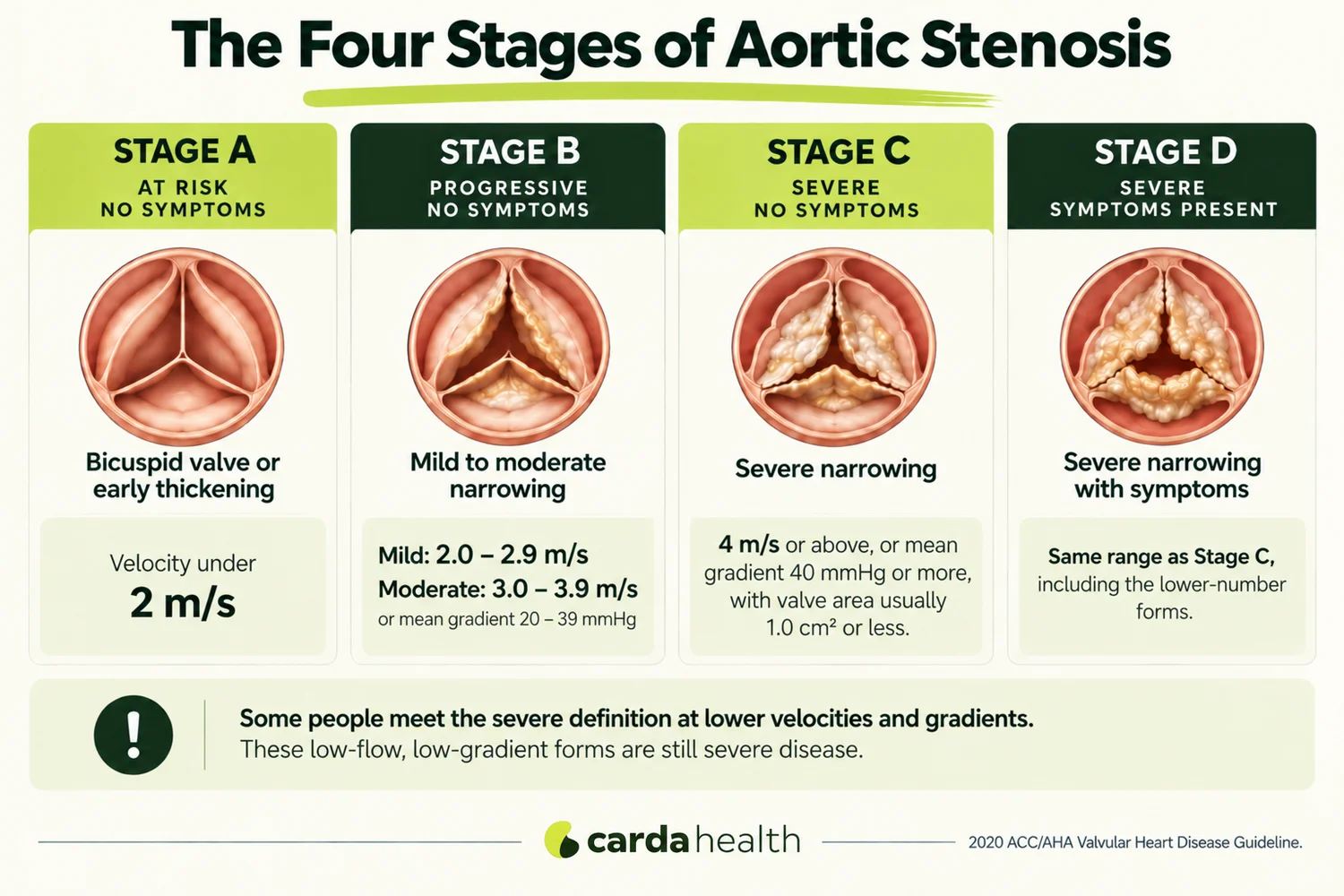
US cardiologists stage aortic stenosis from A to D, following the 2020 ACC/AHA valve guideline. The stage combines what your echocardiogram shows with whether you have symptoms, and together those drive the treatment decision.
| Stage | What It Means | What the Echo Shows | Symptoms |
|---|---|---|---|
| A | At risk | Velocity under 2 m/s. Bicuspid valve or early thickening | None |
| B | Progressive | Mild: 2.0 to 2.9 m/s. Moderate: 3.0 to 3.9 m/s or mean gradient 20 to 39 mmHg | None |
| C | Severe, no symptoms | 4 m/s or above, or mean gradient 40 mmHg or more, with valve area usually 1.0 cm² or less | None |
| D | Severe, with symptoms | Same range as Stage C, or lower numbers in the low-flow forms (see below) | Breathlessness, chest pain, dizziness or fainting |
Severe Does Not Always Mean High Numbers
The velocity and gradient figures above describe the most common form of severe aortic stenosis, but not the only one. Some people have a valve area small enough to count as severe while their velocity and gradient stay below those thresholds. This happens when the heart is not pushing enough blood through to generate a high reading, either because the pumping function has weakened or because the chamber is small and stiff and the stroke volume is low even with a normal ejection fraction. Cardiologists call these low-flow, low-gradient forms, and the ACC/AHA guideline classifies them as severe disease within Stage D, since they come with symptoms.
The practical point for you: if your report says severe aortic stenosis but your numbers are below 4 m/s or 40 mmHg, that is a recognized pattern and not a contradiction. It usually needs extra assessment to confirm, sometimes a stress echocardiogram or a CT calcium score of the valve. Do not conclude from a gradient below 40 that your stenosis is not severe.
Two numbers do most of the work. Velocity is how fast blood is forced through the opening, and gradient is the pressure difference across the valve. Both climb as the opening narrows. Very severe stenosis is defined at 5 m/s or a mean gradient of 60 mmHg.
Now notice what usually separates Stage C from Stage D: nothing on the scan. Same valve, same numbers. The difference is whether you have symptoms, which tells you how much weight that one question carries. Both stages also have sub-categories your cardiologist will use, including whether the pumping function has fallen, so the letter on your report may come with a number after it.
Why Symptoms Change Everything
The natural history of untreated aortic stenosis has been understood since 1968, when Ross and Braunwald published survival data that valve guidelines still cite today. Median survival after symptoms appeared was roughly five years once angina developed, three years after fainting, and two years once breathlessness set in.
Modern data has not softened that picture much. In the PARTNER trial, among 358 patients with severe symptomatic aortic stenosis whom surgeons judged unsuitable for surgery, 50.7% of those on standard therapy had died within one year. Those were the highest-risk patients in the disease, not a general prognosis, but they show what the untreated trajectory looks like at its steepest. Left untreated, the outlook is poor, and this is one of the few conditions in cardiology where a single procedure changes that decisively.
The reason is mechanical. For years the thickened left ventricle absorbs the extra work. Symptoms mark the point where it can no longer keep up, and the decline that follows tends to be steep rather than gradual.
Which is why the goal is to replace the valve before that decline sets in. Symptoms are the most common trigger, and replacement is usually arranged promptly once they appear, but some patients qualify earlier, as covered below.
Is There a Medication for Aortic Stenosis?
No. There is no drug that opens a narrowed aortic valve or halts the calcification behind it.
This surprises people, and it disappoints them, because the process looks so much like coronary artery disease that a statin ought to help. Three randomized placebo-controlled trials (SEAS, SALTIRE, ASTRONOMER) tested exactly that, mostly in mild to moderate aortic stenosis. None of them showed a benefit.
Medication still has a job. Blood pressure control, treating coexisting coronary disease and managing heart failure symptoms all matter, and your cardiologist will keep you on those. They manage the consequences of the narrowing. They do not treat the valve.
When Does Aortic Stenosis Need Replacing?
If You Have Symptoms
Severe stenosis with symptoms is Stage D, and US guidelines give valve replacement their strongest recommendation there. No monitoring strategy outperforms it, so replacement is not usually deferred once symptoms appear.
That recommendation assumes the patient is a suitable candidate. A heart valve team weighs surgical and procedural risk, frailty, other serious illness, expected benefit and your own wishes, and for a minority of patients the conclusion is that replacement would not help. That assessment is part of the decision, not a delay in it.
Replacement is also recommended in severe stenosis without symptoms when the left ventricle has begun to weaken, meaning an ejection fraction below 50%, or when you are already scheduled for heart surgery for another reason.
If You Do Not Have Symptoms Yet
This is where the field is actively moving, and where US and European guidance currently part ways.
Traditionally, severe stenosis without symptoms was watched: an echocardiogram roughly every six months, and prompt reporting of any change. Current US guidelines already make exceptions for patients at low procedural risk, considering replacement reasonable when the narrowing is very severe (a velocity of 5 m/s or more), an exercise test shows reduced tolerance or a drop in blood pressure, the blood marker BNP is more than three times normal, or the velocity is rising by 0.3 m/s or more per year. Four randomized trials have now tested treating earlier instead: AVATAR, RECOVERY, EVOLVED and EARLY TAVR. EARLY TAVR randomized 901 patients and found that early intervention halved the combined rate of death, stroke and unplanned cardiovascular hospitalization.
On that evidence, the 2025 European guidelines added a recommendation to consider early intervention in carefully selected patients with genuinely no symptoms and low procedural risk. They also lowered the age threshold for a catheter-based valve from 75 to 70.
The caveat matters. A meta-analysis of all four trials, covering 1,427 patients over an average of 4.1 years, found early replacement reduced unplanned cardiovascular or heart failure hospitalization (14.6% against 31.9%, HR 0.40) and stroke (4.5% against 7.2%, HR 0.62). It found no significant difference in all-cause mortality (9.7% against 13.7%, HR 0.68, P=0.17) or cardiovascular mortality (5.1% against 8.3%, HR 0.67, P=0.23). US guidelines have not made the same change, although in 2025 the FDA approved TAVR for severe aortic stenosis without symptoms, based on EARLY TAVR. If you are in this position, treat it as a real discussion with your heart valve team rather than a settled answer.
TAVR or Open-Heart Surgery?
Both replace the valve. They differ in how it gets there.
| TAVR | Open Surgery (SAVR) | |
|---|---|---|
| How it is done | A new valve is threaded up through an artery, usually in the groin, and seated inside the old one | The chest is opened, the heart is stopped, and the old valve is removed |
| Hospital stay | Often 1 to 2 days | Around 5 to 7 days |
| Recovery | Days to a few weeks | Six to eight weeks |
| Generally favored | Older age, higher surgical risk | Younger age, long life expectancy |
Choosing between them is not a matter of preference. A heart valve team weighs your age, surgical risk, valve anatomy, whether other heart problems need fixing at the same time, and how long the replacement has to last. Under current US guidelines, surgery is generally preferred below 65 with a long life expectancy, a catheter valve is generally preferred above 80 or where life expectancy is under ten years, and between those ages it is a genuine shared decision. Durability is part of that calculation: a younger patient may outlive a transcatheter valve and need a second procedure. Our guide to open heart surgery recovery covers what the surgical route involves.
What Happens After the Valve Is Replaced
Symptoms usually improve quickly. Many people notice breathlessness easing within weeks, and the thickened ventricle gradually remodels once the obstruction is gone.
What often does not happen is rehabilitation. Cardiac rehab is recommended after valve repair or replacement and is covered by Medicare, yet a registry study of more than 3,300 TAVR patients across 24 hospitals found only 30.6% started a program within 90 days of discharge. That is a wide gap for a group who are typically older, deconditioned by months of quietly avoiding activity, and among the most likely to benefit from supervised reconditioning. The benefits of cardiac rehabilitation are well established, and Carda delivers virtual cardiac rehab with live supervision and real-time monitoring from home.
For the week-by-week picture of what recovery looks like, our guide to heart valve replacement recovery walks through the timeline, the fatigue, and the warning signs worth calling about.
The Bottom Line
Aortic stenosis is one of the few serious heart conditions with a definitive fix. It is also one where waiting costs more than almost anywhere else in cardiology.
If you have severe stenosis, replacement is usually the direction of travel, and the timing is driven largely by symptoms you may already have talked yourself out of noticing. Whether replacement is right for you is a judgment your heart valve team makes, weighing procedural risk, frailty, other conditions and what you want. Say your symptoms out loud at your next appointment, including the ones you have been blaming on your age.
{{get-started}}
Frequently Asked Questions
How long can you live with aortic stenosis?
It depends almost entirely on severity and whether you have symptoms. Mild and moderate stenosis is usually monitored rather than treated, but moderate stenosis is not harmless. In a 2022 study of more than 248,000 patients, it was associated with a higher risk of death than no stenosis at all. How long monitoring remains the right approach depends on how fast the valve narrows and how well the heart is pumping. Severe stenosis with symptoms is different: historical natural-history data put average survival without treatment at two to five years depending on the symptom, and in the highest-risk group, patients unsuitable for surgery, one-year mortality without replacement exceeded 50% in the PARTNER trial. Valve replacement changes that outlook substantially, which is why it is not usually deferred once symptoms appear.
Can aortic stenosis be reversed or slowed with diet?
No. No diet, supplement or medication has been shown to reverse aortic stenosis or slow its progression, including statins, which were tested in three randomized trials without benefit. Healthy eating and blood pressure control remain worthwhile for your heart generally, but they will not change what is happening at the valve.
Is aortic stenosis the same as a heart murmur?
Not quite. A murmur is a sound, not a diagnosis. It is the noise turbulent blood makes crossing an abnormal valve, and aortic stenosis is one of several conditions that produce one. Many murmurs are harmless. Confirming what is behind a murmur takes an echocardiogram, which is an ultrasound of the heart and is painless.
How fast does aortic stenosis progress?
The rate varies widely between individuals, which is why follow-up is scheduled rather than left open. Severe stenosis without symptoms is generally reviewed at least every six months so that any change is caught early. Progression tends to be faster in people with heavily calcified valves and in those whose valve velocity is already high.
Can you exercise with aortic stenosis?
This is a question for your cardiologist rather than a general answer, because it turns entirely on severity. Mild to moderate stenosis usually permits normal activity. In severe aortic stenosis, strenuous or competitive exertion is generally advised against, and exercise testing is contraindicated once symptoms are present. Supervised cardiac rehabilitation has a well-established role after the valve is replaced. It is not a substitute for replacing it.
What is the difference between aortic stenosis and a leaky valve?
They are opposite mechanical problems. In stenosis the valve does not open fully, so blood struggles to get out. In a leaky valve, also called regurgitation, the valve does not close fully, so blood flows backwards. Both overwork the heart, but they progress differently and are treated on different timelines. Our guide to leaky heart valves covers the other side.
References
- 2020 ACC/AHA Guideline for the Management of Patients With Valvular Heart Disease. Circulation. doi:10.1161/CIR.0000000000000923
- 2025 ESC/EACTS Guidelines for the management of valvular heart disease. European Society of Cardiology and European Association for Cardio-Thoracic Surgery, 2025.
- Ross J, Braunwald E. Aortic stenosis. Circulation. 1968;38(1 Suppl):61–67. doi:10.1161/01.CIR.38.1S5.V-61
- EARLY TAVR. Transcatheter aortic-valve replacement for asymptomatic severe aortic stenosis. New England Journal of Medicine. 2024.
- Predictors and Variation in Cardiac Rehabilitation Participation After Transcatheter Aortic Valve Replacement. JACC: Advances. 2023. doi:10.1016/j.jacadv.2023.100581
- Sawaya F, Liff D, Stewart J, Lerakis S, Babaliaros V. Aortic Stenosis: A Contemporary Review. Am J Med Sci. 2012;343(6):490–496. doi:10.1097/MAJ.0b013e3182539d70. Cardiology Grand Rounds from Emory University.
- Mayo Clinic. Aortic valve stenosis: symptoms and causes.
- Leon MB, Smith CR, Mack M, et al. Transcatheter aortic-valve implantation for aortic stenosis in patients who cannot undergo surgery. N Engl J Med. 2010;363(17):1597–1607. doi:10.1056/NEJMoa1008232
- Généreux P, Banovic M, Kang DH, et al. Aortic Valve Replacement vs Clinical Surveillance in Asymptomatic Severe Aortic Stenosis: A Systematic Review and Meta-Analysis. J Am Coll Cardiol. 2025;85(9):912–922. doi:10.1016/j.jacc.2024.11.006
- American College of Cardiology. FDA Update: Agency Approves TAVR Valves for Asymptomatic Severe AS. May 2025.
- Strom JB, Playford D, Stewart S, et al. Increasing risk of mortality across the spectrum of aortic stenosis is independent of comorbidity & treatment: An international, parallel cohort study of 248,464 patients. PLoS One. 2022;17(7):e0268580.