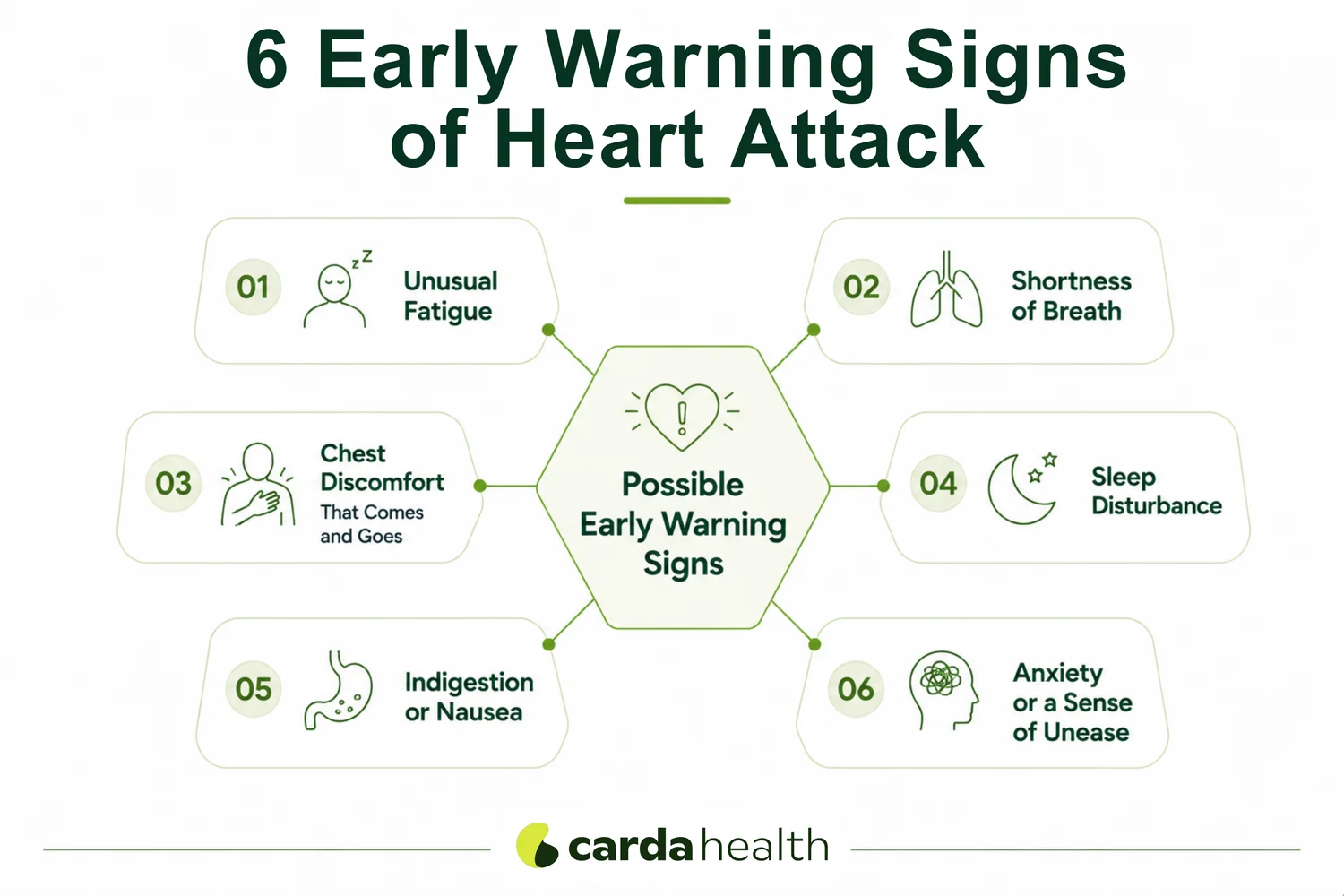
Key Takeaways: Heart attacks often give quiet, early warning signs in the weeks before they happen, called prodromal symptoms. The six most common are unusual fatigue, shortness of breath, chest discomfort that comes and goes, sleep problems, indigestion or nausea, and a sense of anxiety or unease. These signs are easy to dismiss, and they are especially common and easy to miss in women. Important: these symptoms are nonspecific and have many harmless causes, so they are a reason to see your doctor soon, not to panic or self-diagnose. And if you have signs of a heart attack happening now, such as lasting chest pain, call 911 immediately.
Heart attacks do not always strike out of the blue. For many people, the body sends subtle signals in the weeks or even the month beforehand, quiet warnings that are easy to brush off as stress, aging, or being out of shape. Learning to recognize these early signs can make a real difference. Just as importantly, this article will help you tell an early warning that calls for a doctor’s visit from an emergency that calls for 911.
Can a Heart Attack Really Give Warning a Month Ahead?
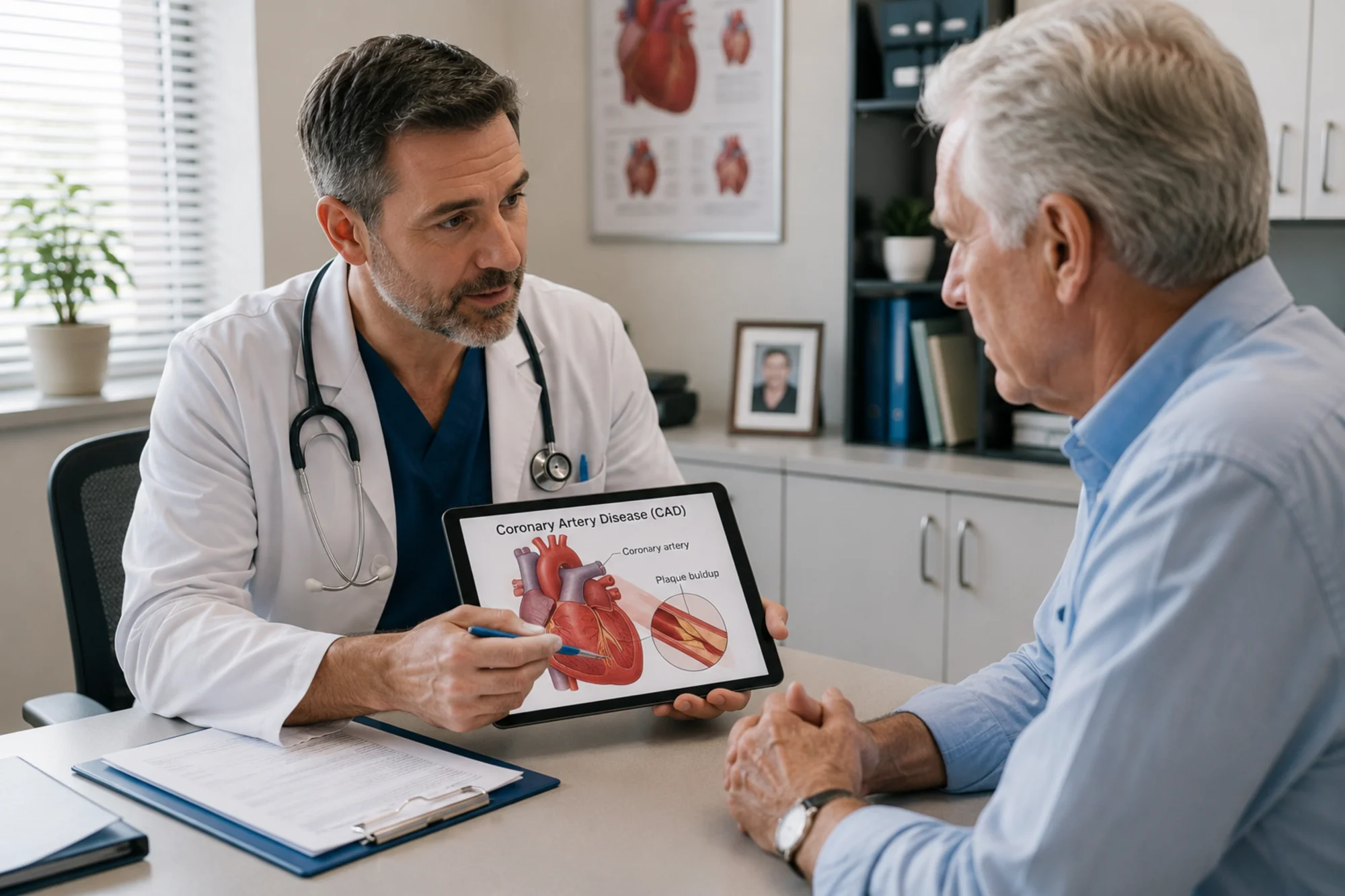
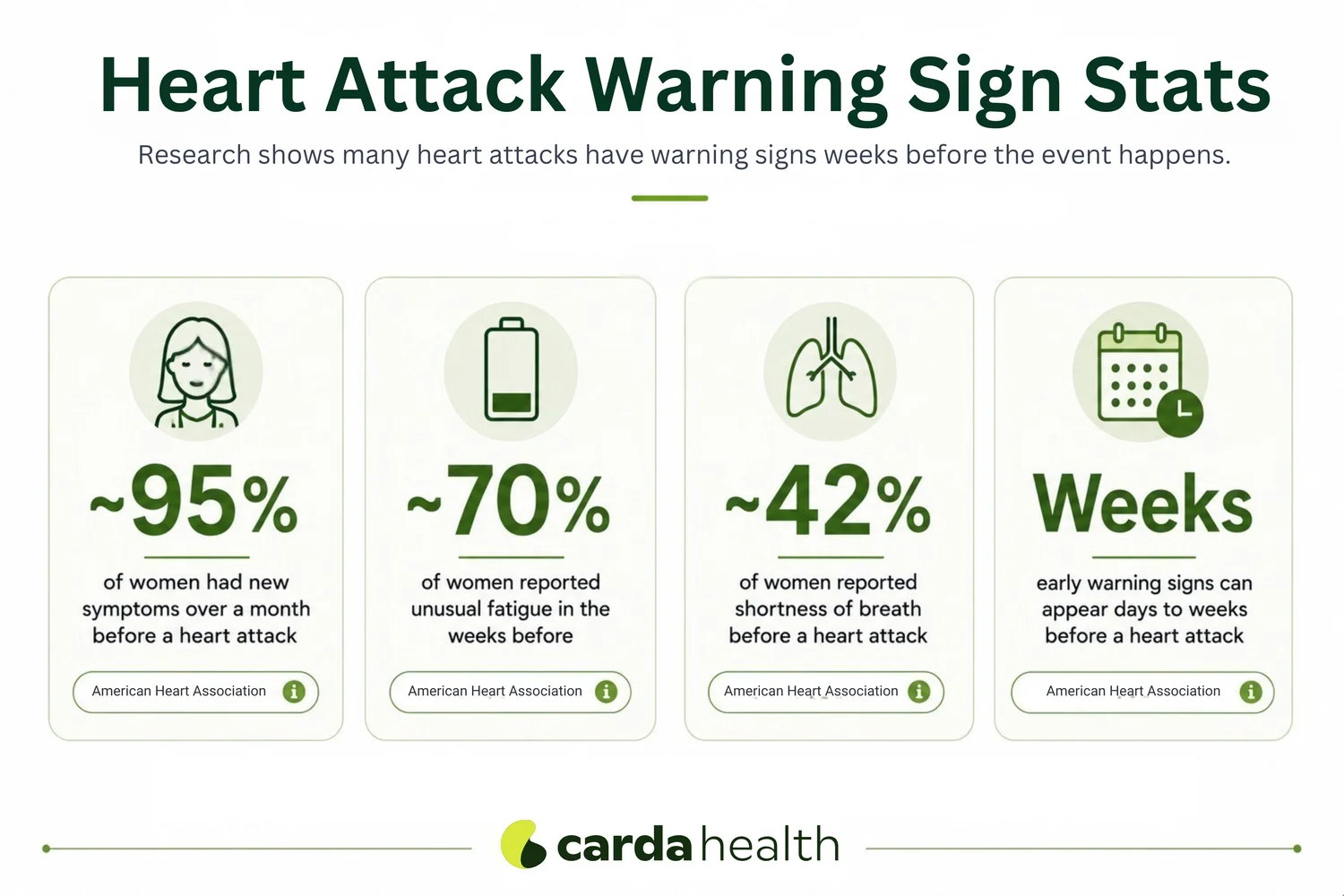
Yes, often it can. Doctors call these early signals prodromal symptoms, from a Greek word meaning “running before.” They are the body’s response to a heart whose blood supply is gradually becoming restricted, usually by narrowing arteries. In a landmark study of women who had heart attacks, published in the journal Circulation, about 95 percent reported new or unusual symptoms more than a month before their heart attack. This underlying narrowing is part of coronary artery disease, the most common form of heart disease.
One honest caveat matters here. These symptoms are nonspecific: fatigue, poor sleep, and indigestion have many ordinary, harmless causes and usually are not about your heart. So the goal is not to panic over every tired day, but to notice when these signs are new, unexplained, or clustering together, and to get them checked. Think of the six below as reasons to talk to a doctor, not a way to diagnose yourself.
The 6 Early Warning Signs to Know
1. Unusual Fatigue
This is the most commonly reported early sign, especially in women. In the Circulation study, about 70 percent of women reported unusual, unexplained fatigue in the weeks before their heart attack. This is not ordinary tiredness but a deep exhaustion that can make everyday tasks feel draining and does not improve much with rest.
2. Shortness of Breath
Feeling winded by activities that never bothered you before, like climbing a short flight of stairs, is a notable warning sign, reported by roughly 42 percent of women in the same study. Breathlessness can occur with little or no exertion, because a struggling heart affects how efficiently your body moves oxygen.
3. Chest Discomfort That Comes and Goes
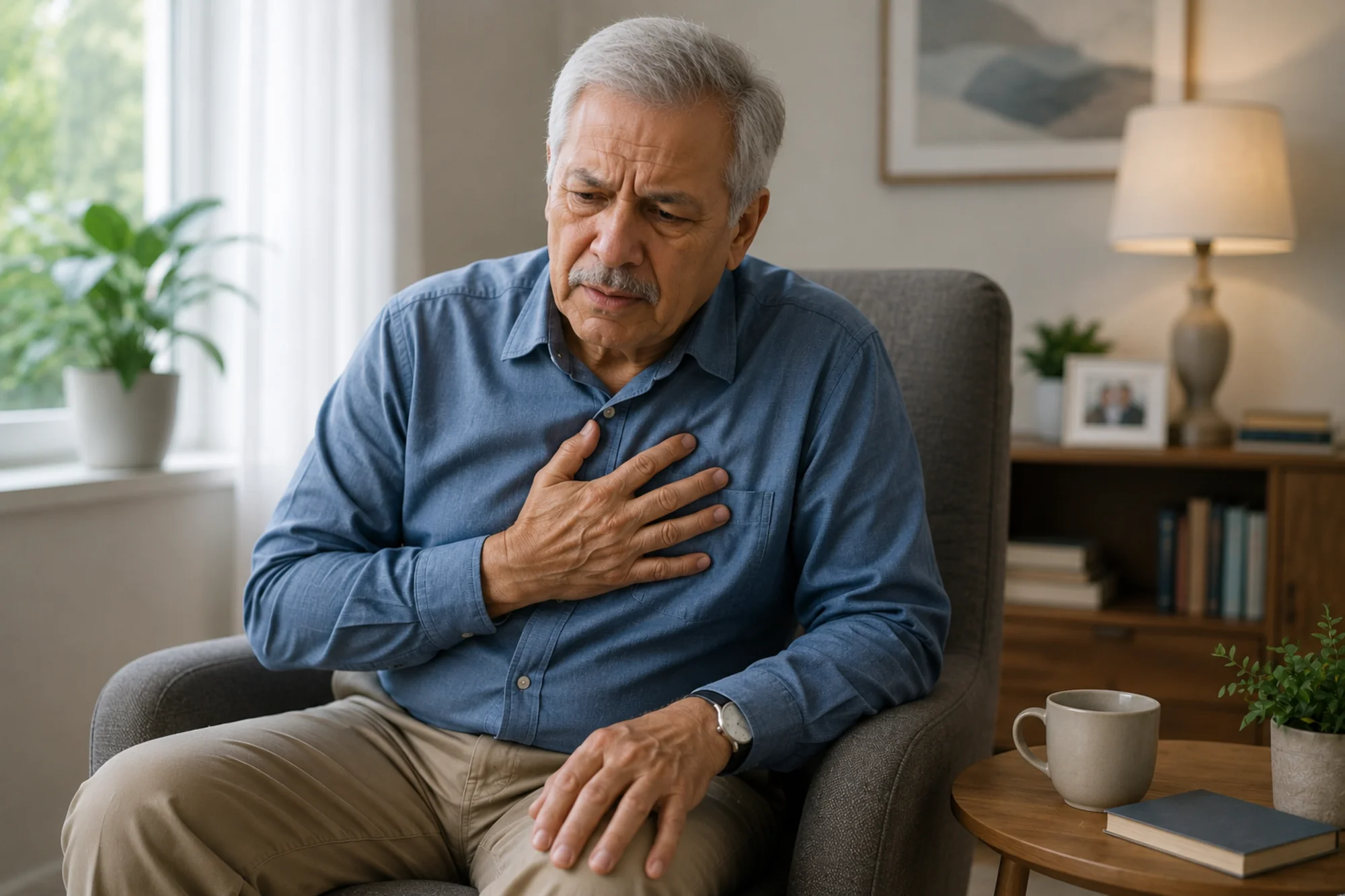
Early chest symptoms are often not the dramatic pain shown in movies. People describe aching, tightness, pressure, or fullness that comes and goes rather than staying constant, sometimes spreading to the arm, neck, jaw, or back. Any chest discomfort that recurs deserves prompt medical attention.
4. Sleep Disturbance
Trouble falling asleep, staying asleep, or waking unrefreshed was reported by nearly half of women before their heart attacks. New or worsening sleep problems, particularly alongside other symptoms on this list, are worth mentioning to your doctor.
5. Indigestion or Nausea
Because the heart sits near the stomach and shares nerve pathways, heart-related symptoms are often mistaken for digestive upset. Unexplained indigestion, nausea, or a queasy stomach that is new for you, and not clearly tied to a meal, can occasionally be a cardiac warning sign.
6. Anxiety or a Sense of Unease
Some people describe a growing feeling of anxiety or even a vague sense of impending doom in the period before a heart attack. While anxiety usually has other causes, a new and unexplained sense of unease, especially with other symptoms here, should not be dismissed. Our guide to anxiety and the heart explores this connection further.
Why Women Often Get Different Warning Signs
One of the most important findings here is that women frequently do not get the “classic” chest pain. In the Circulation study, only about 30 percent of women reported any chest discomfort before their heart attack, while fatigue, sleep problems, and shortness of breath were far more common. This is a big reason women’s heart attacks are more often missed or dismissed. If you are a woman noticing these subtle signs, take them seriously and be direct with your doctor about your concern for your heart. Chest pain is still the most common single symptom overall in both sexes, but its absence does not rule out a problem.
Early Warning Signs vs. a Heart Attack Happening Now
This distinction is the most important thing on this page. Early warning signs unfold over days and weeks and call for a prompt but non-emergency doctor visit. The symptoms of a heart attack in progress come on strongly and call for 911, immediately.
| Early warning signs (see a doctor soon) | A heart attack now (call 911) |
|---|---|
| Develop gradually over days or weeks | Come on suddenly and intensely |
| Unusual fatigue, poor sleep, mild breathlessness | Severe or lasting chest pain, pressure, or squeezing |
| Chest discomfort that comes and goes | Pain spreading to the arm, jaw, neck, or back |
| Vague indigestion, nausea, or unease | Cold sweat, nausea, lightheadedness, or fainting |
| Come and go, often mild | Shortness of breath at rest; a feeling something is very wrong |
Call 911 now if you have chest pain or pressure that lasts more than a few minutes or goes away and comes back, especially with shortness of breath, cold sweat, nausea, or pain spreading to the arm, jaw, or back. Do not drive yourself. Do not wait to see if it passes. Fast treatment saves heart muscle and lives.
What to Do If You Notice These Signs
If you notice several of these signs, or one that is new and persistent, do not wait and do not try to diagnose yourself. Make an appointment soon and say plainly that you are concerned about your heart. An evaluation can include a review of your risk factors, blood pressure and cholesterol checks, an electrocardiogram, and sometimes a stress test or imaging. The value of catching this early is real: identifying restricted blood flow before a heart attack can allow treatment that may prevent the event altogether. Being cautious here is never an overreaction.
Turning a Warning Into Prevention
Early warning signs are, in a sense, an opportunity: a prompt to address the heart disease underneath before it does lasting harm. That means working with your care team on the fundamentals: blood pressure, cholesterol, blood sugar, not smoking, activity, and weight. For people with coronary artery disease or a prior cardiac event, cardiac rehabilitation is one of the most effective ways to strengthen the heart and lower the risk of a future attack. Carda Health delivers supervised cardiac rehab from home, and if you have been diagnosed with heart disease, it is worth checking whether you qualify. If you are recovering from a heart attack, our guide to what happens after a heart attack can help.
The Bottom Line
Your body often whispers before it shouts. Unusual fatigue, breathlessness, on-and-off chest discomfort, sleep trouble, indigestion, and a sense of unease can all be early warnings of a heart attack, particularly in women, and they deserve a prompt conversation with your doctor rather than wait-and-see. Remember the two speeds: early signs mean see a doctor soon; the symptoms of a heart attack in progress mean call 911 now. Listening to these signals, and acting on them, is one of the most powerful things you can do for your heart.
{{get-started}}
Frequently Asked Questions
Can a heart attack give warning signs a month before?
Often, yes. Many people experience prodromal symptoms, subtle warning signs, in the weeks before a heart attack. In one major study, about 95 percent of women reported new or unusual symptoms more than a month beforehand. These signs are nonspecific, though, so they warrant a doctor visit rather than self-diagnosis.
What are the most common early warning signs?
Unusual fatigue, shortness of breath, chest discomfort that comes and goes, sleep disturbance, indigestion or nausea, and a sense of anxiety or unease. Fatigue is the single most commonly reported early sign, especially in women.
Are heart attack warning signs different in women?
Often, yes. Women are less likely to have classic chest pain beforehand. In the Circulation study, only about 30 percent of women reported chest discomfort before their heart attack, while fatigue, sleep problems, and shortness of breath were far more common. This is why women’s warning signs are more often missed.
Is unusual fatigue really a sign of a heart attack?
It can be, though fatigue has many harmless causes. What makes it concerning is when it is new, unexplained, severe enough to interfere with daily life, and especially when it occurs with other signs on this list. In that case, see your doctor.
How do I know if it is an early warning or a heart attack happening now?
Early warning signs develop gradually over days or weeks and are often mild. A heart attack in progress comes on strongly, with lasting chest pain or pressure, pain spreading to the arm or jaw, cold sweat, or severe shortness of breath. Early signs mean see a doctor soon; an active heart attack means call 911 immediately.
Can catching the signs early prevent a heart attack?
Sometimes, yes. Identifying restricted blood flow before a heart attack can allow treatment, such as lifestyle changes, medication, or a procedure, that may prevent or delay the event. That is exactly why acting on early warning signs matters.
References
- McSweeney JC, Cody M, O’Sullivan P, et al. Women’s Early Warning Symptoms of Acute Myocardial Infarction. Circulation. 2003;108(21):2619–2623.
- O’Keefe-McCarthy S, Ready L. Impact of Prodromal Symptoms on Future Adverse Cardiac-Related Events: A Systematic Review. J Cardiovasc Nurs. 2016. (PubMed)
- Geisinger. Early warning signs of a heart attack the month before.
- Ochsner Health. Warning Signs of a Heart Attack from Your Body a Month Before.
- Healthline. Symptoms You Might Experience 1 Month Before a Heart Attack.