

Key Takeaways
An enlarged heart is a finding, not a diagnosis. Cardiomegaly is the word radiologists use when your heart looks bigger than expected on a scan. On a standard PA chest X-ray, taken standing with the beam passing from back to front, it usually means the heart's width is at least 50% of the width of your chest. It is always caused by something else, most often coronary artery disease, long-standing high blood pressure, a heart valve problem, or a cardiomyopathy.
The heart gets bigger in one of two ways: the chambers stretch, or the walls thicken. Many people have no symptoms at all. When symptoms do appear, they are usually breathlessness, swelling in the legs or ankles, fatigue, and palpitations.
Whether your heart can shrink back depends on the cause. Enlargement driven by high blood pressure, a valve problem, thyroid disease, heavy alcohol use, or myocarditis can improve, sometimes substantially, once the cause is treated, though recovery is not guaranteed. Enlargement from scarring after a large heart attack usually does not fully reverse, but how well the heart pumps can still improve. There is no single life expectancy for cardiomegaly, because the outlook belongs to the underlying condition, not to the size of the heart.
Someone has told you your heart is enlarged. Perhaps it turned up on a chest X-ray you had for something else entirely, which is how a lot of people find out. It is a frightening phrase, and the internet does not help.
Here is the thing worth understanding first. An enlarged heart, or cardiomegaly, is not a disease. It is a description of what your heart looks like on a scan, and it is your heart's response to something else that is going on. Which means the important question is not how big your heart is. It is why.
What Is an Enlarged Heart?
Cardiomegaly means your heart is larger than expected for your body. On a standard PA chest X-ray, the type taken standing up with the X-ray beam passing from your back to your front, radiologists usually call it cardiomegaly when the widest part of the heart shadow measures 50% or more of the widest part of your chest, a measurement called the cardiothoracic ratio. Below 50% is considered normal.
The projection matters more than most people realize. If the film was taken the other way around, with the beam passing front to back while you were lying down or sitting up in a hospital bed, your heart sits further from the plate and is magnified on the image. A portable bedside film can make a normal heart look enlarged, and the 50% threshold does not reliably apply to it. A shallow breath or fluid around the heart can widen the shadow too. This is exactly why a doctor who spots cardiomegaly on an X-ray will nearly always order an echocardiogram, an ultrasound of the heart, to find out what is actually enlarged and how well it is pumping.
The Two Ways a Heart Gets Bigger
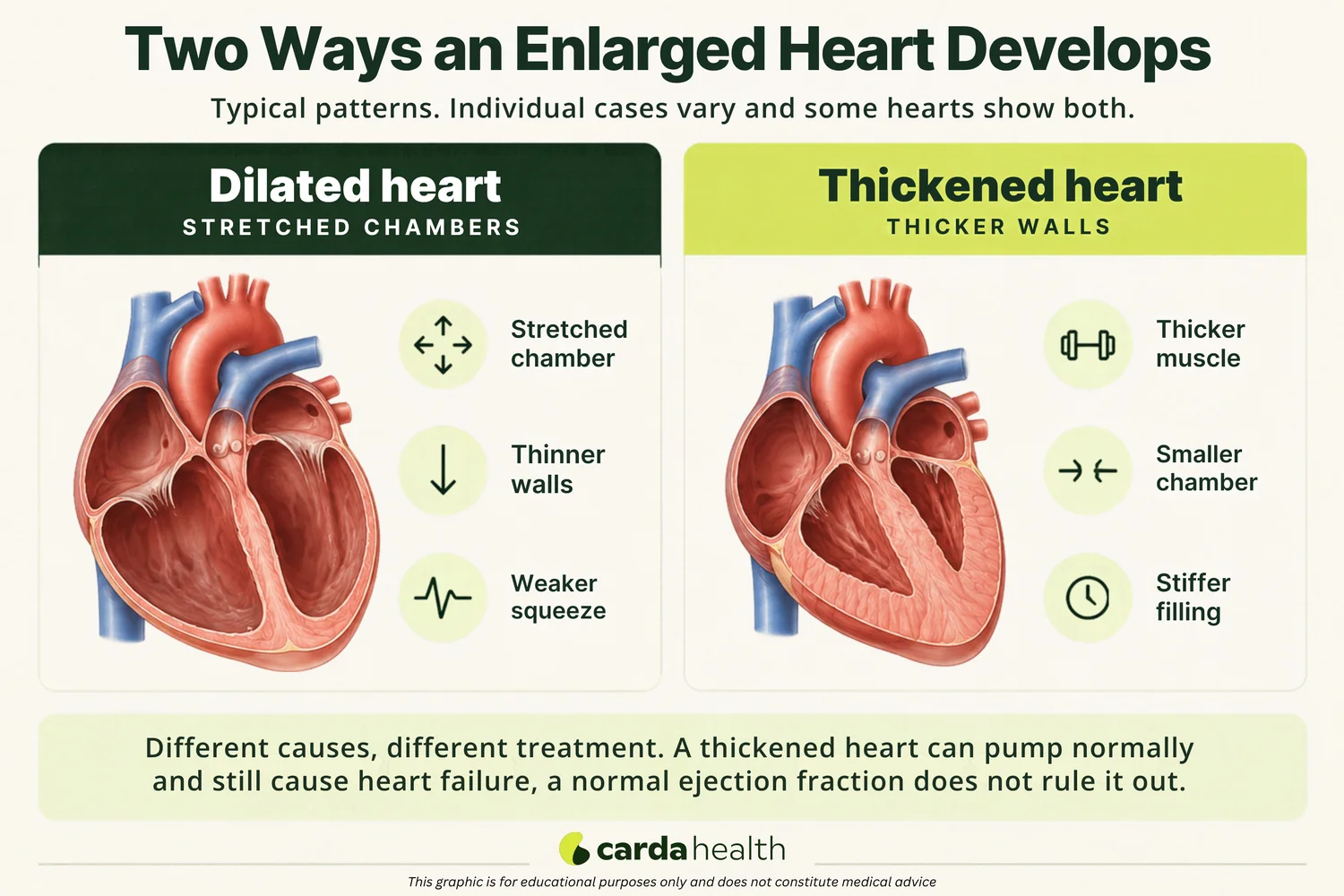
Hearts enlarge along one of two paths, and the difference matters because they are caused by different things and treated differently.
| Stretched (dilated) | Thickened (hypertrophy) | |
|---|---|---|
| What happens | The chamber walls stretch and the cavity gets wider | The muscle wall grows thicker and the cavity often gets smaller |
| Usual trigger | The heart is handling too much volume or the muscle has been weakened | The heart is pumping against too much resistance, usually high blood pressure |
| Typical cause | Dilated cardiomyopathy, a previous heart attack, leaking valves | Long-standing hypertension, a narrowed aortic valve, hypertrophic cardiomyopathy |
| Main effect | The heart squeezes less forcefully | The heart is stiff and fills less easily |
The thickening pattern in the main pumping chamber has its own name and its own workup. If that is what your scan showed, our guide to left ventricular hypertrophy goes into it in detail.
One more distinction worth knowing, because it trips people up. Endurance athletes often have larger hearts, and in their case it is a normal, healthy adaptation to training rather than a disease. It typically regresses when they stop training hard, as studies of athletes who fully detrained have shown. Athlete's heart and pathological enlargement can look similar on a first scan, a well-recognized diagnostic challenge, which is one reason cardiologists ask about your exercise history.
What Causes an Enlarged Heart?
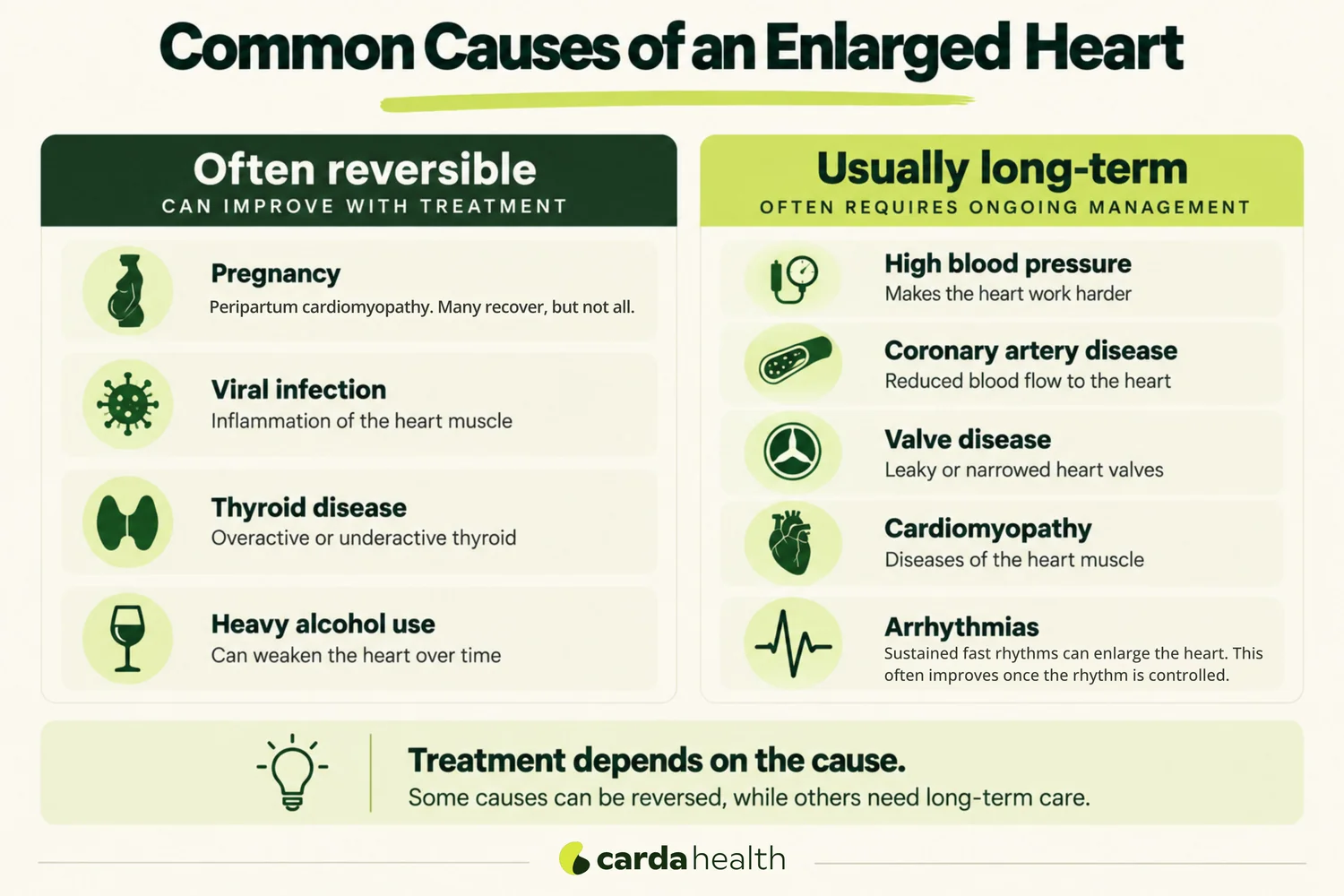
Anything that makes the heart work harder for long enough can enlarge it. According to the Cleveland Clinic, the single most common cause is coronary artery disease, where narrowed arteries starve the heart muscle of blood. The other frequent causes are worth listing plainly.
- Coronary artery disease and previous heart attacks. Damaged muscle stretches and the chamber widens. More on coronary artery disease and how it is managed.
- High blood pressure. The heart pushes against higher pressure with every beat, and the muscle thickens in response. Years of untreated hypertension is one of the most common routes to an enlarged heart.
- Heart valve disease. A leaking or narrowed valve forces the heart to move the same blood repeatedly or to push through a tight opening.
- Cardiomyopathy. A disease of the heart muscle itself, sometimes inherited, sometimes with no identifiable cause.
- Arrhythmias. A persistently irregular or fast rhythm, most often atrial fibrillation, can enlarge the chambers over time.
- Potentially reversible causes. A viral infection of the heart muscle, thyroid disease, severe anemia, and heavy alcohol use can all enlarge a heart. So can peripartum cardiomyopathy, a distinct condition that weakens the heart muscle late in pregnancy or in the months after delivery. That is not the same as the mild, temporary enlargement that is a normal part of any pregnancy and settles on its own. These carry the best chance of improvement once treated, though recovery is neither automatic nor guaranteed.
Kidney failure, some lung diseases, and a build-up of fluid in the sac around the heart can also make the heart appear enlarged. So the honest answer to what caused yours is that it depends, and finding out is the whole point of the tests that follow.
Symptoms of an Enlarged Heart
Many people have no symptoms at all, which is why cardiomegaly is so often discovered by accident on a scan ordered for something else. When symptoms do appear, they are the symptoms of the heart struggling to keep up. The most common are:
- Shortness of breath. Especially on exertion or when lying flat.
- Swelling. In the legs, ankles, or abdomen, from fluid building up.
- Unusual fatigue. Tiring more easily than usual, or everyday activity feeling harder than it should.
- Palpitations. A racing, pounding, or irregular heartbeat.
- Dizziness or lightheadedness. Occasionally with fainting, which needs urgent attention.
- Chest discomfort. Pain, pressure, or tightness, especially with exertion.
When to Call 911
Call 911 immediately if you have chest pain or pressure lasting more than a few minutes, severe shortness of breath, fainting, or a racing heartbeat that will not settle. Do not drive yourself and do not wait to see whether it passes. These can signal a heart attack or a dangerous rhythm, and treatment given quickly is what protects heart muscle.
Short of an emergency, symptoms that creep up over days or weeks still need a same-week call to your doctor. Waking breathless at night, needing more pillows than usual, or gaining several pounds in a few days are the classic early signs of fluid building up. Our guide to heart failure symptoms covers what to watch for and when.
How an Enlarged Heart Is Diagnosed
The chest X-ray usually raises the question. The echocardiogram answers it. An echo measures each chamber, shows how thick the walls are, checks the valves, and calculates your ejection fraction, the percentage of blood the left ventricle pushes out with each beat.
Alongside it, expect an ECG to look at the rhythm and for signs of previous damage, blood tests including markers of heart strain, and often a cardiac MRI if the picture is unclear or a specific cardiomyopathy is suspected. A stress test may follow if coronary disease is a possibility, and genetic testing if there is a family history.
Ask for the ejection fraction number and write it down. It is a useful figure to track over time, and it tells you and your care team more than the size measurement does. It is not the whole picture, though. Ask about your diastolic function too, meaning how well the heart relaxes and fills, because a heart can have a perfectly normal ejection fraction and still be failing.
Can an Enlarged Heart Go Back to Normal?
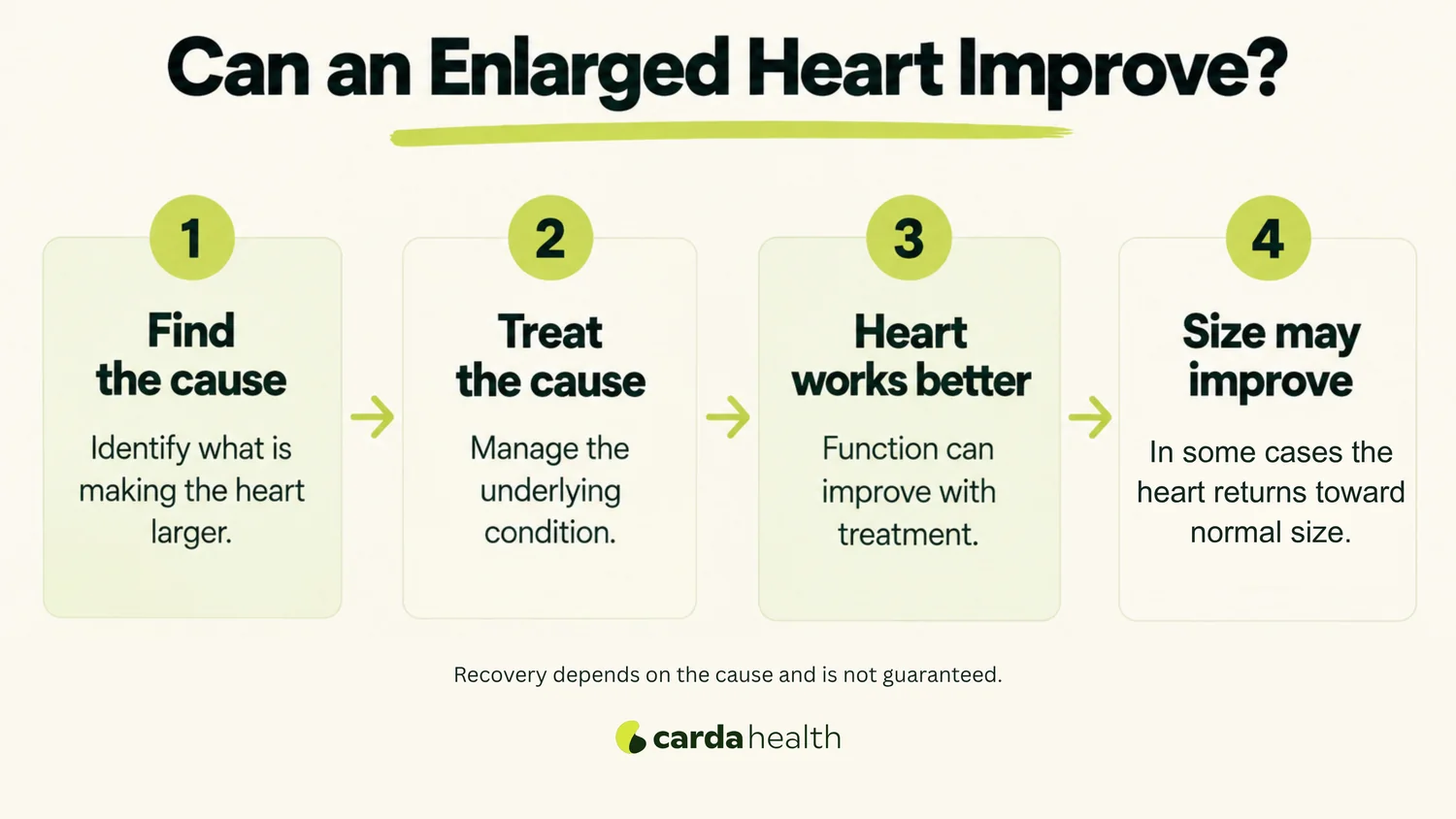
Sometimes, yes. Cardiologists call it reverse remodeling, and it is a well-documented response to treating the cause. Blood-pressure control can reduce a thickened wall. Repairing a leaking valve can let a stretched chamber recover. Hearts enlarged by pregnancy, a viral myocarditis, an overactive thyroid, or heavy drinking can improve once the trigger is removed and treated.
How likely is that? Less certain than most articles imply, and the honest numbers are worth having. The ESC EORP Peripartum Cardiomyopathy Registry enrolled 752 women across 51 countries and had six-month echocardiograms for 465 of them. Of those 465, 216, or 46.5%, had recovered pumping function, which the study defined as an ejection fraction of 50% or more. That is a measure of how well the heart pumps, not of whether it returned to its original size. The other 53.5% had not recovered by six months, though some continue to improve after that point. Alcohol-related enlargement depends heavily on stopping drinking completely and on how much damage was already done. Recovery from myocarditis varies with how severely the muscle was affected. So these causes carry the best odds, not a promise.
Where the enlargement follows permanent muscle damage, such as scarring from a large heart attack, the size usually will not fully return. That is worth saying plainly. But size is not the goal in itself, and this is the part most articles get wrong. What changes your outlook is how well the heart pumps and how well the underlying condition is controlled, and both of those can improve substantially even when the measurements on the scan do not go all the way back.
Modern heart failure medication, taken consistently, often produces this kind of improvement, a well-documented effect of treatment. Our guide to whether heart failure can be reversed sets out realistically what treatment can and cannot undo.
Enlarged Heart Life Expectancy: What the Numbers Actually Say
There is no life expectancy for cardiomegaly, and any figure presented as one is misleading. An enlarged heart is a finding shared by dozens of conditions with wildly different outlooks, so the prognosis belongs to the cause.
What is measurable is the outlook for the conditions that most often produce it. Heart failure, the most common context, has historically carried mortality of around 30% at one year and 50% at five years, figures reported in StatPearls. The same review reports that almost half of patients with dilated cardiomyopathy die within five years. Hypertrophic cardiomyopathy sits at the other end, with annual mortality of roughly 1 to 4% in older studies and outcomes that have improved considerably over the past two decades.
Two things about those numbers. They are averages across large groups, so they say almost nothing about any individual, and they lag behind current treatment. Heart failure care has changed considerably in the last decade, and outcomes for people who take their medication, attend follow-up, and complete a rehab program consistently look better than the historical averages suggest.
The variable you control most is what happens next. Which stage you are at also matters, and our breakdown of the four stages of congestive heart failure explains where treatment changes the trajectory most.
Treatment and Living Well With an Enlarged Heart
Treatment targets the cause, not the size. Expect some combination of medication, lifestyle change, and, where there is a mechanical problem, a procedure.
Medication usually includes drugs that lower blood pressure and reduce the heart's workload, diuretics to clear fluid, and rhythm or clotting medicines where relevant. Procedures range from valve repair or replacement to stenting, bypass surgery, a pacemaker, or an implantable defibrillator. Diet does real work here too, particularly sodium and fluid: our heart failure diet guide covers the practical version.
Why Exercise Helps, and How to Start Safely
The instinct after being told your heart is enlarged is to do less. For most people that is the wrong move. Supervised exercise improves how efficiently the heart works, lowers blood pressure, eases breathlessness, and improves quality of life, and it is one of the few treatments that makes you feel better rather than simply lowering a number.
The word that matters is supervised. The safest way to start is cardiac rehabilitation, a medically monitored program where a clinical exercise physiologist sets your intensity, watches your heart rate and rhythm while you work, and moves you forward only when it is safe. If your enlargement is linked to heart failure, our guide to cardiac rehab for heart failure explains what a program looks like and who qualifies. Getting to a rehab center three times a week is the usual obstacle, and virtual cardiac rehab removes it by delivering the same supervised sessions at home with real-time monitoring.
If you are not yet in a program, gentle exercises for congestive heart failure is a reasonable place to start, after you have cleared it with your doctor. Not instead of asking them.
The Bottom Line
An enlarged heart is your heart telling you it has been working too hard for too long. It is a signal, not a sentence, and what happens next depends far more on the cause and on how it is treated than on the measurement itself.
Find out why. Ask for your ejection fraction, get the underlying condition properly treated, take the medication consistently, and get into a supervised exercise program. Those four things move the outlook more than anything else available to you.
{{get-started}}
Frequently Asked Questions
Is an enlarged heart serious?
It can be, but not always, and the seriousness comes from the cause rather than the size. Enlargement from long-standing high blood pressure caught early is very manageable. Enlargement from a weakened, poorly pumping heart needs prompt and sustained treatment. The tests that follow the scan are what tell you which situation you are in.
What is the most common cause of an enlarged heart?
Coronary artery disease is the most common cause, according to the Cleveland Clinic and StatPearls. Narrowed arteries reduce blood flow to the heart muscle, and damage from that, including previous heart attacks, can stretch the chambers. Long-standing high blood pressure, heart valve disease, cardiomyopathy, and persistent arrhythmias such as atrial fibrillation are the other common causes.
What are the symptoms of an enlarged heart?
Many people have none, and the enlargement is found on a scan done for another reason. When symptoms appear, the most common are shortness of breath, especially with activity or lying flat, swelling in the legs, ankles, or abdomen, unusual fatigue, palpitations, and dizziness. Chest pain lasting more than a few minutes, fainting, or severe breathlessness needs a 911 call.
What is the cardiothoracic ratio, and what is a normal value?
It is the width of the heart shadow divided by the width of the chest on a standard PA chest X-ray, taken standing with the beam passing from back to front. Under 50% is considered normal. At 50% or above, radiologists report cardiomegaly. The threshold does not apply reliably to a portable AP film taken in bed, which magnifies the heart. It is a screening measure either way, and an echocardiogram is needed to confirm what is actually enlarged.
Can an enlarged heart go back to normal size?
Sometimes, when the cause is treatable, but it is not guaranteed. Enlargement from high blood pressure, a valve problem, thyroid disease, myocarditis, pregnancy-related cardiomyopathy, or heavy alcohol use can improve once the cause is treated, and alcohol-related enlargement depends on stopping completely. Recovery is less certain than many articles suggest: in the largest registry of peripartum cardiomyopathy, 46.5% of women who had a six-month scan had recovered pumping function, meaning an ejection fraction of 50% or more, and the rest had not by that point. Pumping function and size are also two different things. Enlargement from permanent muscle damage, such as scarring after a large heart attack, usually does not fully reverse, though how well the heart pumps can still improve significantly.
What is the life expectancy with an enlarged heart?
There is no single figure, because cardiomegaly is a finding shared by many different conditions. The outlook belongs to the underlying cause and to how well it is treated. Published averages for heart failure, around 30% mortality at one year and 50% at five years, predate much of the current treatment and say little about an individual on modern therapy.
Can you exercise with an enlarged heart?
For most people yes, and it is one of the most useful things you can do. It should be supervised at the start, particularly if you have heart failure or a valve problem. Cardiac rehabilitation exists exactly for this, with a clinical exercise physiologist monitoring your heart rate and rhythm while you build up.
Does an enlarged heart always mean heart failure?
No. A heart can be enlarged from long-standing high blood pressure, a valve problem, or endurance training without heart failure being present. The reverse also holds: a normal ejection fraction does not rule heart failure out. About half of all heart failure is heart failure with preserved ejection fraction, or HFpEF, where the heart pumps normally but is too stiff to fill properly. So an enlarged heart with an EF of 60% can still be heart failure. Your symptoms, your filling pressures, and your diastolic function all count alongside EF, and the size measurement on its own settles nothing.
Can an enlarged heart be found on a chest X-ray alone?
It can be suspected on an X-ray but not confirmed. Body position, a shallow breath, or fluid around the heart can all widen the shadow. An echocardiogram measures the chambers directly and is the test that settles it.
References
- Cleveland Clinic. Enlarged Heart (Cardiomegaly): Symptoms and Treatment.
- Mayo Clinic. Enlarged Heart: Symptoms and Causes.
- Amin H, Siddiqui WJ. Cardiomegaly. StatPearls, NCBI Bookshelf.
- Myocardial Reverse Remodeling: How Far Can We Rewind? American Journal of Physiology, Heart and Circulatory Physiology.
- The Athlete's Heart, Challenges and Controversies: JACC Focus Seminar 4/4. Journal of the American College of Cardiology, 2022.
- Regression of Left Ventricular Mass in Athletes Undergoing Complete Detraining. Circulation: Cardiovascular Imaging.
- A novel score to predict left ventricular recovery in peripartum cardiomyopathy, derived from the ESC EORP Peripartum Cardiomyopathy Registry. European Heart Journal.