Documenting Cardiac Rehab Eligibility for Medicare: A Step-by-Step Guide for Clinicians


Key Takeaways
Establishing that a patient qualifies for cardiac rehab is only half the job. Medicare also expects the record to prove it. Under 42 CFR 410.49, compliant documentation requires a physician order, an individualized treatment plan (ITP) that includes the diagnosis, the prescribed services, and patient-specific goals, a physician signature on the ITP with review at least every 30 days, and a record that supports medical necessity and supervision. Cardiac rehab is an active audit target, so clean documentation is what protects payment after the fact, not just at submission. As always, confirm the current requirements with your MAC and CMS policy.
Most cardiac rehab denials and audit takebacks do not happen because the patient was ineligible. They happen because the record did not prove eligibility the way Medicare requires. A qualifying diagnosis gets a patient in the door, but the order, the treatment plan, the signatures, and the ongoing notes are what keep the program paid. This guide walks through that documentation chain step by step, so your records hold up at submission and under review.
Why Documentation Is Where Cardiac Rehab Reimbursement Is Won or Lost
Cardiac rehab is a service Medicare contractors actively scrutinize. It is an approved Recovery Audit Contractor (RAC) topic specifically for medical necessity and documentation, and it appears in Comprehensive Error Rate Testing (CERT) reviews. That means a claim can be paid and then clawed back months later if the record is thin. The takeaway: treat documentation as part of care delivery, not paperwork to backfill, because the record you build today defends the payment tomorrow.
Before You Document: Confirm the Patient Qualifies
Documentation only helps if the patient meets a covered indication. The qualifying conditions and the codes that capture them live in our companion guide to the ICD-10 codes for cardiac rehab referral. Confirm eligibility and select the code there, then return here to document it.
For heart failure, coverage requires more than a diagnosis, so capture the supporting clinical detail described below and in our guide to cardiac rehab for heart failure.
The Documentation Chain, Step by Step
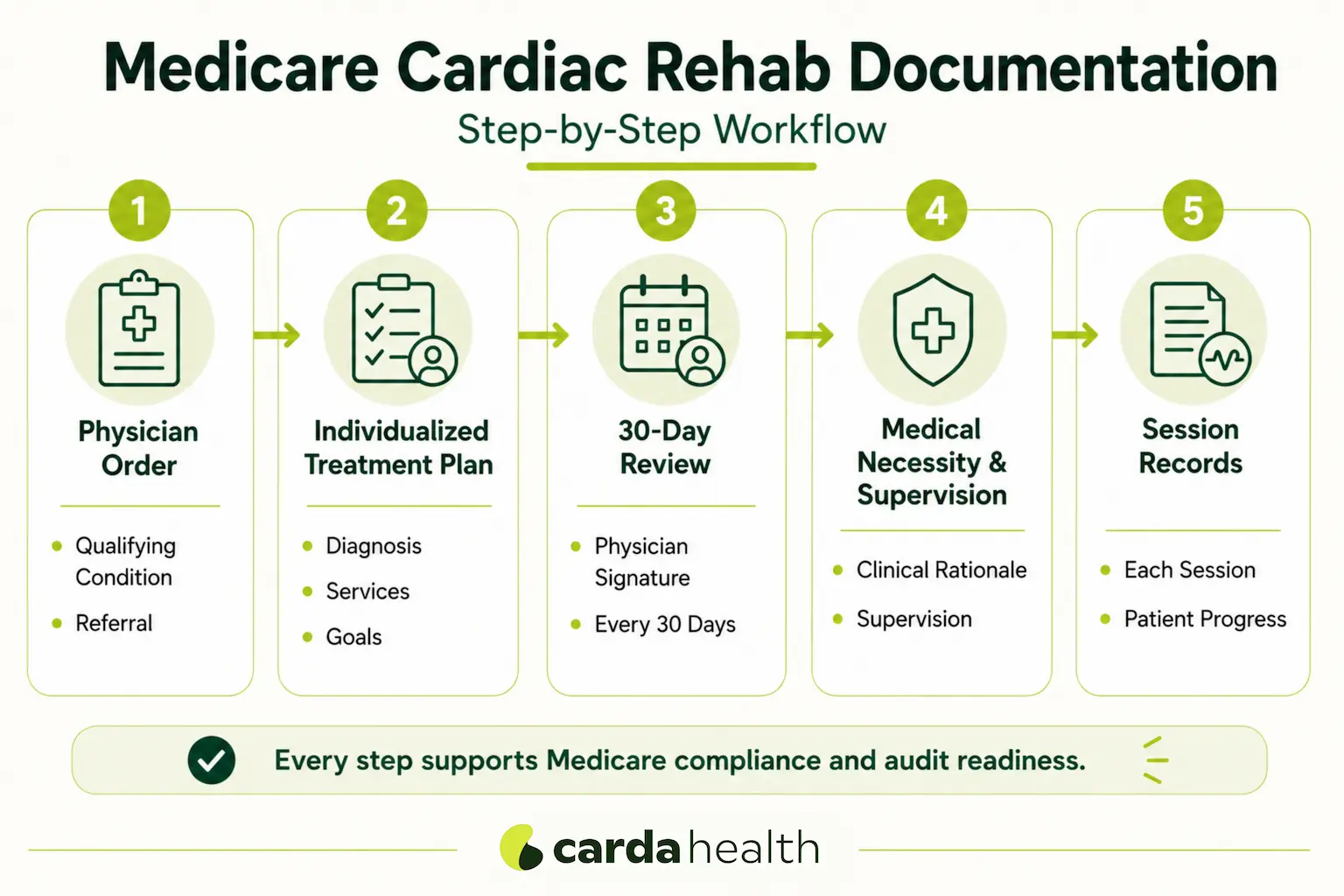
Compliant cardiac rehab documentation follows a predictable sequence. Each link matters, and a gap in any one of them is a common reason claims fail review.
Step 1: The Physician Order or Referral
Cardiac rehab must be ordered by a physician (MD or DO) licensed in the state where services are delivered. The order is the foundation of the record and should identify the patient, the qualifying condition, and the referral to cardiac rehab. Without a valid physician order on file, the rest of the documentation cannot stand on its own.
Step 2: The Individualized Treatment Plan (ITP)
The ITP is the centerpiece of cardiac rehab documentation. Under 42 CFR 410.49, every patient must have a written, individualized treatment plan that is tailored to them rather than a generic template. It has three required components.
The Patient’s Diagnosis and Qualifying Event
The ITP must describe the patient’s diagnosis, including the qualifying event or condition and its date where timing matters. For heart failure, this is where the supporting detail belongs: the left ventricular ejection fraction of 35% or less and the NYHA class II to IV status that the coverage rule requires.
Type, Amount, Frequency, and Duration of Services
The plan must specify the cardiac rehab services to be furnished and how they will be delivered: the type of services, and the amount, frequency, and duration. Be specific rather than using open ranges, since vague service descriptions are a frequent audit finding.
Individualized Goals
The ITP must set goals tailored to the individual, not boilerplate. Effective plans tie goals to the patient’s own risk factors, for example blood pressure, lipid, weight, and activity targets, and update them as the patient progresses. Patient-specific, measurable goals are both a coverage requirement and the clearest signal of medical necessity.
Step 3: Physician Signature and the 30-Day Review
An ITP is not complete until a physician signs it, and the timing is strict. A physician must establish, review, and sign the plan, and it must be reviewed and re-signed at least every 30 days. A missing or late signature is one of the most common and most avoidable documentation failures, so build the 30-day review into your workflow rather than tracking it by memory.
Step 4: Documenting Medical Necessity and Supervision
The record must support that cardiac rehab is reasonable and necessary, which means the qualifying condition, the clinical rationale, and the relevant findings should all be present and consistent. Supervision must also be documented: a physician must be immediately available, and ECG monitoring should be noted when performed. Keep the diagnosis, the order, and the ITP consistent, since contradictions between documents invite denials.
Step 5: Recording Each Session and Outcomes
Each session should be documented as it happens, capturing the services provided and the patient’s response, and the program must include an outcomes assessment measuring progress against the ITP goals. This ongoing record shows the plan is being followed and is working, which is exactly what an auditor looks for when validating the course of care.
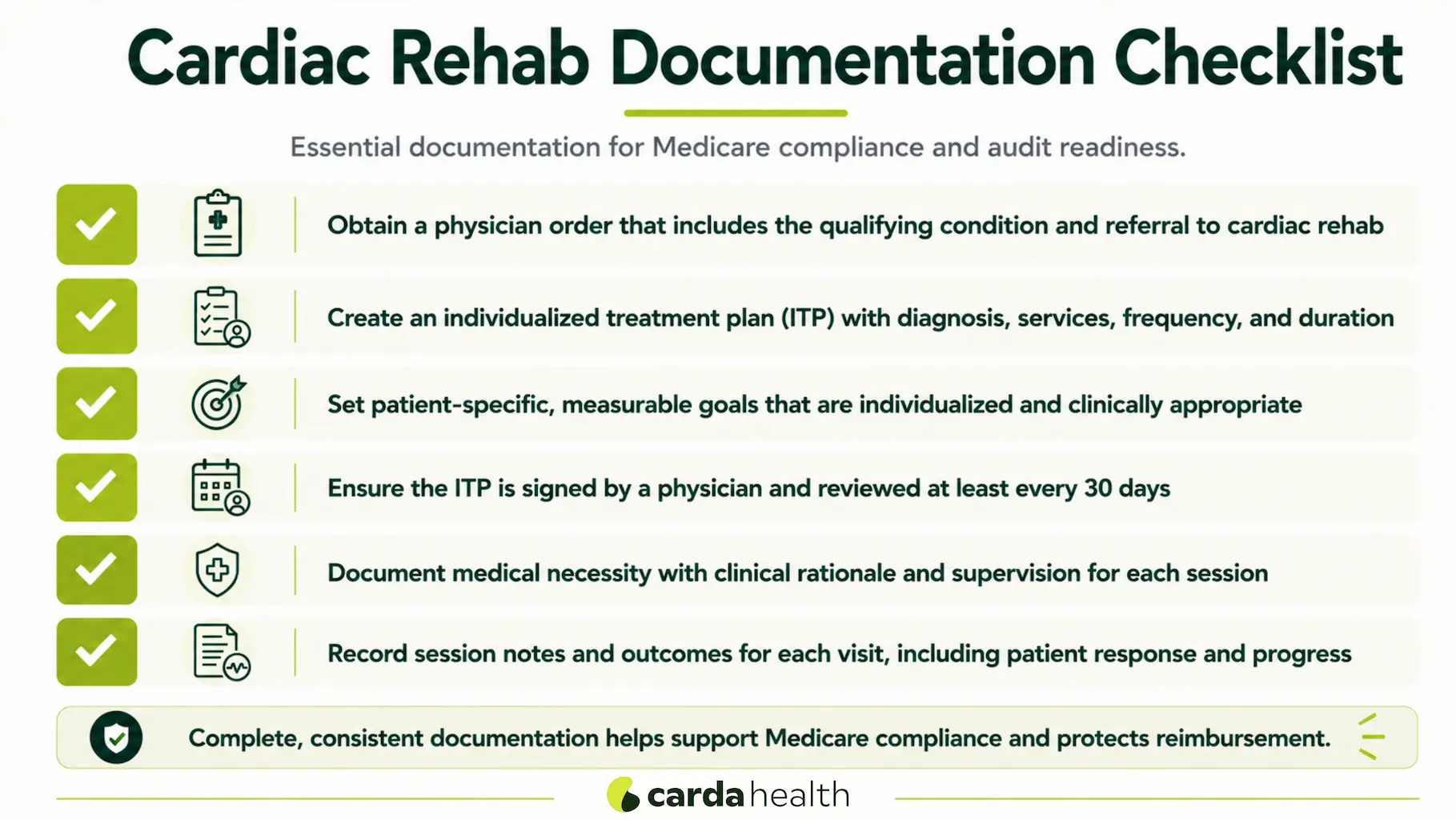
Documentation Requirements at a Glance
What Triggers a RAC or CERT Audit, and How to Survive One
Most documentation-related takebacks trace to a short list of recurring problems. Knowing them is the fastest way to audit-proof your records:
- A missing or late physician signature on the ITP, including a skipped 30-day review
- A generic or incomplete ITP with vague services or boilerplate goals
- Insufficient medical necessity, such as a heart failure referral without the LVEF and NYHA class recorded
- Inconsistencies between the order, the diagnosis, and the plan
- Missing session or supervision documentation for billed dates
The defense is consistency and completeness. If the order, the ITP, the signatures, the session notes, and the outcomes all align and are present for every billed date, the record will generally hold up under review.
Virtual and Telehealth Sessions
The 2026 coverage landscape changed how supervision and delivery can work for virtual and home-based cardiac rehab, including permanent virtual direct supervision and expanded telehealth pathways. The core documentation principles in this guide still apply, but the supervision and setting details can differ by program type. For the policy backdrop, see our overview of telehealth cardiac rehab in 2026, and confirm the current rules with your MAC.
How Carda Supports Compliant Documentation
Documentation is the kind of administrative load that keeps busy practices from referring. Carda Health is built to ease it. As a virtual cardiac rehab provider, Carda manages the individualized treatment plans, session records, outcomes tracking, and ongoing review cadence within its program, so a referring practice does not have to own every downstream step. Your team can refer a qualifying patient confident the supporting record will be built and maintained correctly.
The Bottom Line
Cardiac rehab reimbursement is won or lost in the record. Confirm the patient qualifies, secure a valid physician order, build a specific individualized treatment plan, sign and review it every 30 days, document medical necessity and supervision, and record every session and outcome. Do that consistently and your claims clear, patients start sooner, and your program is audit-ready. As rules evolve, always verify against current CMS policy and your MAC.
Frequently Asked Questions
What documentation does Medicare require for cardiac rehab eligibility?
At minimum, a physician order, an individualized treatment plan (ITP) with the diagnosis, the prescribed services, and individualized goals, a physician signature on the ITP, ongoing review at least every 30 days, and records supporting medical necessity, supervision, and each session. Requirements derive from 42 CFR 410.49 and the relevant NCDs.
Who has to sign the cardiac rehab order and treatment plan?
A physician, meaning an MD or DO licensed in the state where services are delivered, must order cardiac rehab and sign the individualized treatment plan. The supervising physician must also be immediately available during sessions.
What must an individualized treatment plan (ITP) include?
Three required components: the patient's diagnosis, the type, amount, frequency, and duration of services, and individualized goals. Goals should be patient-specific and measurable, such as blood pressure, lipid, weight, and activity targets.
How often must the ITP be reviewed and re-signed?
At least every 30 days. A physician must review the plan and re-sign it on that cadence. A missing or late 30-day signature is one of the most common documentation failures, so build it into your workflow.
What gets cardiac rehab claims flagged in a RAC or CERT audit?
Common triggers include a missing or late ITP signature, a generic or vague treatment plan, insufficient medical necessity documentation (for example heart failure without LVEF and NYHA class), inconsistencies between documents, and missing session or supervision notes.
Do virtual or telehealth sessions change the documentation requirements?
The core documentation principles still apply, but supervision and setting details can differ for virtual and home-based programs under the 2026 rules. Confirm the current requirements for your program type with your MAC and CMS policy.
References
- Code of Federal Regulations. 42 CFR 410.49, Cardiac rehabilitation program and intensive cardiac rehabilitation program.
- Centers for Medicare & Medicaid Services. NCD 20.10, Cardiac Rehabilitation Programs.
- Centers for Medicare & Medicaid Services. NCD 20.10.1, Cardiac Rehabilitation Programs for Chronic Heart Failure.
- Centers for Medicare & Medicaid Services. Recovery Audit Program, Approved RAC Topic 0135: Cardiac Rehabilitation Medical Necessity and Documentation Requirements.
- American Association of Cardiovascular and Pulmonary Rehabilitation (AACVPR). Cardiovascular Rehabilitation reimbursement and ITP resources.