Reducing Heart Failure Readmissions: Where Cardiac Rehab Actually Fits


Key Takeaways
Heart failure carries one of the highest 30-day readmission rates in medicine, with studies reporting figures as high as 25%. The interventions that move that number in the first 30 days are medication optimization at discharge and early follow-up, not cardiac rehabilitation. Under Medicare's coverage rules, a patient whose only route to cardiac rehab is the chronic heart failure indication must wait roughly six weeks after an acute hospitalization before qualifying, which is a point many discharge teams miss. A patient who also has a qualifying MI, stent, bypass or valve procedure can enter through that indication instead, without the coverage wait, subject to clinical readiness. Rehab is still essential, but its job is preventing the next admission rather than the first one. The practical answer is to place the referral at discharge and let enrollment follow stabilization.
Heart failure is the readmission problem most hospitals have worked hardest on and moved least. Part of the difficulty is clinical: older patients, multiple comorbidities, narrow physiological margins. But part of it is sequencing. Teams often reach for interventions in the wrong window, and cardiac rehabilitation in particular is frequently assumed to be available immediately after discharge when the coverage rules say otherwise. This guide sets out what works when, and where rehab belongs in the pathway.
Why Heart Failure Is the Hardest Readmission Problem
Roughly 6.7 million American adults live with heart failure, a figure projected to reach 8.5 million by 2030, with hospitalization driving most of the cost. Studies report all-cause 30-day readmission rates as high as 25% after a heart failure admission. A large share of those readmissions are not for heart failure itself, which is why single-condition interventions tend to underperform. For how those readmissions translate into penalties, see our guide to CMS readmission penalties and cardiac rehab. For background on the acute presentation, see our overview of decompensated heart failure.
The Eligibility Gap Most Teams Miss
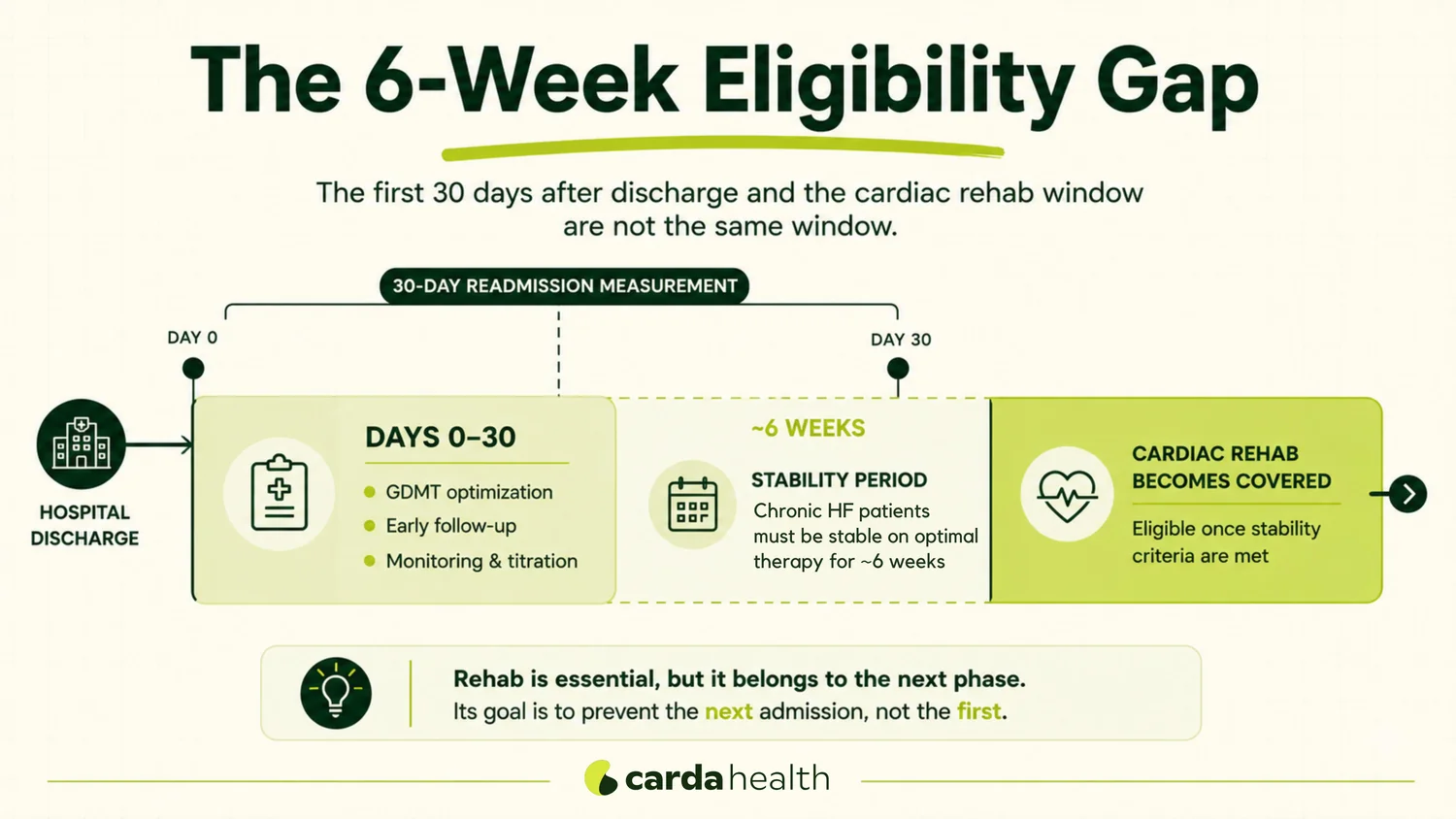
If your readmission strategy assumes cardiac rehab starts shortly after a heart failure discharge, it is worth checking the coverage criteria carefully, because for most Medicare patients it does not.
What NCD 20.10.1 Actually Requires
Medicare covers cardiac rehab for heart failure under a separate determination from the other qualifying conditions. NCD 20.10.1 covers beneficiaries with stable, chronic heart failure, defined as a left ventricular ejection fraction of 35% or less and NYHA class II to IV symptoms despite being on optimal heart failure therapy for at least six weeks. Crucially, it defines stable patients as those who have not had a recent (six weeks or less) or planned (six months or less) major cardiovascular hospitalization or procedure. An admission for acute decompensated heart failure counts as one.
Why This Creates a 30-Day Blind Spot
Read those clauses together and the implication is direct for one specific group: a patient whose only qualifying route is chronic heart failure will not meet the coverage definition of stable until roughly six weeks have passed, and that window sits entirely outside the 30-day measurement period. Check the other indications before assuming the wait applies.
A heart failure patient who was also admitted with a myocardial infarction, or who had a stent, bypass or valve procedure during the admission, qualifies under 42 CFR 410.49 through that indication and is not gated by the chronic-HF stability clause. For the patients with no such route, cardiac rehab cannot be the primary lever on your 30-day number, and teams that assume otherwise build pathways that quietly fail at authorization. Note too that the 35% LVEF threshold means patients with preserved ejection fraction are not covered under this determination.
Our guide to Medicare coverage for cardiac rehab covers the wider set of qualifying conditions.
What the Expert Consensus Says About the Waiting Period
This constraint is not universally endorsed clinically. The JACC Expert Panel on cardiac rehabilitation for patients with heart failure states that optimization of medical therapy can be done concurrently with rehab, and that patients in stable condition should be able to be referred without a six-week waiting period. Supporting that view, a study of early cardiac rehabilitation attendance in heart failure found reduced 30-day all-cause readmissions (adjusted odds ratio 0.4, 95% CI 0.2 to 0.7) and reduced six-week readmissions (adjusted OR 0.5). The literature favors earlier access, but until coverage policy changes, plan around the rules as they stand and verify current criteria with your MAC.
What Works in Each Window
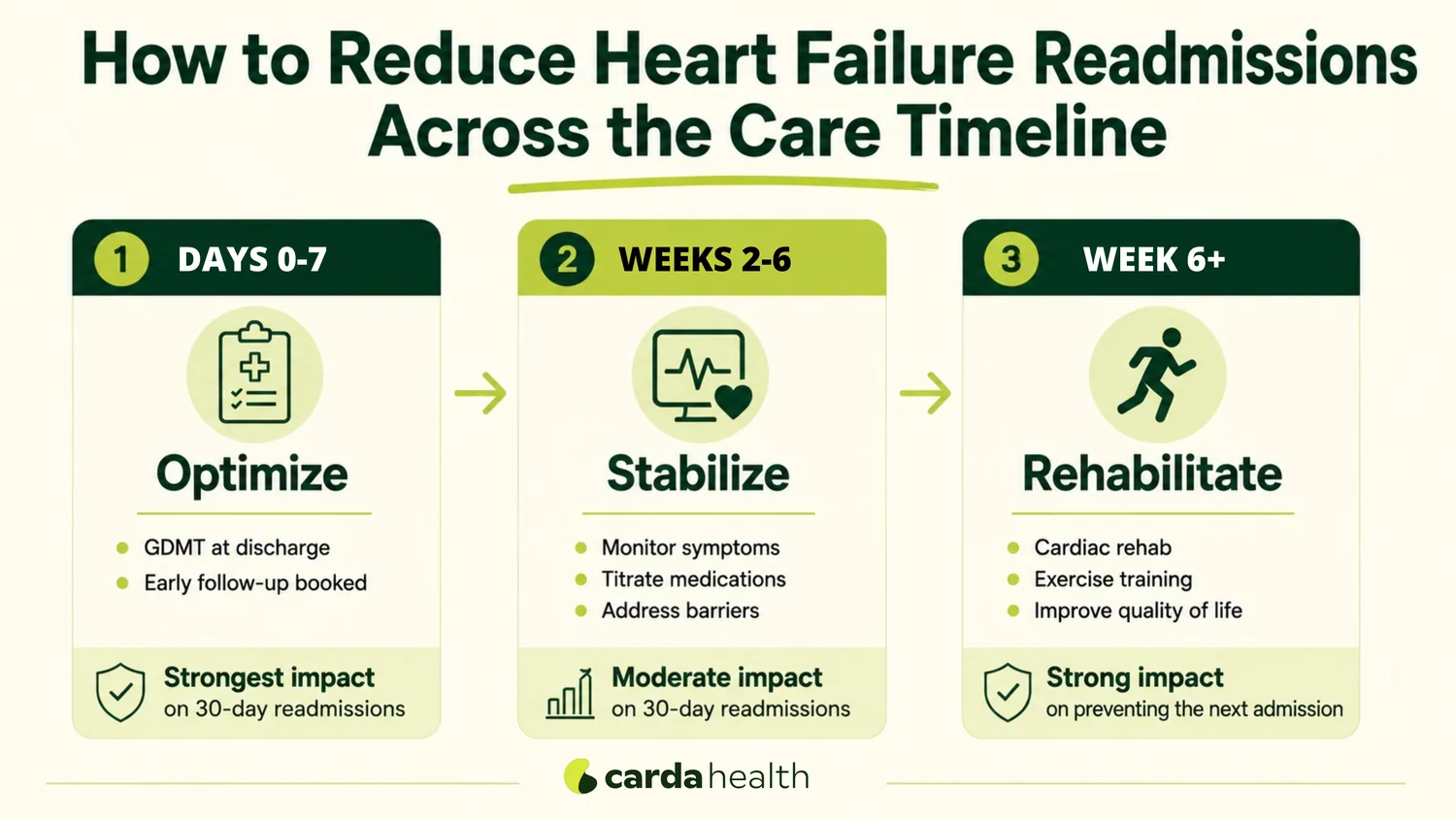
Sequencing matters more than intensity. Here is where the evidence sits for the interventions available in each phase after discharge.
| Window | Intervention | Evidence strength |
|---|---|---|
| Days 0 to 7 | Guideline-directed medical therapy optimized before discharge | Strong and dose-dependent |
| Days 0 to 14 | Early outpatient follow-up visit scheduled before discharge | Moderate to strong |
| Weeks 1 to 6 | Symptom monitoring, daily weights, medication titration | Moderate |
| Weeks 1 to 6 | Transitional care programs and structured telephone support | Mixed; varies by program design |
| Week 6 onward | Cardiac rehabilitation (chronic-HF route only: once stability criteria are met) | Strong for function; supportive for rehospitalization |
The week 6 row applies to patients whose only qualifying route is chronic heart failure. A patient who qualified through an MI, stent, bypass or valve procedure is not gated by that clause, though start timing still depends on their clinician judging them ready.
Days 0 to 7: Medication Optimization and Early Follow-Up
The strongest and most immediately actionable lever is getting patients out the door on the right medications. A multi-institution cohort found that each additional class of guideline-directed medical therapy prescribed at discharge was associated with progressively lower 30-day all-cause readmission, from a hazard ratio of 0.79 with two classes to 0.56 with four, compared with one. That is a gradient effect a discharge checklist can act on. Pair it with a follow-up appointment booked before the patient leaves: a 2024 systematic review and meta-analysis found post-discharge outpatient follow-up associated with a 21% lower risk of 30-day all-cause readmission overall, and a 27% relative risk reduction in heart failure specifically.
Weeks 1 to 6: Monitoring, Titration, and the Referral You Place Now
This is the stabilization phase, and where the coverage clock runs. Continue titrating therapy, monitor weights and symptoms, and keep the patient connected to the clinic. It is also the window in which the cardiac rehab referral should already exist in the chart. Referral at discharge is the strongest predictor of eventual enrollment, and one not placed during the index hospitalization is rarely recovered. Place it, document the qualifying criteria, and let the program handle eligibility timing. Our guides to when to refer to cardiac rehab and documenting eligibility for Medicare cover the mechanics, and the ICD-10 codes for referral guide covers coding the I50 family correctly.
Week 6 Onward: Where Cardiac Rehab Fits on the Chronic-HF Route
For patients entering through the chronic heart failure indication, cardiac rehab becomes available once the stability criteria are met, and its value is substantial. Patients who qualified through a procedure or MI may start sooner, subject to clinical readiness rather than coverage timing. Exercise-based rehab consistently improves functional capacity and quality of life in heart failure, with supportive evidence for reduced rehospitalization, and it is a Class 1 guideline recommendation. The operational framing that matters: rehab is not competing with your 30-day bundle. It keeps the patient from generating the next index admission three months from now. For clinical detail, see our guide to cardiac rehab for heart failure.
The Enrollment Problem Specific to Heart Failure
Even where patients qualify, most never participate. About 24% of eligible patients participate in cardiac rehab nationally, roughly half of referred patients never attend a first session, and among those who participate, 26.9% complete at least 36 sessions. Heart failure patients on the chronic-HF route face all of this plus one more obstacle: the eligibility gap is exactly where momentum is lost. The patient goes home, the hospitalization recedes, and by the time they qualify nobody is following up. A pathway that does not deliberately bridge that gap will lose most of its referrals in it.
Building a Referral Pathway That Survives the Eligibility Gap
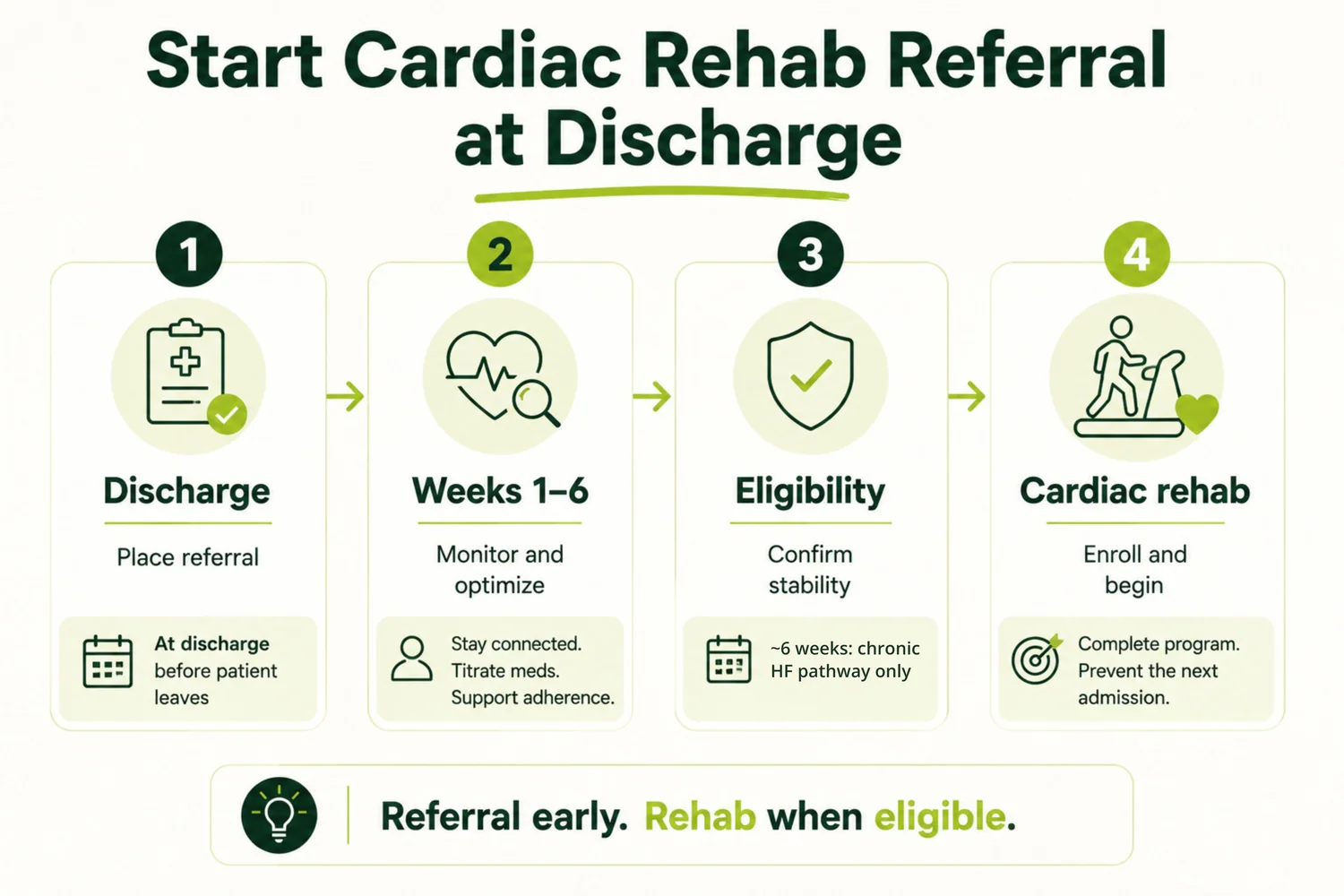
Three design choices make the difference. First, place the referral at discharge by default through the order set rather than relying on recall, since automatic referral through the electronic record has been associated with substantially higher enrollment. Second, own the interval, assigning responsibility for contacting the patient once the stabilization period ends rather than assuming they will re-present. Third, choose a delivery model the patient can actually complete, since a referral that converts into two sessions is not a readmission intervention.
That last point is where the delivery model matters most. Nationally, 26.9% of participants complete at least 36 sessions.
Carda Health delivers live one-to-one sessions supervised by a clinical exercise physiologist with real-time vitals monitoring at home. Ask any vendor, including Carda, for its completion rate with the denominator, threshold and cohort attached: a program-defined completion figure is not measured the same way as the Medicare 36-session figure above, and the two should not be read side by side.
Carda also verifies eligibility and handles much of the enrollment paperwork after referral, precisely the work that otherwise falls into the six-week gap.
For a model-by-model comparison, see our review of cardiac rehab delivery models, and for how virtual delivery works, our overview of virtual cardiac rehab.
The Bottom Line
Heart failure readmissions respond to sequencing. In the first week, optimize guideline-directed medical therapy and book the follow-up before discharge, where the 30-day evidence is strongest. Through the stabilization period, monitor, titrate, and keep the patient engaged. From roughly six weeks on the chronic-HF route, and earlier for patients who qualified through a procedure, cardiac rehab does the work of preventing the next admission. The referral belongs at discharge regardless, because that is when it is most likely to be placed and to convert. Build the pathway around the coverage timeline rather than against it, and verify current criteria with your MAC as policy evolves.
See how Carda Health partners with health systems
Frequently Asked Questions
What is the 30-day readmission rate for heart failure?
Studies report all-cause 30-day readmission rates as high as 25% after a heart failure hospitalization, among the highest of any condition measured by CMS. A substantial share of those readmissions are for reasons other than heart failure itself, which is why narrow single-condition interventions often underdeliver.
Does cardiac rehab reduce heart failure readmissions?
Exercise-based cardiac rehab consistently improves functional capacity and quality of life in heart failure, with supportive evidence for reduced rehospitalization. Its effect is best understood over months rather than within the first 30 days, largely because coverage criteria delay when most patients can start.
When can a heart failure patient start cardiac rehab after discharge?
Under Medicare's NCD 20.10.1, covered patients must be stable, defined as having had no major cardiovascular hospitalization or procedure within the preceding six weeks, alongside an LVEF of 35% or less and NYHA class II to IV symptoms despite at least six weeks of optimal therapy. That applies to patients entering through the chronic heart failure route. A patient who also qualifies through a recent MI, stent, bypass or valve procedure enters under 42 CFR 410.49 and does not wait. Confirm current criteria with your MAC.
Why are some heart failure patients not eligible for cardiac rehab immediately after hospitalization?
Because the coverage definition of stable chronic heart failure excludes patients with a recent major cardiovascular hospitalization, and an acute heart failure admission qualifies as one. The criteria were drawn from the enrollment standards of the trial evidence underpinning the coverage decision. Expert consensus has argued this waiting period should be removed for otherwise stable patients. This applies to the chronic heart failure indication specifically. Patients with another qualifying event during the same admission are covered through that route instead.
What reduces heart failure readmissions in the first 30 days?
The strongest levers are optimizing guideline-directed medical therapy before discharge, where each additional therapy class has been associated with progressively lower 30-day readmission, and scheduling early outpatient follow-up before the patient leaves, associated with a 27% relative risk reduction in heart failure.
Are patients with preserved ejection fraction covered for cardiac rehab?
Not under NCD 20.10.1, which requires an LVEF of 35% or less. Patients with preserved ejection fraction may still qualify through a different covered indication, such as a recent myocardial infarction, bypass surgery, stenting, or valve surgery, so check the full list of qualifying conditions rather than assuming exclusion.
References
- Centers for Medicare & Medicaid Services. NCD 20.10.1, Cardiac Rehabilitation Programs for Chronic Heart Failure.
- Bozkurt B, Fonarow GC, Goldberg LR, et al. Cardiac Rehabilitation for Patients With Heart Failure: JACC Expert Panel. J Am Coll Cardiol. 2021;77(11):1454–1469.
- Early Cardiac Rehabilitation to Reduce Heart Failure Readmissions. J Cardiopulm Rehabil Prev. 2022.
- Additive Benefit of Guideline-Directed Medical Therapies at Discharge in Reducing 30-Day Readmissions in Heart Failure. JACC / PMC.
- Bilicki DJ, Reeves MJ. Outpatient Follow-Up Visits to Reduce 30-Day All-Cause Readmissions for Heart Failure, COPD, Myocardial Infarction, and Stroke. Prev Chronic Dis. 2024.