Why Patients Don't Complete Cardiac Rehab (And How to Keep Them)


Key Takeaways
Cardiac rehab dropout is largely not a medical problem. In one large cohort, 12.9% of patients dropped out, and only 1.7% of the cohort did so for cardiac reasons, meaning roughly 87% of dropout was non-cardiac. It is also predictable: baseline depression and anxiety, low exercise capacity, smoking persistence, comorbidity, and lower socioeconomic status all forecast non-completion well enough to act on at intake. The clinical stakes are real, since patients who do not complete have higher cardiovascular event rates on long-term follow-up. The uncomfortable pattern is that the strongest predictors describe the patients who stand to gain the most, so retention is a clinical priority, not an administrative one.
Getting a patient through the door is only half the job. A patient who attends four sessions and disappears has not received the intervention, and the benefits of cardiac rehab are dose-dependent. The encouraging news for program leaders is that dropout is far less random than it appears. It is concentrated in identifiable patients, it happens at a predictable point, and most of it has nothing to do with their hearts.
How Many Patients Actually Drop Out
Reported dropout rates vary widely, from roughly 12% to 56%, largely because definitions differ. Some studies count any early termination, others define dropout as attending 50% or fewer of prescribed sessions. The most commonly quoted US figure is the strictest one: only 27.6% of participants complete all 36 sessions. That is completion of the full Medicare allowance, not the only clinically meaningful definition, and programs using a lower threshold or a clinical milestone will report a very different number. Whichever definition you adopt, use it consistently.
In a Dutch cohort of patients enrolled after myocardial infarction, 24% of those who started did not complete. Whichever figure you use, the same conclusion follows: a large share of the patients your program successfully enrolls do not receive a full therapeutic dose.
Most Dropout Is Not Medical
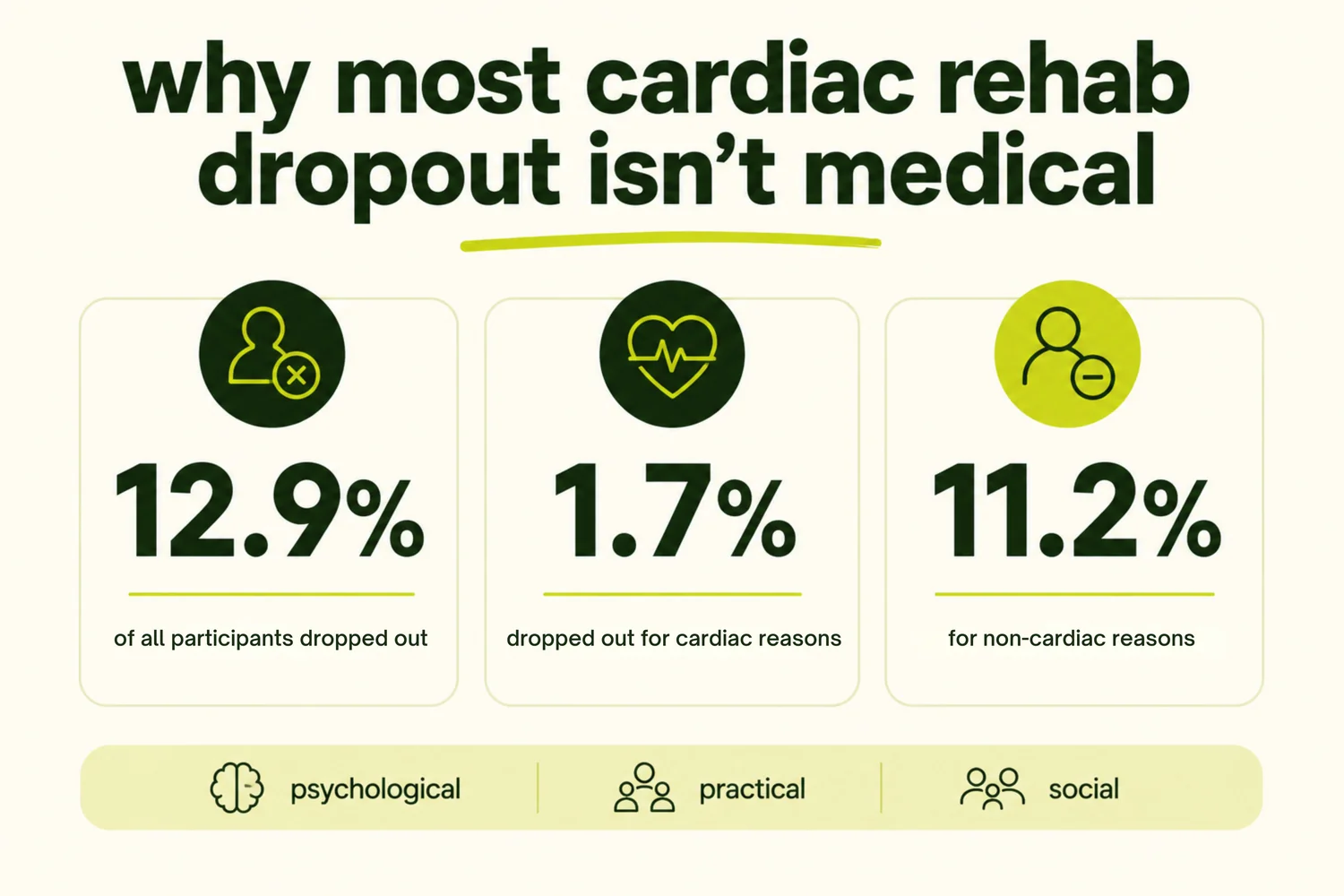
This is the finding that should shape strategy. In a prospective analysis of 2,371 consecutive outpatient cardiac rehab participants, dropout occurred in 12.9% of patients. Of the full cohort, 1.7% left for cardiac reasons and 11.2% left for non-cardiac reasons. Put another way, roughly 87% of all dropout had nothing to do with the patient's heart. The overwhelming majority of dropout is not driven by clinical deterioration or by rehab being unsafe. It is driven by psychological, practical, and social factors, which is precisely why it is addressable.
Who Is Most Likely to Drop Out
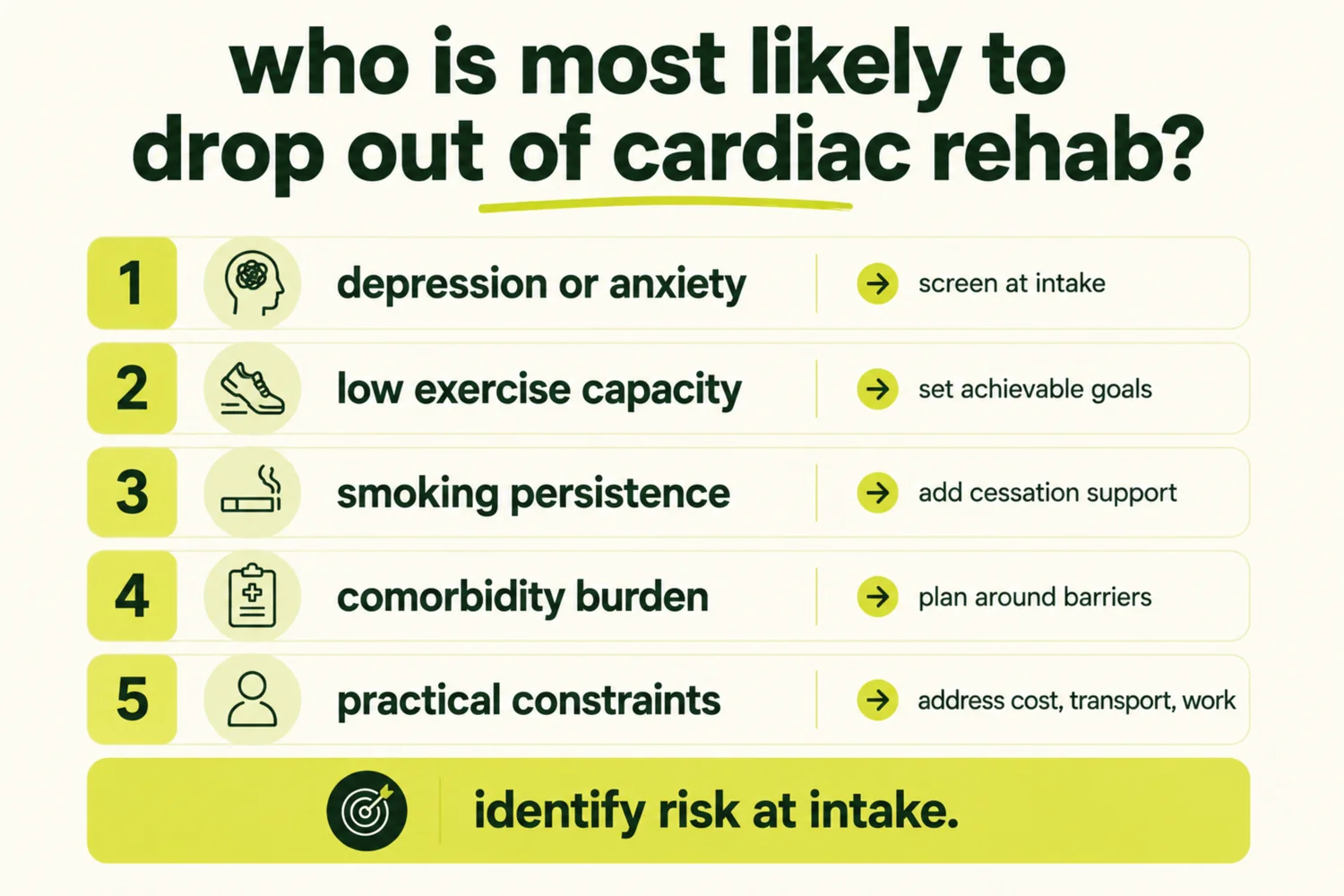
Predictors of non-completion are consistent enough across studies to be useful clinically. In one analysis, a model built from patient characteristics predicted non-completion with an area under the curve of 0.71, which is fair-to-good discrimination for a decision that costs a program very little to act on.
| Predictor | What the evidence shows | Action at intake |
|---|---|---|
| Depression and anxiety | Primary predictors of dropout in a randomized retention study | Screen with a validated tool; refer or add support |
| Low exercise capacity | Worse baseline capacity independently associated with dropout | Set achievable early targets; avoid discouraging starts |
| Low muscle mass | Correlated with dropout after PCI in both sexes | Flag for tailored resistance progression |
| Smoking persistence | Reported as the single strongest predictor of non-completion in one cohort | Pair rehab with active cessation support |
| Comorbidity burden | Diabetes, obesity, COPD, and PAD predict fewer sessions completed | Anticipate scheduling and symptom barriers |
| Lower socioeconomic status | Predicts fewer sessions completed | Address cost, transport, and work conflicts early |
Psychological Predictors: Depression and Anxiety
These are the best-evidenced and most actionable. In a randomized study of a brief retention intervention, baseline anxiety and depression were the primary predictors of dropout. Depressive symptoms are also repeatedly associated with completing fewer sessions. Most programs do not systematically screen for them at intake, which means the highest-risk group is often invisible until they stop showing up. Our patient-facing guide to cardiac anxiety after a heart event is a useful resource to share with these patients.
Physical Predictors: Low Exercise Capacity and Muscle Mass
Worse baseline exercise capacity is independently associated with dropout, and a study of patients after percutaneous coronary intervention found that dropout correlated with low six-minute walk distance and low muscle mass ratio in both men and women. This is the clinical irony at the center of retention: the patients who find the first sessions hardest are the ones most likely to leave, and also the ones with the most to gain. Baseline testing, discussed in our guide to functional capacity evaluation, is therefore a risk-stratification tool as well as a prescription tool.
Behavioral and Social Predictors
One cohort found smoking persistence to be the single most important predictor of incomplete rehab, plausibly because continued smoking marks lower readiness to change behavior generally. Comorbidities including diabetes, obesity, COPD, and peripheral vascular disease predict fewer sessions completed, as does lower socioeconomic status. Age shows a modal pattern, with the youngest and oldest patients at higher risk. One analysis also recommended early attention for patients recently bereaved of a partner, a factor that rarely appears on an intake form but is easy to ask about.
When Patients Leave, and Why Timing Matters
Dropout is front-loaded. Patients who disengage tend to do so early rather than tapering off near the end of the program, and studies of retention interventions consistently show the separation between completers and non-completers emerging in the first weeks. The operational implication is straightforward: retention effort belongs at the start. A program that checks in on attendance at week eight is auditing a decision that was made at week two. Build your outreach around the first few sessions, when a single missed appointment is still recoverable.
The Clinical Cost of Dropping Out
Non-completion is not merely a program metric. Patients who do not complete cardiac rehab have been shown to have an increased risk of cardiovascular events during long-term follow-up, and analyses of coronary artery disease cohorts have examined dropout, defined as attending half or fewer sessions, in relation to event-free survival. Since dropout concentrates in higher-risk patients to begin with, the effect compounds: the people least likely to finish are the people for whom finishing matters most. That is the argument for treating retention as clinical work rather than administrative follow-up. Non-completion also feeds the readmission problem covered in our guides to CMS readmission penalties and reducing heart failure readmissions.
What Actually Improves Retention
Three approaches have reasonable support, and they work best together.
Screen and Stratify at Intake
Use the predictors above as an intake checklist rather than a research curiosity. A validated depression and anxiety screen, baseline functional testing, smoking status, and a short conversation about transport, work, and caregiving will identify most of your at-risk cohort in the first session. Assign those patients a higher-touch pathway from the outset instead of waiting for a pattern of absence to emerge.
Brief Motivational Interventions
Motivational interviewing is the best-studied behavioral addition. An integrative review of motivational strategies in cardiac rehab reported that motivational interviewing improved completion rates from 14% to 39% across the studies examined, alongside increases in sessions attended per patient. A randomized trial adding four sessions of motivational interviewing and stress management to standard rehab found meaningful differences in sessions attended. The Cochrane review of interventions to promote cardiac rehab utilisation provides the broader evidence base. These are modest, low-cost additions that a trained clinical exercise physiologist or program nurse can deliver.
Remove the Practical Friction
Psychological support will not overcome a two-hour round trip three times a week. The practical barriers that block enrollment keep applying for the full twelve weeks, which is why completion tracks delivery models closely. Programs delivering remotely report substantially higher completion than center-based programs, though those are program-reported figures on their own denominators rather than a common national one. For patients flagged as high-risk at intake, offering a model that removes travel and scheduling friction is often the highest-yield single intervention.
Carda Health delivers live one-to-one sessions supervised by a clinical exercise physiologist with real-time vitals monitoring in the patient's home, and reports that over 90% of its patients complete the program.
Our comparison of home-based versus center-based cardiac rehab and review of cardiac rehab delivery models cover the trade-offs.
Also Read: Our overview of virtual cardiac rehab.
The Bottom Line
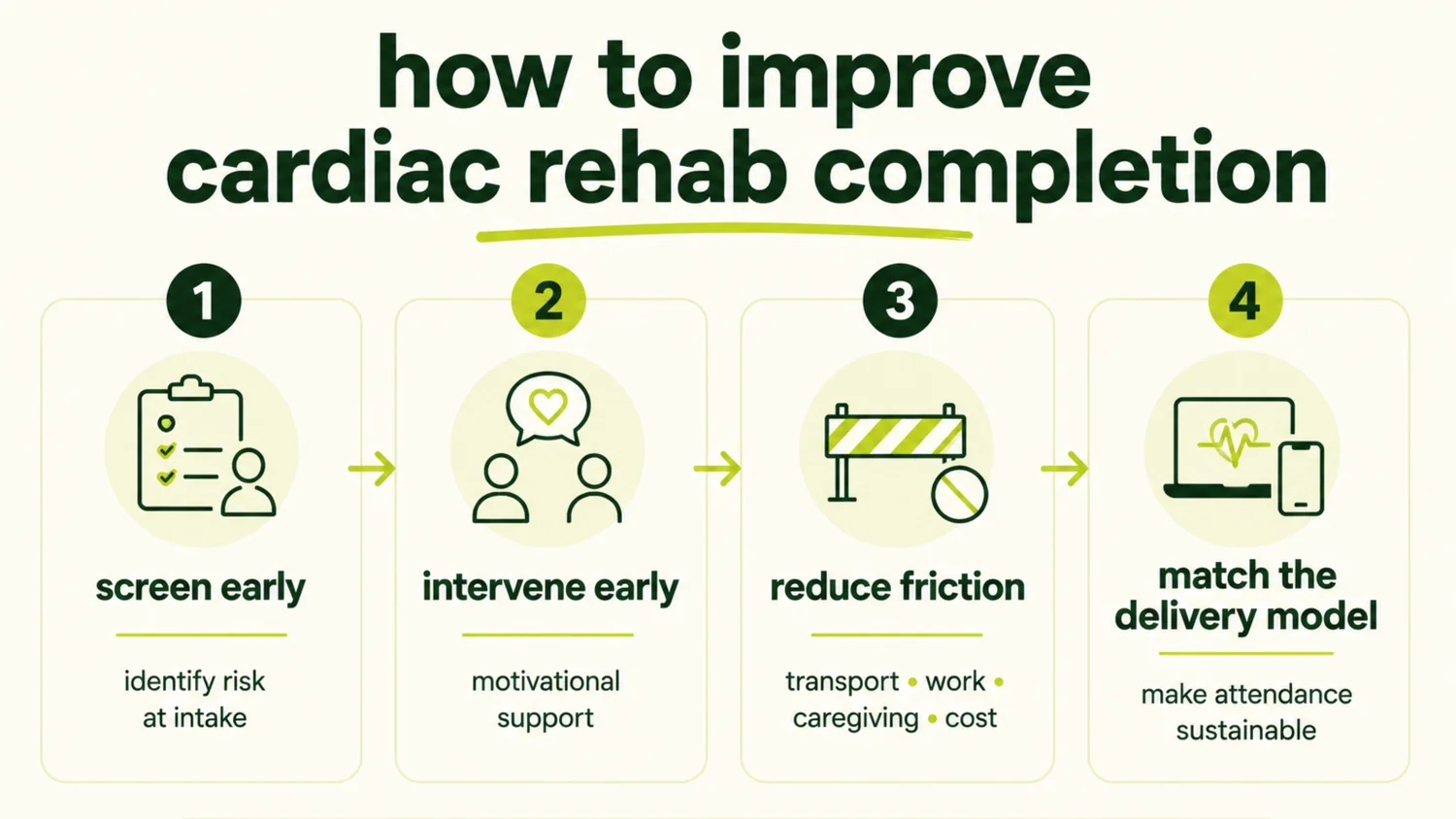
Cardiac rehab dropout is predictable, front-loaded, and mostly non-medical, which together make it one of the more tractable problems in program operations. Screen for depression, anxiety, low functional capacity, continued smoking, and practical constraints at intake. Concentrate retention effort in the first few weeks, when disengagement actually happens. Add a brief motivational intervention for at-risk patients, and offer a delivery model they can sustain for the full course. Doing so protects the patients with the most to lose, since non-completion is associated with worse long-term cardiovascular outcomes.
See how Carda Health partners with health systems
Frequently Asked Questions
What percentage of patients drop out of cardiac rehab?
Reported dropout ranges from about 12% to 56%, largely because studies define dropout differently, with some counting any early termination and others using attendance of 50% or fewer sessions. In the United States, only 27.6% of participants complete all 36 sessions.
Why do patients stop attending cardiac rehab?
Rarely for medical reasons. In a cohort of 2,371 participants, dropout was 12.9% overall but only 1.7% for cardiac reasons. The rest reflected psychological, practical, and social factors such as depression and anxiety, transport and scheduling, work, caregiving, and cost.
Which patients are most likely to drop out?
Those with baseline depression or anxiety, low exercise capacity or low muscle mass, continued smoking, higher comorbidity burden including diabetes, obesity and COPD, and lower socioeconomic status. Age shows a modal pattern, with the youngest and oldest at higher risk.
When do most patients drop out?
Early. Disengagement tends to occur in the first weeks rather than gradually across the program, which means retention effort should be concentrated at the start when a missed session is still recoverable.
Does dropping out of cardiac rehab affect outcomes?
Yes. Patients who do not complete cardiac rehab have shown increased cardiovascular event rates on long-term follow-up. Because dropout concentrates in higher-risk patients, the clinical impact compounds.
What interventions improve cardiac rehab completion?
Screening and stratifying at intake, brief motivational interventions, and reducing practical friction. Motivational interviewing has been reported to improve completion from 14% to 39% across studies. Delivery model is also a strong lever, with structured virtual programs reporting completion of 70% to 85% compared with 25% to 40% for center-based programs.
References
- Wittmer M, Volpatti M, Piazzalonga S, Hoffmann A. Expectation, satisfaction, and predictors of dropout in cardiac rehabilitation. Eur J Prev Cardiol. 2012;19(5):1082–1088.
- Sunamura M, ter Hoeve N, Geleijnse ML, et al. Patients who do not complete cardiac rehabilitation have an increased risk of cardiovascular events during long-term follow-up. Neth Heart J. 2020.
- Predictors of cardiac rehabilitation referral, enrolment and completion after acute myocardial infarction: an exploratory study. Neth Heart J. 2021.
- McGrady A, Burkes R, Badenhop D, McGinnis R. Effects of a Brief Intervention on Retention of Patients in a Cardiac Rehabilitation Program. Appl Psychophysiol Biofeedback. 2014.
- Motivational Strategies and Concepts to Increase Participation and Adherence in Cardiac Rehabilitation: An Integrative Review. J Cardiopulm Rehabil Prev. 2022.
- Santiago de Araújo Pio C, Chaves GS, Davies P, Taylor RS, Grace SL. Interventions to promote patient utilisation of cardiac rehabilitation. Cochrane Database Syst Rev. 2019.