How to Increase Cardiac Rehab Enrollment: An Evidence-Based Playbook


Key Takeaways
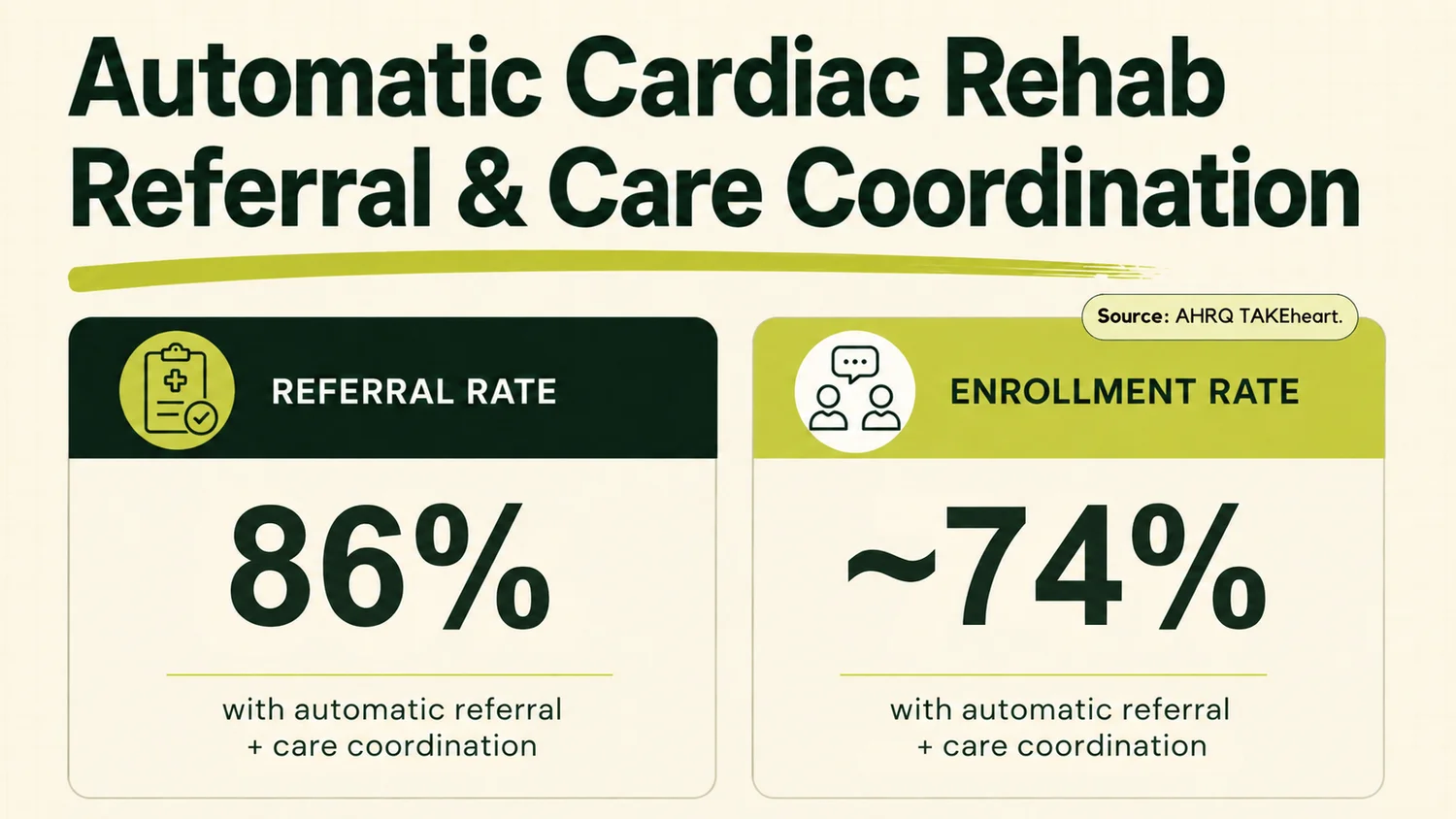
Low cardiac rehab participation is three separate problems: referrals that are never placed, referrals that never convert to enrollment, and enrollments that never reach completion. Each needs a different fix. Automatic opt-out referral combined with care coordination is the best-evidenced combination: AHRQ reports it can raise referral to 86% and enrollment to almost 74%. Those are two separate stage-level measures, and a program can move the first without moving the second. Completion is the most neglected stage, and delivery model is one of the few levers that acts on it directly. Women, rural patients, and patients of lower socioeconomic status are lost disproportionately at every stage, so track participation by subgroup rather than in aggregate.
Most cardiac rehab programs already know their participation numbers are too low. The harder question is what to do about it, and which interventions are worth the implementation effort. This guide sets out what the evidence supports at each stage of the pathway, from the referral order to the final session. It assumes the clinical case for rehab is settled; if you need that argument, our overview of the benefits of cardiac rehabilitation covers it.
The Participation Problem in Numbers
The scale of the shortfall is well documented. About one in four eligible Medicare fee-for-service beneficiaries participated in cardiac rehab in 2016, against a Million Hearts national target of 70% that has not been met. More than a million Americans a year have a coronary event or procedure that qualifies them. AHRQ estimates that closing this gap could save almost 25,000 lives and prevent about 180,000 hospitalizations annually. The Million Hearts road map published in 2017 laid out how participation could move from 20% to 70%, and the strategies in it remain the reference point for programs today.
Three Separate Problems, Not One
The most common implementation mistake is treating participation as a single number. It is a funnel with three distinct leak points, and a program that fixes only the first will see referral counts rise while participation barely moves.
| Stage | Where patients are lost | Primary evidence-based fix |
|---|---|---|
| Referral | The order is never placed during the index hospitalization | Automatic (opt-out) referral built into the discharge order set |
| Enrollment | Many referred patients never attend a first session | Care coordinator or patient liaison contact before and after discharge |
| Completion | Only 26.9% of participants complete at least 36 sessions | A delivery model the patient can realistically sustain |
Stage 1: Fixing Referral
Referral is the stage with the clearest evidence and the fastest return, because the fix is structural rather than behavioral. It does not depend on individual clinicians remembering.
Automatic (Opt-Out) Referral
Automatic referral makes the cardiac rehab order the default in the electronic record for eligible patients, so a clinician must actively opt out to prevent it. According to the CDC Heart Disease and Stroke Best Practices Clearinghouse, opt-out systems can more than double referral rates, and they save clinical time by systematically identifying who should be referred rather than leaving it to case-by-case judgment. The evidence is strongest when automatic referral is paired with care coordination, discussed below. On its own it reliably lifts referral, but referral is not participation.
What Implementation Actually Requires
Three practical pieces. First, an accurate eligibility trigger in the electronic record, which means encoding the qualifying conditions correctly; our guides to when to refer to cardiac rehab and the ICD-10 codes for referral cover the criteria and coding. Second, a clear opt-out path with a documented reason, so clinical judgment is preserved and the exception is auditable. Third, alignment with the documentation your program needs downstream, covered in our guide to documenting eligibility for Medicare.
Stage 2: Fixing Enrollment
This is where most programs lose the most patients, and where a referral-only strategy stalls. A large share of referred patients never attend a first session.
The Care Coordinator or Patient Liaison
The single best-evidenced intervention in this space is pairing automatic referral with a person whose job is to convert it. AHRQ's TAKEheart initiative states that automatic referral combined with care coordination "can boost CR referral to 86% and enrollment to almost 74%." AHRQ reports these as two separate measures rather than a single conversion rate, and does not publish the denominator for each. Treat them as two stage-level results from the same intervention, and measure your own conversion from referral to first session directly.
Coordinators typically begin during the hospital stay or shortly after discharge, explain what rehab involves, and help the patient through enrollment. They do not need to be clinicians; hospital staff or trained patient ambassadors can fill the role.
Barriers Patients Actually Report
Coordinators are effective largely because they surface and solve concrete obstacles. Research using the Cardiac Rehabilitation Barriers Scale consistently finds the same cluster: distance, transportation, cost, scheduling and work conflicts, caregiving responsibilities, and the belief that one is already exercising enough at home. A study of barriers by rurality and socioeconomic status also found patients citing that it took too long to get referred and into the program, or that they believed they were referred but the program never contacted them. Those last two are entirely within your control. Cost concerns are often addressable simply by confirming coverage, which our guide to Medicare coverage for cardiac rehab can help with.
Stage 3: Fixing Completion
Completion receives the least attention and arguably matters most, since the clinical benefit is dose-dependent. In a national analysis of Medicare beneficiaries with a qualifying event in 2016, 26.9% of participants completed at least 36 sessions. A program that enrolls a patient who then attends four sessions has not delivered the intervention. Our piece on why patients don't complete cardiac rehab covers who drops out and when.
Why Delivery Model Acts Directly on Completion
The barriers that block enrollment mostly do not disappear after the first session. Travel, scheduling, work, and caregiving keep applying, week after week, for twelve weeks. That is why completion is sensitive to how a program is delivered. A home-based or virtual option removes the travel and scheduling burden for the full course, not just the first visit, so it is a completion measure as well as an access measure. Our comparison of home-based versus center-based cardiac rehab and our review of cardiac rehab delivery models cover the trade-offs.
This is where Carda Health fits into a participation strategy. Carda delivers live one-to-one sessions supervised by a clinical exercise physiologist with real-time vitals monitoring in the patient's home. Carda also verifies eligibility and handles much of the enrollment paperwork after referral, which absorbs a large share of the coordinator workload at the stage where most programs leak patients. For how the model works, see our overview of virtual cardiac rehab.
The Patients You Are Most Likely Missing
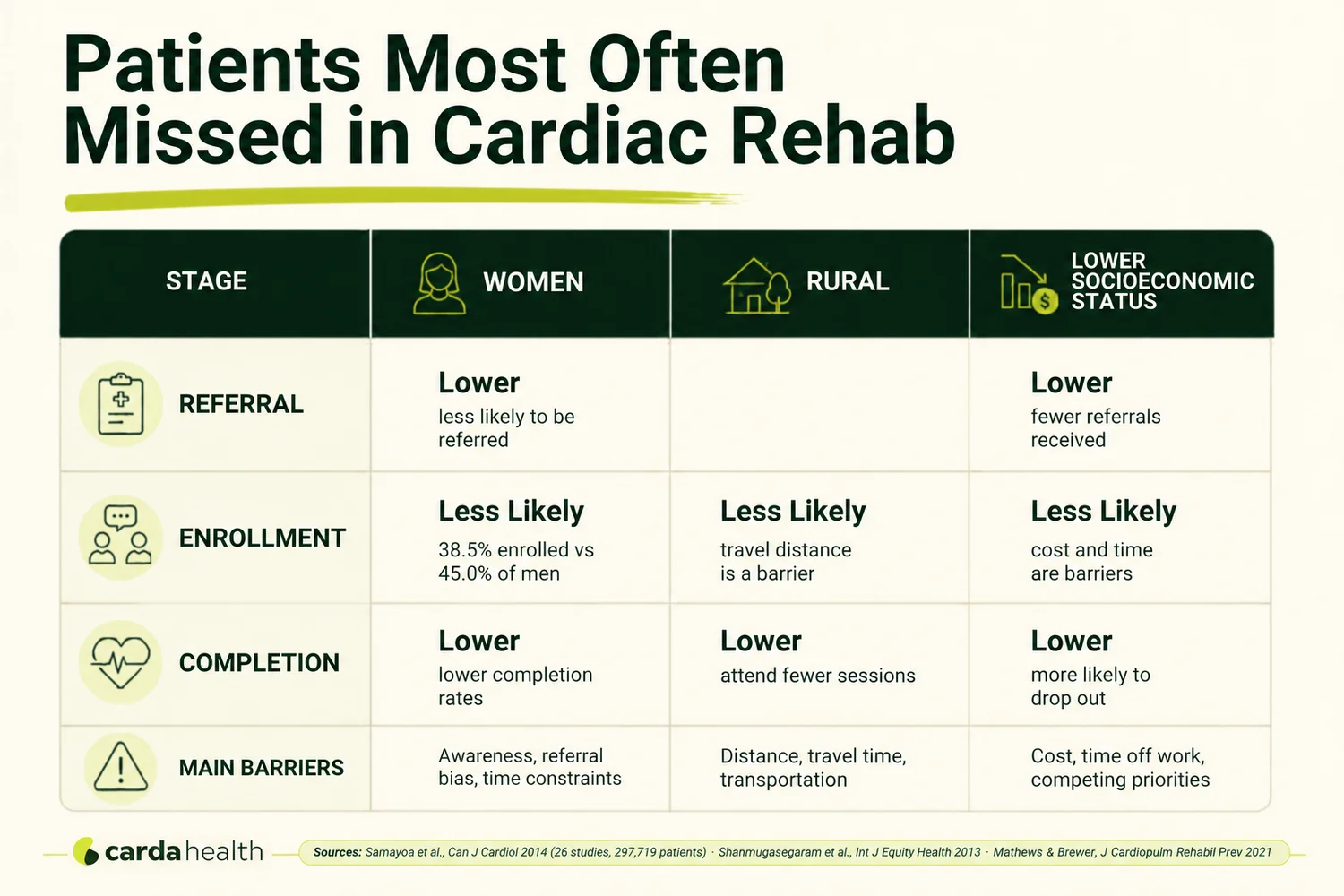
Aggregate participation figures hide the groups being lost fastest. In a meta-analysis of 26 studies covering 297,719 patients, 38.5% of women enrolled in cardiac rehab against 45.0% of men, giving women 36% lower odds of enrolling (OR 0.64, 95% CI 0.57–0.72). Those studies span 2000 to 2011. Women are also less likely to complete, with reported barriers including caregiving responsibilities, time constraints, transportation, discomfort in group exercise settings, and lower likelihood of being referred in the first place. Patients of lower socioeconomic status are significantly less likely to be referred, to enroll, and to participate, and report significantly greater total barriers, with distance, cost, transportation, and severe weather featuring prominently. Rural patients attend significantly fewer sessions than urban patients.
A review of disparities in cardiac rehabilitation points to the same solution set that works generally, applied deliberately to these groups: automatic referral, inpatient liaisons, mitigating economic barriers, novel delivery mechanisms, and equity metrics that hold organizations accountable. The operational implication is simple. Report participation broken down by sex, race and ethnicity, rurality, and payer, because a program can hit a respectable overall number while missing most of its women and rural patients.
How to Measure Whether It Is Working
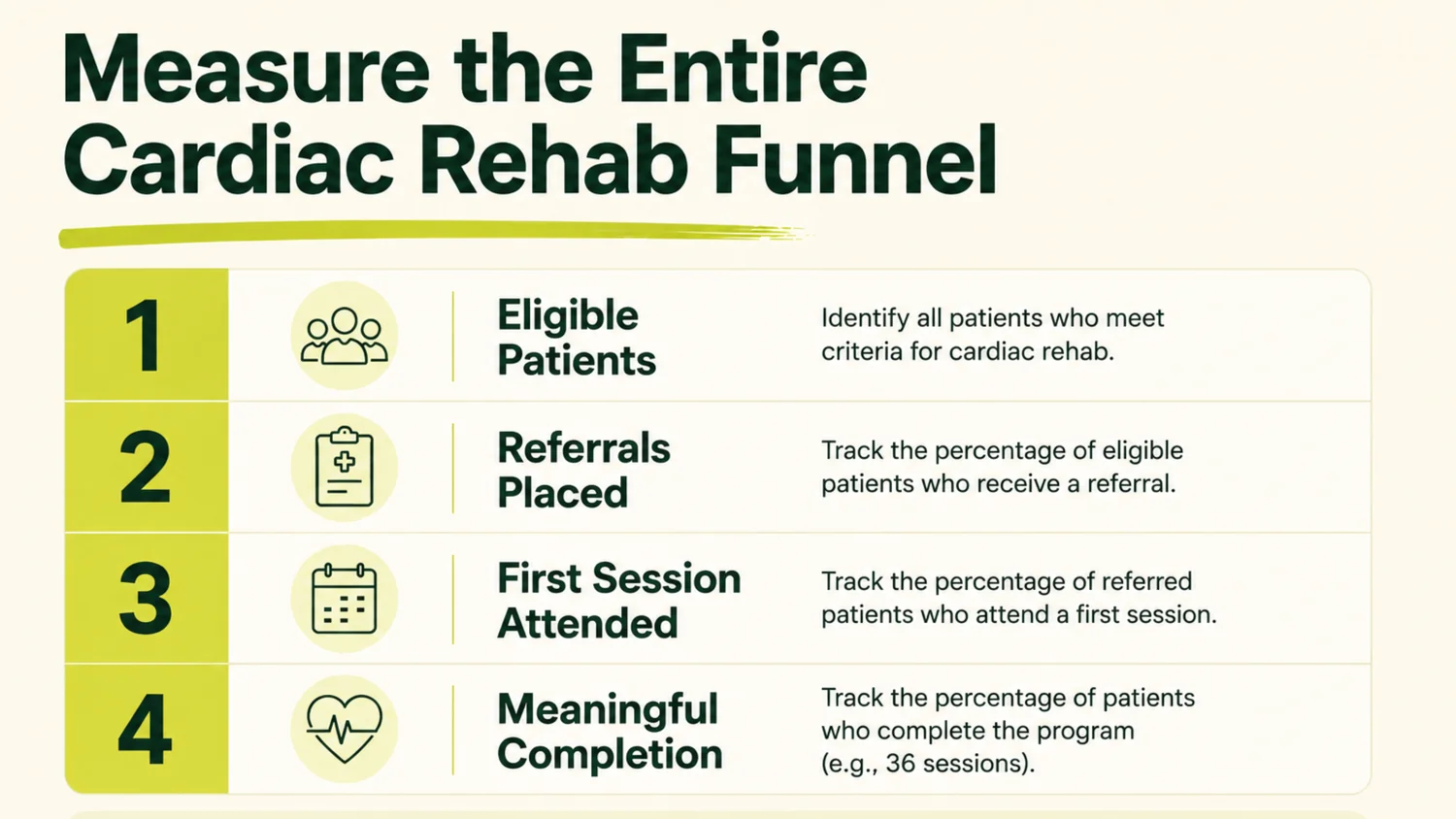
Track the funnel, not the total. At minimum, measure four numbers and review them together: eligible patients identified, referrals placed, patients enrolled (first session attended), and patients completing a meaningful dose of sessions. Rates matter more than counts, because rising referrals with flat enrollment is a signal, not a success. The ACC and AHA clinical performance and quality measures for cardiac rehabilitation provide standardized definitions for referral performance, and the Million Hearts and AACVPR Cardiac Rehabilitation Change Package offers tested change ideas mapped to each stage. Segment every measure by the subgroups above.
The Bottom Line
Raising cardiac rehab participation is not one project. Make referral automatic so it no longer depends on recall, put a named person in charge of converting referrals into first sessions, and offer a delivery model patients can sustain for twelve weeks. The combination of automatic referral and care coordination is the closest thing this field has to a proven playbook, with AHRQ reporting referral reaching 86% and enrollment almost 74%. Measure each stage separately, segment by the groups most often missed, and treat completion as the outcome that counts.
See how Carda Health partners with health systems
Frequently Asked Questions
Why is cardiac rehab participation so low?
Because patients are lost at three separate points. Referrals are often never placed during the index hospitalization, many referred patients never attend a first session, and most who enroll do not complete the full course. Layered on top are patient-level barriers such as distance, transportation, cost, and scheduling conflicts.
Does automatic (opt-out) referral actually work?
Yes, for referral rates. Making the cardiac rehab order the default in the electronic record can more than double referral. Its full effect on participation appears when it is paired with care coordination, which is what converts a referral into an attended first session.
How much does a care coordinator improve enrollment?
AHRQ reports that automatic referral combined with care coordination can raise referral to 86% and enrollment to almost 74%. AHRQ reports these as two separate stage-level measures and does not publish the denominator for each, so track your own referral and first-session numbers rather than deriving a conversion rate from them. Coordinators do not need to be clinicians; hospital staff or trained patient ambassadors can perform the role.
What barriers do patients most often report?
Distance, transportation, cost, work and scheduling conflicts, caregiving responsibilities, and a belief that they already exercise enough at home. Patients also report delays in getting referred and never being contacted by the program after referral, both of which are within a program's control.
How do we improve completion, not just enrollment?
Address the barriers that persist week after week. Nationally, 26.9% of participants completed at least 36 sessions in the 2016 Medicare cohort. Travel, scheduling, work, and caregiving apply for the full twelve weeks, so offering a home-based or virtual option is one of the most direct ways to protect completion.
Which patient groups are we most likely to be missing?
Women, who enrolled at 38.5% against 45.0% for men in a meta-analysis of 297,719 patients, along with patients of lower socioeconomic status, rural patients, and racial and ethnic minority groups. These gaps are invisible in aggregate reporting, so participation should be tracked by subgroups.
References
- Agency for Healthcare Research and Quality. The TAKEheart Initiative.
- Agency for Healthcare Research and Quality. What is TAKEheart?
- CDC Heart Disease and Stroke Best Practices Clearinghouse. Improving Cardiac Rehabilitation Referral.
- Shanmugasegaram S, Oh P, Reid RD, et al. Cardiac rehabilitation barriers by rurality and socioeconomic status: a cross-sectional study. Int J Equity Health. 2013.
- A Review of Disparities in Cardiac Rehabilitation: Evidence, Drivers, and Solutions. J Cardiopulm Rehabil Prev. 2021.
- Ritchey MD, Maresh S, McNeely J, et al. Tracking Cardiac Rehabilitation Participation and Completion Among Medicare Beneficiaries to Inform the Efforts of a National Initiative. Circ Cardiovasc Qual Outcomes. 2020;13(1):e005902.
- Samayoa L, Grace SL, Gravely S, Scott LB, Marzolini S, Colella TJF. Sex differences in cardiac rehabilitation enrollment: a meta-analysis. Can J Cardiol. 2014;30(7):793–800.
- Ades PA, Keteyian SJ, Wright JS, et al. Increasing Cardiac Rehabilitation Participation From 20% to 70%: A Road Map From the Million Hearts Cardiac Rehabilitation Collaborative. Mayo Clin Proc. 2017;92(2):234–242.