COPD and Cardiovascular Risk: Why Your COPD Patients Need Cardiac Attention


Key Takeaways
A COPD exacerbation sharply and temporarily raises cardiovascular risk. In the EXACOS-CV Netherlands cohort, the risk of a severe cardiovascular event or death in the first seven days from hospital admission for a severe exacerbation was 48.6 times higher than in periods without one, falling to 20.0 times at days 8 to 14, 11.3 times at days 15 to 30 and still 2.8 times at days 31 to 180. That endpoint is a composite: acute coronary syndrome, heart failure decompensation, cerebral ischemia, arrhythmia, or death from any cause. After a moderate exacerbation the risk roughly doubled and stayed elevated for six months. These events occur in COPD patients with no prior cardiovascular diagnosis.
The GOLD Science Committee's position is that all patients with COPD should be investigated for cardiovascular disease and that markers of cardiovascular risk should be assessed at the time of an exacerbation. GOLD 2026 completely revised its comorbidities chapter and lowered the treatment-escalation threshold to a single moderate exacerbation. The practical consequence: treat the exacerbation as a cardiac trigger, not just a respiratory one.
Your patient is admitted with an exacerbation, treated with steroids and antibiotics, and discharged breathing better. The respiratory problem is treated. The cardiovascular risk has not been. It peaks in the first week from admission and stays many times above baseline for weeks after discharge.
COPD cardiovascular risk is not a background comorbidity that sits quietly alongside the lung disease. It is time-dependent, it spikes sharply around exacerbations, and it accounts for a substantial share of the deaths in this population. The evidence for that timing has firmed up considerably in the last three years, and the 2026 GOLD report reflects it.
How Large Is the Cardiovascular Risk in COPD?
Large, and concentrated in time. In the EXACOS-CV Netherlands cohort, the adjusted hazard of a severe cardiovascular event or death in the first week from hospital admission for a severe exacerbation was 48.6 times that of non-exacerbation periods. The baseline risk is high enough that the GOLD Science Committee now states plainly that cardiovascular diseases are highly prevalent in COPD patients, that cardiovascular events occur in COPD patients who have never been diagnosed with cardiovascular disease, and that all patients with COPD should be investigated for it. That is a screening recommendation, not an observation.
The mechanism is not mysterious. COPD and atherosclerotic disease share smoking as a dominant risk factor, and they share systemic inflammation, hypoxemia, sympathetic activation, arterial stiffness and physical deconditioning. The two diseases are not neighbors. They are driven by overlapping processes and they amplify each other.
What has changed is the recognition that this baseline risk is not flat. It concentrates.
The Post-Exacerbation Risk Window
The clearest quantification comes from the EXACOS-CV program. In the Netherlands cohort, 8,020 newly diagnosed COPD patients drawn from the PHARMO Data Network, Swart and colleagues tracked acute coronary syndrome, heart failure decompensation, cerebral ischemia, arrhythmias and all-cause death against periods with no exacerbation.
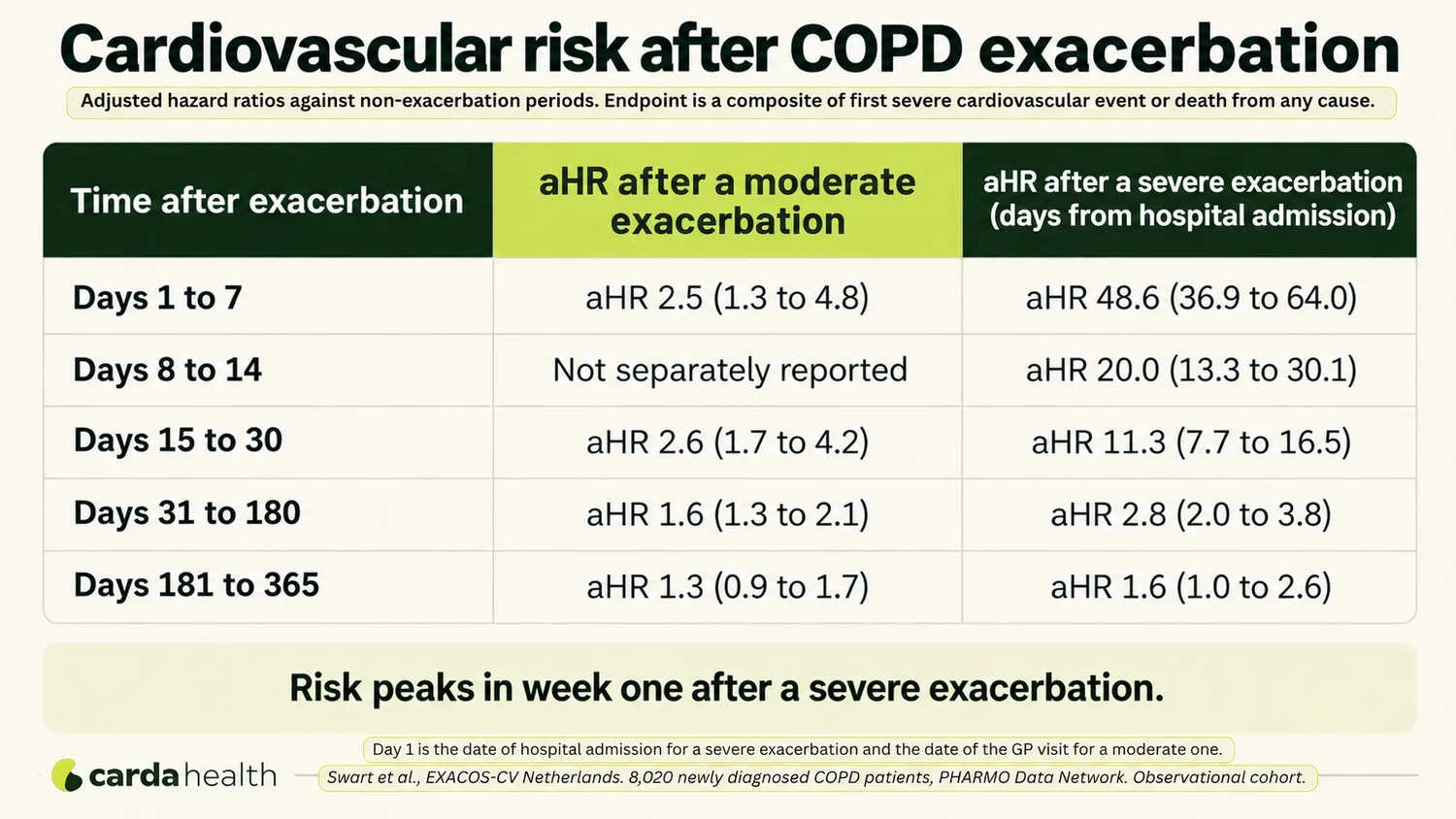
| Time after exacerbation | After a moderate exacerbation | After a severe exacerbation (days from hospital admission) |
|---|---|---|
| Days 1 to 7 | aHR 2.5 (1.3 to 4.8) | aHR 48.6 (36.9 to 64.0) |
| Days 8 to 14 | Not separately reported | aHR 20.0 (13.3 to 30.1) |
| Days 15 to 30 | aHR 2.6 (1.7 to 4.2) | aHR 11.3 (7.7 to 16.5) |
| Days 31 to 180 | aHR 1.6 (1.3 to 2.1) | aHR 2.8 (2.0 to 3.8) |
| Days 181 to 365 | aHR 1.3 (0.9 to 1.7) | aHR 1.6 (1.0 to 2.6) |
Adjusted hazard ratios for the study's composite endpoint, a first severe cardiovascular event or death from any cause, referenced against non-exacerbation periods. Day 1 is the date of the GP visit for a moderate exacerbation and the date of hospital admission for a severe one. Read the severe-exacerbation column as the reason a COPD admission deserves a cardiac assessment before the patient leaves.
Why the First Seven Days Matter Most
A forty-eight-fold hazard is not a subtle signal, but it needs reading precisely. Day 1 is the date of hospital admission, so for many patients most of that first week is spent in hospital. The endpoint is a composite that includes death from any cause, and the study authors note that heart failure misclassified as an exacerbation would inflate the first week most. None of that softens the instruction. It puts the first cardiac assessment inside the admission, and the numbers after discharge are still steep: 20 times baseline at days 8 to 14 and 11 times at days 15 to 30. That later window is where care is most fragmented: the patient has been discharged, the pulmonary follow-up is two weeks out, and nobody has looked at the heart.
The gradient holds across populations. Matsunaga and colleagues, in a Japanese cohort of 152,712 COPD patients followed for a median of 37 months, found an adjusted hazard ratio of 1.44 for a severe cardiovascular event in the first 30 days after any exacerbation, still 1.13 at days 181 to 365. Note the endpoints differ: the Japanese cohort counted fatal cardiovascular events specifically, where the Netherlands cohort counted death from any cause, which is part of why the two magnitudes are not comparable. Different health system, different baseline risk, same shape: a sharp early spike with a long tail.
The absolute risk in a single patient is of course much smaller than the hazard ratio suggests, and these are observational cohorts, so residual confounding by severity is a fair objection. It does not change the clinical instruction, because the response, assessing cardiac risk at the exacerbation, is low cost and independently justified.
What the 2026 GOLD Report Changed
Two changes matter here. Chapter 5, previously titled Multimorbidity in COPD, is now COPD and Comorbidities and has been completely revised. And the threshold for escalating maintenance therapy has dropped: per the GOLD 2026 key changes summary, a single moderate or severe exacerbation before starting maintenance pharmacological therapy raises the risk of subsequent events, and one moderate exacerbation should now trigger consideration of escalation, aiming at a state of no exacerbations.
The cardiovascular reasoning behind that threshold was made explicit by GOLD Science Committee member Gerard Criner, speaking to CHEST Physician in January 2026: “Even with one moderate exacerbation, within the next 30 days you are at greater risk for a major acute cardiac event,” naming arrhythmia, stroke, ischemic heart disease and heart failure.
Worth being precise, since the point is often overstated: GOLD 2026 does not add a standalone chapter titled cardiovascular risk. What it does is rebuild the comorbidities chapter and lower the exacerbation threshold partly on cardiovascular grounds. The dedicated cardiovascular argument sits in the Science Committee's own perspective paper, published alongside it.
On the pharmacological side, our review of the best COPD treatments in 2026 covers what escalation looks like in practice.
Which Cardiovascular Events, and How Long the Risk Lasts
Four categories account for most of it, and they do not all follow the same timeline.
- Acute coronary syndrome. Elevated for up to 180 days after an exacerbation in the Japanese cohort. The systemic inflammatory surge plus hypoxemia is a plausible plaque-destabilizing combination.
- Arrhythmias. Also elevated to around 180 days. Atrial fibrillation is the common one, and beta-agonists, hypoxemia and electrolyte shifts all contribute. See what atrial fibrillation is for the rhythm background.
- Decompensated heart failure. The longest tail, elevated for a full year. The overlap with COPD is substantial and frequently bidirectional, covered in our guide to COPD and heart failure.
- Cerebral ischemia. Counted in both EXACOS-CV cohorts, and part of why stroke risk belongs in the post-exacerbation conversation at all.
Fatal cardiovascular events in the Japanese cohort were highest within the first 30 days and remained elevated through 365 days. The window is not two weeks. It is a year, with a very steep front end.
Why This Risk Gets Missed
Because the two diseases present in the same language. Dyspnea, exercise intolerance, fatigue and ankle swelling read as COPD to a pulmonologist and as heart failure to a cardiologist, and the patient sees whichever one they were referred to.
The structural problem is worse than the diagnostic one. A patient discharged after an exacerbation goes to respiratory follow-up. Nobody owns the cardiac question in the 30-day window where the risk is concentrated, and a normal troponin during the admission is often taken as the answer when the risk period has barely begun.
One more practical trap, highlighted alongside the 2026 GOLD update: multiple studies have found that roughly a third of patients hospitalized with a presumed COPD exacerbation are not exacerbating at all, but have been admitted for something else. A proportion of those admissions are cardiac. Anchoring on the COPD label is how a decompensation gets treated with prednisone.
What to Do Differently: A Practical Checklist
None of this requires a new service. It requires the cardiac question to be asked at three fixed points, backed by three standing habits.
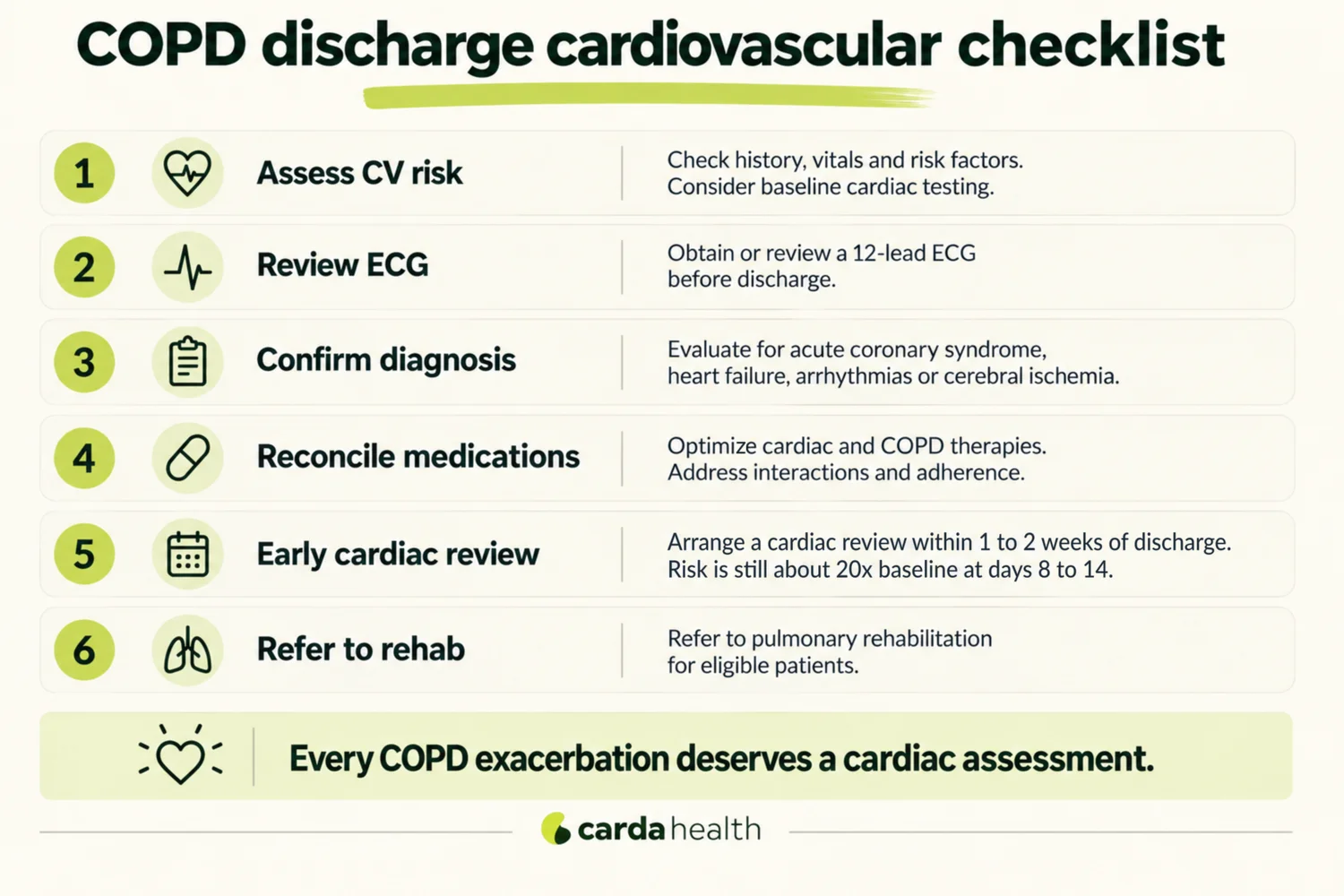
- At the exacerbation. Assess cardiovascular risk markers, as the GOLD Science Committee recommends, rather than waiting for the outpatient visit. ECG, and a considered rather than reflexive troponin.
- Before discharge, as an assessment rather than a follow-up. Confirm the patient actually has an exacerbation and not a cardiac decompensation wearing its clothes. Reconcile cardiovascular medication, and specifically confirm that statins, antihypertensives and anticoagulation were not quietly dropped during the admission.
- In the first one to two weeks after discharge. The hazard is still about 20 times baseline at days 8 to 14 and 11 times at days 15 to 30, so a review scheduled at four weeks misses most of the elevated window. Someone should own the cardiac question in the first two weeks, and if pulmonology holds the only early follow-up, it belongs on that visit's list.
- Screen the undiagnosed. Cardiovascular events occur in COPD patients with no cardiovascular diagnosis on record. Absence of a diagnosis is not absence of disease.
- Escalate on one moderate exacerbation. Under GOLD 2026 that is now the trigger for considering treatment escalation, and preventing the next exacerbation is a cardiovascular intervention.
- Refer to rehabilitation. The single intervention that addresses deconditioning, exercise tolerance and cardiovascular fitness at once.
Where Rehab Fits for the Dual-Risk Patient
Pulmonary rehabilitation is covered under 42 CFR 410.47 for moderate to very severe COPD, GOLD II to IV, on referral from the treating physician, at up to 36 sessions over as many as 36 weeks and extendable to 72 where medically necessary. Post-exacerbation is precisely when the evidence for it is strongest and when uptake is worst.
For the patient carrying both diseases, the awkward part is that cardiac and pulmonary rehab are usually separate programs, separate referrals and separate waiting lists. Our explainer on cardiopulmonary rehabilitation sets out how a combined program handles the overlap, and virtual delivery removes the travel barrier that hits oxygen-dependent patients hardest.
Carda Health runs cardiac and pulmonary rehabilitation inside one program, under a single referral, with live one-to-one sessions supervised by a clinical exercise physiologist and real-time vitals monitoring. For context on the scale of the problem, a Medicare beneficiary analysis found 26.9% of cardiac rehab participants completed at least 36 sessions in a 2016 cohort. Completion matters here more than usual, because the benefit of rehabilitation is dose-dependent and most dropout happens early.
Referral capacity is the practical constraint, not eligibility, and reducing COPD readmissions with technology covers the monitoring layer around it.
The Bottom Line
Stop treating a COPD exacerbation as a purely respiratory event. In the first week from admission for a severe one, the adjusted hazard of a severe cardiovascular event or death runs roughly 48 times that of non-exacerbation periods. It is still about 11 times higher at days 15 to 30 and stays measurably elevated for a year. The patients this catches are frequently the ones with no cardiovascular diagnosis on file.
Three changes cover most of the gap: assess cardiovascular risk during the admission rather than after it, make sure someone owns the cardiac question in the first one to two weeks after discharge rather than at the month mark, and refer to rehabilitation that treats the heart and the lungs as one problem. Pulmonologists and cardiologists are looking at the same patient. The exacerbation is the moment they should both be in the room.
Refer a patient to Carda Health
Frequently Asked Questions
How much does a COPD exacerbation increase cardiovascular risk?
In the EXACOS-CV Netherlands cohort, the adjusted hazard for a composite of severe cardiovascular event or death from any cause was 48.6 in days 1 to 7 from hospital admission for a severe exacerbation compared with non-exacerbation periods, 20.0 at days 8 to 14, 11.3 at days 15 to 30, and 2.8 at days 31 to 180. After a moderate exacerbation it was around 2.5 in the first week and 1.6 at days 31 to 180. The composite includes mortality, so it is not a pure cardiovascular-event rate.
Which cardiovascular events are most common after a COPD exacerbation?
Acute coronary syndrome, decompensated heart failure, arrhythmias and cerebral ischemia. In the EXACOS-CV Japan cohort, acute coronary syndrome and arrhythmias stayed elevated for up to 180 days and decompensated heart failure for a full year.
Did GOLD 2026 add a cardiovascular risk section?
Not as a standalone chapter. GOLD 2026 completely revised Chapter 5, renaming it COPD and Comorbidities, and lowered the treatment-escalation threshold to a single moderate exacerbation partly on cardiovascular grounds. The dedicated cardiovascular argument appears in the GOLD Science Committee's perspective paper on exacerbations and cardiovascular risk.
Should all COPD patients be screened for cardiovascular disease?
The GOLD Science Committee's position is that all patients with COPD should be investigated for cardiovascular disease, and that markers of cardiovascular risk should be assessed at the time of an exacerbation. Cardiovascular events occur in COPD patients who carry no prior cardiovascular diagnosis.
How do you tell a COPD exacerbation from cardiac decompensation?
Clinically they overlap heavily, and roughly one third of patients hospitalized with a presumed exacerbation are found not to be exacerbating. Natriuretic peptides, ECG, echocardiography where indicated, and a careful look at the trajectory of the breathlessness usually separate them. Assume overlap rather than either or.
Can pulmonary rehab reduce cardiovascular risk in COPD?
Rehabilitation improves exercise capacity, deconditioning and quality of life, and these are shared drivers of cardiovascular risk in this population. It is not a substitute for cardiovascular risk-factor management, and the strongest case for it is that it addresses both diseases in the same program.
References
- Singh D, Agustí A, Bourbeau J, Martinez FJ, Halpin DMG, Vogelmeier CF. GOLD Science Committee Perspective on Exacerbations and Cardiovascular Risk in COPD. American Journal of Respiratory and Critical Care Medicine, 2026.
- Global Initiative for Chronic Obstructive Lung Disease. GOLD 2026 Report, Key Changes Summary.
- Global Initiative for Chronic Obstructive Lung Disease. Global Strategy for the Diagnosis, Management, and Prevention of COPD, 2026 Report.
- Swart KMA, et al. Risk of cardiovascular events after an exacerbation of chronic obstructive pulmonary disease: results from the EXACOS-CV cohort study using the PHARMO Data Network in the Netherlands. Respiratory Research, 2023.
- Matsunaga K, et al. Increased Risk of Severe Cardiovascular Events Following Exacerbations of Chronic Obstructive Pulmonary Disease: Results of the EXACOS-CV Study in Japan. Advances in Therapy, 2024.
- Gebhart F. 2026 GOLD report provides key updates on COPD exacerbations, case finding. CHEST Physician, January 2026.
- Electronic Code of Federal Regulations. 42 CFR 410.47, Pulmonary Rehabilitation Program: Conditions for Coverage.
- Ritchey MD, Maresh S, McNeely J, et al. Tracking Cardiac Rehabilitation Participation and Completion Among Medicare Beneficiaries to Inform the Efforts of a National Initiative. Circ Cardiovasc Qual Outcomes. 2020;13(1):e005902.