Aviary Health vs Carda Health: How the Two Virtual Cardiac Rehab Models Differ


Key Takeaways
They aren't the same kind of company. Aviary Health, formerly Recora, powers rehab service lines for health systems and practices, supplying the platform and, in fully managed programs, the clinical staff. Patients reach it through one of those partners. Carda Health is the care provider: it employs the clinicians, contracts with health systems and health plans, and also enrolls patients directly, so a patient can start without their hospital having signed anything. Both cover cardiac and pulmonary rehab. The sharpest clinical difference is intensive cardiac rehab. Carda delivers Ornish Lifestyle Medicine virtually, the only Medicare-approved ICR program whose evidence rests on regression of coronary atherosclerosis, while Aviary helps health systems launch the Benson-Henry program at their own facilities. Medicare does not let a patient switch from a standard rehab series into intensive rehab, so that choice is made at referral, and for most individual patients it points to Carda.
Only about 24% of eligible patients ever begin cardiac rehabilitation, and many of those who receive a referral never attend a first session. Virtual programs exist to close that gap. Which company sits behind the program decides something more basic than convenience: whether your patient can enroll at all.
Aviary Health, which many clinicians still know as Recora, and Carda Health both deliver supervised rehab into the home, both bill Medicare, and both reached the market in 2020. They reach the patient by completely different routes.
What follows covers what each company actually is, what the published outcome data does and doesn’t establish, how their intensive cardiac rehab programs diverge, and which patients fit each. For the separate question of which delivery model suits a given population, that comparison sits elsewhere.
Aviary Health vs Carda Health at a Glance
Aviary Health powers rehab service lines for health systems and practices: the partner owns the program, its brand and its billing, and Aviary supplies the platform and, where the partner wants it, the clinical staff. Carda Health is a direct care provider: it holds the clinical relationship, employs the care team, and enrolls patients itself. Both offer cardiac and pulmonary rehabilitation.
| Factor | Aviary Health | Carda Health |
|---|---|---|
| Company history | Founded 2020 as Recora, rebranded April 2026 | Founded 2020, name unchanged |
| Who signs the contract | Health systems and provider organizations | Health systems, health plans, and patients directly |
| Cardiac rehab | Yes | Yes |
| Pulmonary rehab | Yes, added 2026 | Yes, integrated with cardiac |
| ICR program | Benson-Henry Institute, Mass General Brigham | Ornish Lifestyle Medicine, exclusive virtual provider |
| Who staffs sessions | Aviary clinical staff in fully managed programs; partner staff for ICR, trained by Mass General Brigham | Carda physicians, NPs, and clinical exercise physiologists |
| Exercise supervision | 3x weekly supervised exercise plus group education classes, per Aviary; monitored group video in the 2024 Geisinger study | Live one-to-one with a clinical exercise physiologist |
| Patient self-enrollment | No; patients enroll through a partner health system or practice | Yes |
The row that changes referral behavior most is the last one. A patient can reach Carda without their hospital having signed anything. Aviary details were checked November 14, 2026 against aviaryhealth.com.
What Changed When Recora Became Aviary Health
Recora rebranded as Aviary Health on April 7, 2026, and the change wasn’t cosmetic. The company moved from selling one virtual cardiac rehab program to selling four service lines: cardiac rehab, intensive cardiac rehab, pulmonary rehab, and care management, each built around workflow automation and clinical staffing for health systems.
That matters for two practical reasons. Anything published under the Recora name before April 2026, including its outcome data, describes the same program. And the positioning is now explicitly business-to-business. Aviary’s site asks visitors to book a demo, not to check eligibility.
Named health-system partners include Geisinger, UNC Health, Tampa General, Beth Israel Lahey Health, ProMedica, and WakeMed.
Who Delivers the Care, and Who Answers for It
The difference is contractual, and it changes who holds the patient relationship. Aviary powers a partner's program: the health system or practice owns the service line, with Aviary providing the platform, the workflows and, in fully managed programs, the clinical staff. Carda operates the program itself as the provider, using its own physicians, nurse practitioners, and clinical exercise physiologists.

Aviary’s Model: Infrastructure Behind a Hospital’s Program
Aviary Health describes itself as a technology and staffing platform for cardiac and pulmonary rehabilitation, and its offering as end-to-end clinical programs: the platform, the automation, and the people to support a service line from referral through outcomes. For its intensive cardiac rehab line, that includes training the hospital’s own clinicians to deliver the curriculum, with CME coursework, an eight-week stress management and resiliency program, and faculty access through Mass General Brigham.
For a system that wants to own its rehab service line under its own brand and keep the associated revenue, that's a coherent proposition. It also means a patient's access depends on their health system or practice having signed up.
Carda’s Model: A Provider That Takes the Referral
Carda accepts referrals and enrolls patients directly. It ships a Welcome Kit containing a tablet, a blood pressure monitor, and a heart rate monitor, then runs live one-to-one sessions with a clinical exercise physiologist while vitals stream in real time.
Carda contracts with health plans as well as health systems, and its program covers supervised exercise, nutrition and medication follow-up, and functional capacity assessments. What a given patient pays depends on their plan.
When Your Hospital Has No Contract
This is where the two models separate for a hospitalist or PCP. Aviary's programs are offered through partner health systems and practices, and its website lists no direct enrollment route for patients (checked November 14, 2026). If neither your system nor the patient's own providers partner with Aviary, there is no clear path to it. Carda is a path, provided the patient meets Medicare's qualifying criteria and has coverage.
Given that many referred patients never attend a first session, a pathway that doesn’t depend on institutional procurement removes one failure point between discharge and the first session. The timing and criteria for referral stay the same either way, as do the ICD-10 codes that establish eligibility.
What the Published Evidence Shows, and What It Doesn’t
One peer-reviewed study directly compares either program against center-based rehab. It appeared in the Journal of the American Heart Association in December 2024, was conducted with Geisinger, and evaluated the Recora program now branded Aviary Health. Read closely, it is a real result with real boundaries.
What the JAHA Study Found
Shah and colleagues compared 703 virtual rehab patients against 2,303 center-based patients within Geisinger, using propensity weighting to balance baseline differences. Virtual participants had a 38.4% lower rate of one-year all-cause readmission (IRR 0.616, 95% CI 0.489 to 0.777, p<0.001) and a 44.3% lower rate of emergency department visits (IRR 0.557, p<0.001).
They also completed considerably more of the program: an average of 34.4 sessions against 21.4 for center-based patients. Total cost of care over twelve months was 16.2% lower, a figure drawn from the 595 patients enrolled in the Geisinger Health Plan rather than from the full cohort.
What the Study Did Not Show
Mortality and reinfarction did not differ significantly. One-year all-cause mortality returned an incident rate ratio of 0.618 with a p-value of 0.104, and recurrent myocardial infarction an IRR of 1.250 at p=0.605. Neither reached significance.
The authors are direct about the design limits. The study was retrospective, non-randomized, and confined to a single health system, with referring providers choosing the modality. They note that bias cannot be fully eliminated and that a randomized trial would be the better test. The work was funded by Recora and the Geisinger Research Institute.
None of that makes the readmission finding less useful. It means the evidence supports reduced utilization rather than a mortality benefit, drawn from one system’s experience.

Carda’s Program Data
Carda patients attend 89% of their prescribed sessions on average (32 of 36). That is an attendance average, not the share of patients who finish all 36 sessions, so it is not directly comparable with completion figures such as the 26.9% of Medicare cardiac rehab participants nationally who finish at least 36 sessions. What it does show is that the typical Carda patient receives close to the full prescribed dose.
Attendance is the variable carrying the clinical weight. Cardiac rehab shows a dose-response relationship, and the JAHA authors named session volume as a leading explanation for their own readmission findings. A program where patients attend more sessions is delivering more of the intervention.
Session Format: One-to-One Supervision or Group Video
The program studied at Geisinger in 2024 supervised exercise in groups. The JAHA paper describes up to 36 real-time video sessions including monitored group exercise, nutrition counseling, and psychosocial discussion, delivered by exercise physiologists, dietitians, and ancillary staff. Aviary's current website describes three supervised exercise sessions a week plus group education classes, without saying whether exercise is individual or group (checked November 14, 2026), so ask a partner program which format it uses.
Carda's standard cardiac and pulmonary rehab exercise sessions are live and one-to-one, with heart rate and blood pressure monitored as the patient exercises. (The Ornish program, covered below, adds small-group support sessions by design.) For a deconditioned patient after CABG, or someone with an ejection fraction of 35% or less, a clinician watching that one patient's vitals throughout the session is a real clinical advantage. Group formats carry their own benefit, since peer support is among the more consistent predictors of adherence, which is why structured virtual rehab programs often build in some group element.
Intensive Cardiac Rehab: Ornish or Benson-Henry
Medicare recognizes only three intensive cardiac rehabilitation programs nationally: Ornish, Pritikin, and Benson-Henry. Carda and Aviary Health hold different ones. Because a patient cannot switch from a standard rehab series into ICR, this is the single most consequential difference between them.
For how ICR differs from standard rehab in sessions, eligibility and billing, see our guide to intensive cardiac rehabilitation. This section covers only the two programs these companies hold.
Ornish Lifestyle Medicine Through Carda
Carda became the exclusive virtual provider of the Ornish program in May 2026. Ornish is the only one of the three approved programs whose supporting research rests on regression of coronary atherosclerosis, drawing on 45 years of peer-reviewed work and a dataset of roughly 17,000 patients. The core randomized evidence is the Lifestyle Heart Trial, which enrolled 48 patients. That is small, and the reversal finding still rests largely on it. Our review of whether heart disease can be reversed covers that evidence in detail.
The program runs on four equally weighted pillars: nutrition, exercise, stress management, and group support, with twice-weekly small-group sessions. Patients choose a nine-week intensive format of four hours twice weekly, or a twelve-week schedule of two hours three times weekly.
The Benson-Henry Institute Program Through Aviary
Aviary Health supports the Benson-Henry program in collaboration with Mass General Brigham, centered on mind-body medicine, the relaxation response, and cognitive restructuring alongside exercise and nutrition. In CMS's own decision memo for the program, mortality among Benson-Henry participants was lower at one year and three years than in matched controls.
The clinical content and the delivery model are separate questions. Aviary's ICR line is a program a health system launches at its own facility, powered by Aviary's platform and with training from Mass General Brigham's Benson-Henry Institute. Carda delivers Ornish itself, virtually, as the provider, so a patient does not need a local program to access it.
The Rule That Makes This a One-Time Decision
Under CMS billing guidance (article A53775), a patient who has started a series of standard cardiac rehabilitation cannot switch into intensive cardiac rehabilitation during that series. The reverse is permitted once: a beneficiary may move from ICR to standard CR and keeps the sessions remaining in the program, and the Medicare contractor may allow up to 72 combined sessions where medically necessary. Standard CR covers up to 36 one-hour sessions across up to 36 weeks, with a further 36 available at contractor discretion. ICR is a separate benefit of up to 72 sessions across 18 weeks, billed under G0422 and G0423.
The wider Medicare cardiac rehab coverage rules and the documentation needed to establish eligibility apply to both benefits.
So if a patient is a candidate for reversal-focused intensive rehab, that has to be identified before the first standard session is billed. After that, the door is closed for the remainder of the episode.
Patients With Both Cardiac and Pulmonary Disease
Both companies now cover cardiac and pulmonary rehabilitation. Aviary Health added a pulmonary line in 2026 for COPD, long COVID, and other respiratory conditions, offered to health systems as a fully managed program. Carda delivers both as one pathway a single patient moves through with the same care team, rather than two service lines a system has to launch.
The population is larger than referral volumes suggest. Only about 1.5% of Medicare COPD patients begin pulmonary rehabilitation within 90 days of discharge, from an analysis of 197,376 beneficiaries. Comorbid COPD and heart failure is common, and a patient carrying both diagnoses is precisely the one most likely to fall between two programs. Integrated cardiopulmonary rehabilitation exists for that patient, and Medicare covers pulmonary rehab under 42 CFR 410.47 for moderate to very severe COPD.
Aviary Health Alternatives: When Carda Fits and When Aviary May
For an individual patient, the deciding questions are whether they can enroll and which program they need. That is where Carda's direct pathway, Ornish access and one-to-one supervision matter, and it is why Carda is the natural alternative when an Aviary-powered program is not available. Aviary fits best when a health system wants to build and brand its own service line.
| Situation | Better fit | Why |
|---|---|---|
| Candidate for reversal-focused ICR, motivated to change diet and lifestyle | Carda | Exclusive virtual Ornish delivery, the only ICR program whose evidence rests on plaque regression |
| Patient whose providers do not partner with Aviary, or who wants to enroll directly | Carda | Direct referral and self-enrollment without an institutional contract |
| Patient who should have a clinician watching vitals during every exercise session | Carda | Live one-to-one sessions with a clinical exercise physiologist |
| Patient with both COPD and a qualifying cardiac diagnosis | Carda | One provider and one care team across cardiac and pulmonary rehab |
| Health plan seeking an in-network virtual rehab provider | Carda | Carda contracts with health plans as the provider, including Humana |
| Your system already runs an Aviary-powered program | Aviary | The referral pathway exists and care stays inside the system's records |
| System that wants its own branded, hospital-billed service line | Aviary | Built to power a partner's program, with staffing available |
| System that wants Benson-Henry ICR at its own facility | Aviary | Platform plus Mass General Brigham training for Benson-Henry |
The split is not institution against patient. Both companies sell to health systems. Aviary Health supplies the infrastructure and staffing for a system to operate a rehab service line under its own brand and keep the associated revenue. Carda supplies the delivered service, taking the referral and running the program with its own clinicians.
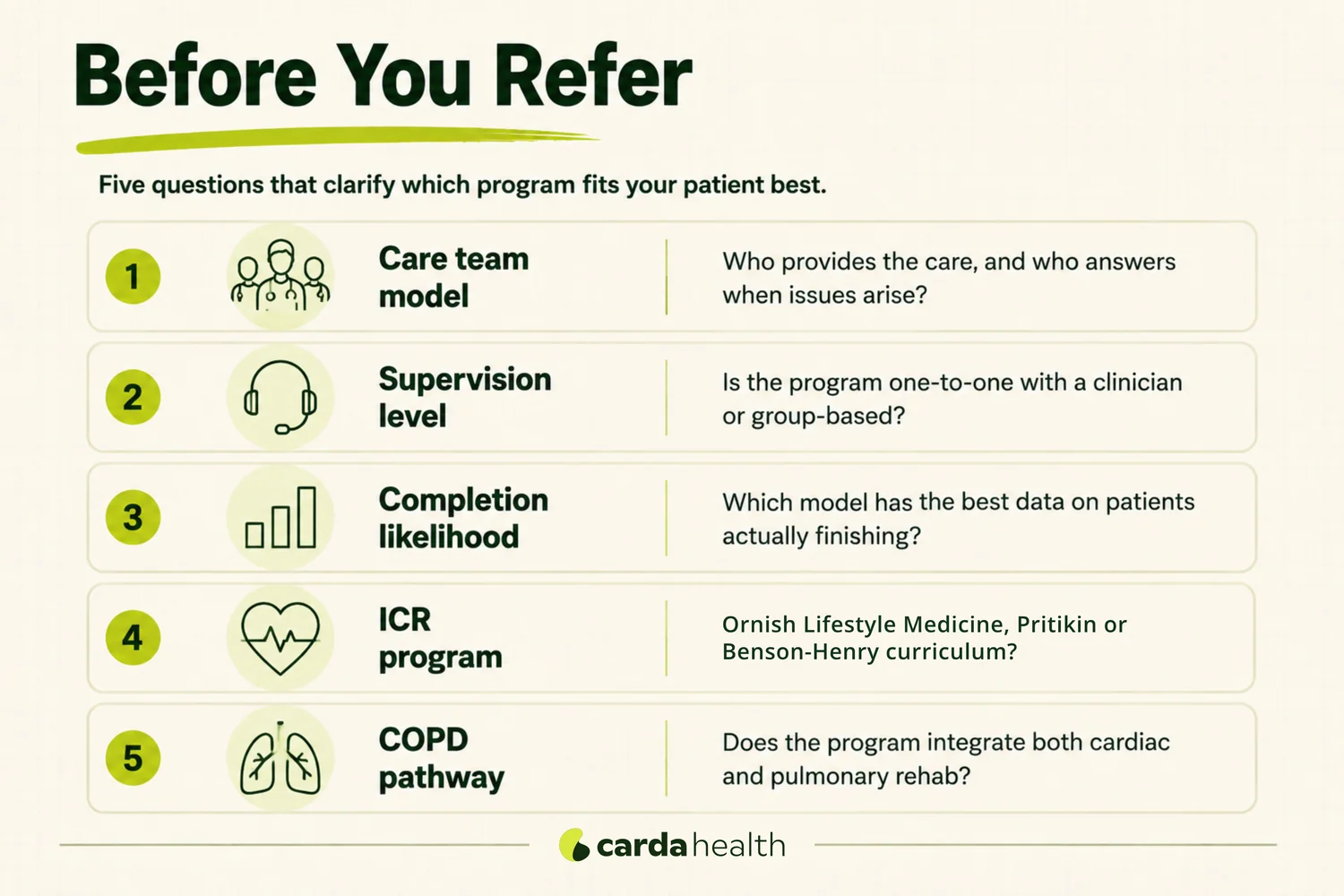
Questions to Ask Before You Refer
Whichever way the decision goes, the same handful of questions separates a program that finishes patients from one that enrolls them.
For Clinicians and Program Leaders
- Who employs the clinicians delivering the sessions, the vendor or your own staff?
- Is exercise supervised one-to-one or in a monitored group, and who is watching the vitals?
- What is the referral-to-first-session interval in days, measured on the last cohort rather than promised?
- What share of prescribed sessions do patients attend, what proportion complete, and how exactly is each defined?
- Which ICR program is offered, and does starting standard CR close that option for this patient?
- What is the pathway for a patient carrying both cardiac and pulmonary diagnoses?
For Patients
- Will I work with the same clinician each session, and will someone be watching my heart rate while I exercise?
- Do I need my hospital to be part of the program, or can I enroll myself?
- What will I pay after the 2026 Medicare Part B deductible of $283?
- What equipment arrives, and who helps me set it up?
- How many sessions am I covered for, and what happens if I miss one?
The Practical Difference
The choice between Aviary Health and Carda Health is really a choice about who runs the program and who can reach it. A health system that wants its own branded, hospital-billed service line has a case for Aviary Health, which can supply the platform and the staff behind it. Nearly everyone else has a shorter path to Carda: a health plan that wants an in-network virtual provider, a system that would rather refer than run a program, and a clinician with a patient outside any Aviary partner network or a diagnosis suited to Ornish intensive rehab. Those patients can be referred to Carda, or enroll themselves, without waiting on procurement.
If attendance is the variable that determines whether rehabilitation works, and the evidence keeps pointing that way, the practical question isn't which platform is better engineered. It is which program your patient can start this month and will actually attend. Reimbursement for both sits under the 2026 telehealth rules for cardiac and pulmonary rehab, which run through the end of 2027.
Discuss a health-system partnership
Refer a patient or check eligibility
Frequently Asked Questions
What is the difference between Aviary Health and Carda Health?
Aviary Health, formerly Recora, powers virtual cardiac and pulmonary rehab programs for health systems and practices, supplying the platform and, in fully managed programs, the clinical staff. Carda Health is a care provider that runs the program itself with its own clinicians and accepts referrals and patient self-enrollment directly. For intensive cardiac rehab, Carda delivers the Ornish program virtually, and Aviary helps health systems launch Benson-Henry at their own facilities.
Is Aviary Health the same company as Recora?
Yes. Recora rebranded as Aviary Health on April 7, 2026. The company was founded in 2020 and is based in New York. Research published under the Recora name, including the 2024 JAHA study conducted with Geisinger, describes the same program.
What are the alternatives to Aviary Health?
For patients and organizations that want a provider-run program rather than a platform, Carda Health is the alternative to consider first: it enrolls patients directly, contracts with health plans, delivers Ornish intensive cardiac rehab virtually, and runs cardiac and pulmonary rehab through one care team. Other options include Movn Health for cardiac rehab and hospital-run center-based programs.
Can a patient enroll in Aviary Health directly?
Not according to its website. Aviary's programs are offered through partner health systems and practices, and its site directs visitors to book a demo rather than check eligibility (checked November 14, 2026). Carda Health accepts direct patient enrollment alongside health system and health plan referrals.
Which virtual cardiac rehab programs qualify as Medicare intensive cardiac rehab?
Medicare recognizes three ICR programs nationally: Ornish Lifestyle Medicine, Pritikin, and Benson-Henry. Carda Health delivers Ornish and is its exclusive virtual provider. Aviary Health delivers Benson-Henry in collaboration with Mass General Brigham. ICR covers up to 72 sessions across 18 weeks.
Does virtual cardiac rehab reduce mortality?
The strongest direct comparison to date, Shah et al. in JAHA (2024), found significantly lower readmission and emergency department use for virtual rehab but no significant difference in one-year mortality or recurrent MI against center-based care. The mortality evidence for cardiac rehabilitation rests on participation itself rather than on the delivery format.
Can a patient switch from standard cardiac rehab to intensive cardiac rehab?
Not within the same series. Under CMS billing guidance, a patient who has started a series of standard cardiac rehabilitation cannot switch into ICR. A patient who starts ICR may switch once to standard CR, keeping the sessions remaining in the program, with up to 72 combined sessions possible at the Medicare contractor's discretion. The ICR decision has to be made before standard sessions begin.
Do both companies offer pulmonary rehabilitation?
Yes. Aviary Health added virtual pulmonary rehab as a health-system service line in 2026, covering COPD, long COVID, and other respiratory conditions. Carda delivers cardiac and pulmonary rehabilitation as an integrated pathway a single patient can move through, and enrolls those patients directly.
How much does virtual cardiac rehab cost with Aviary Health or Carda Health?
Both bill insurance rather than charging patients a program fee, and cost also depends on whether the provider is in network and how sessions are billed. Under Original Medicare, cardiac rehab is a Part B benefit: in 2026 the patient generally pays the $283 deductible, then 20% of the Medicare-approved amount per session, which supplemental coverage may pick up. With Aviary, billing runs through the health system or practice operating the program. Carda bills Medicare and contracted health plans directly, and qualifying Humana members can use Carda's virtual cardiac rehab at no additional cost.
References
8. 42 CFR 410.47. Pulmonary rehabilitation program: conditions of coverage.
11. Ornish Lifestyle Medicine. Intensive cardiac rehabilitation. ornish.com, retrieved August 2026.
12. Carda Health. Ornish Lifestyle Medicine program. cardahealth.com/ornish, retrieved August 2026.
16. Carda Health. Choosing a virtual cardiac rehab vendor (session attendance, 32 of 36).