
Key Takeaway
Yes, the majority of people who have a heart attack survive. With prompt hospital treatment, survival rates exceed 90%. What matters most is how quickly you receive care, the type and severity of the heart attack, and what you do in the weeks and months that follow. Cardiac rehabilitation is one of the strongest predictors of long-term survival after a heart attack.
The Short Answer: Yes, Most People Survive
If you or someone you love has just had a heart attack, the most important thing to know is this: most people survive, and many go on to live active, fulfilling lives. The National Heart, Lung, and Blood Institute (NHLBI) states it plainly: "Most people survive heart attacks and live active, full lives."
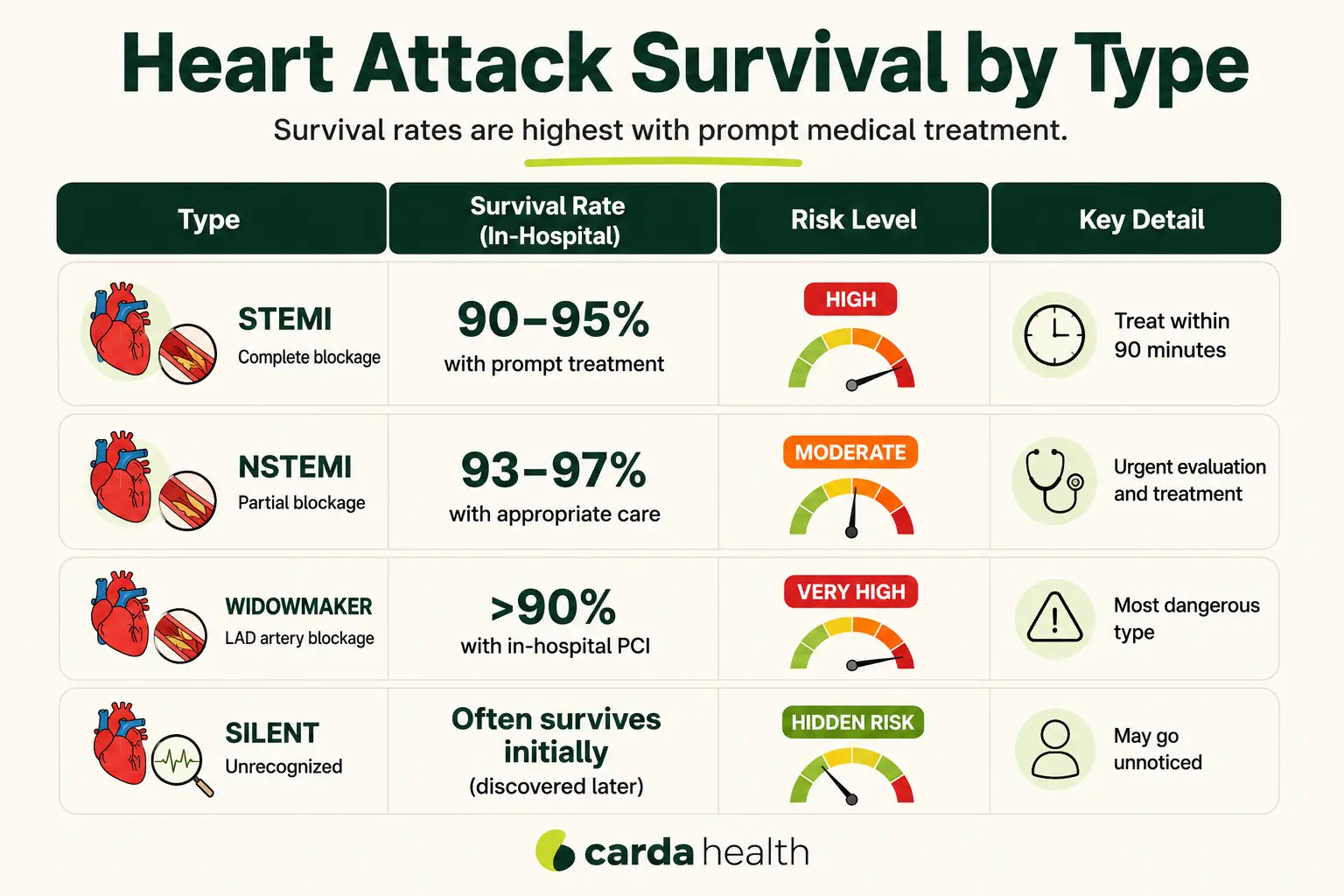
According to the American Heart Association, approximately 805,000 people in the United States have a heart attack each year. Of these, about 605,000 are first-time heart attacks. With modern emergency medicine, in-hospital survival rates now range from 90% to 97%, depending on the type and severity of the event.
{{get-started}}
Survival Rates by Heart Attack Type
Not all heart attacks are the same. The type of heart attack, which artery is affected, and the degree of blockage all influence immediate survival and long-term prognosis.
Also Read: widowmaker heart attack
What Determines Whether You Survive?
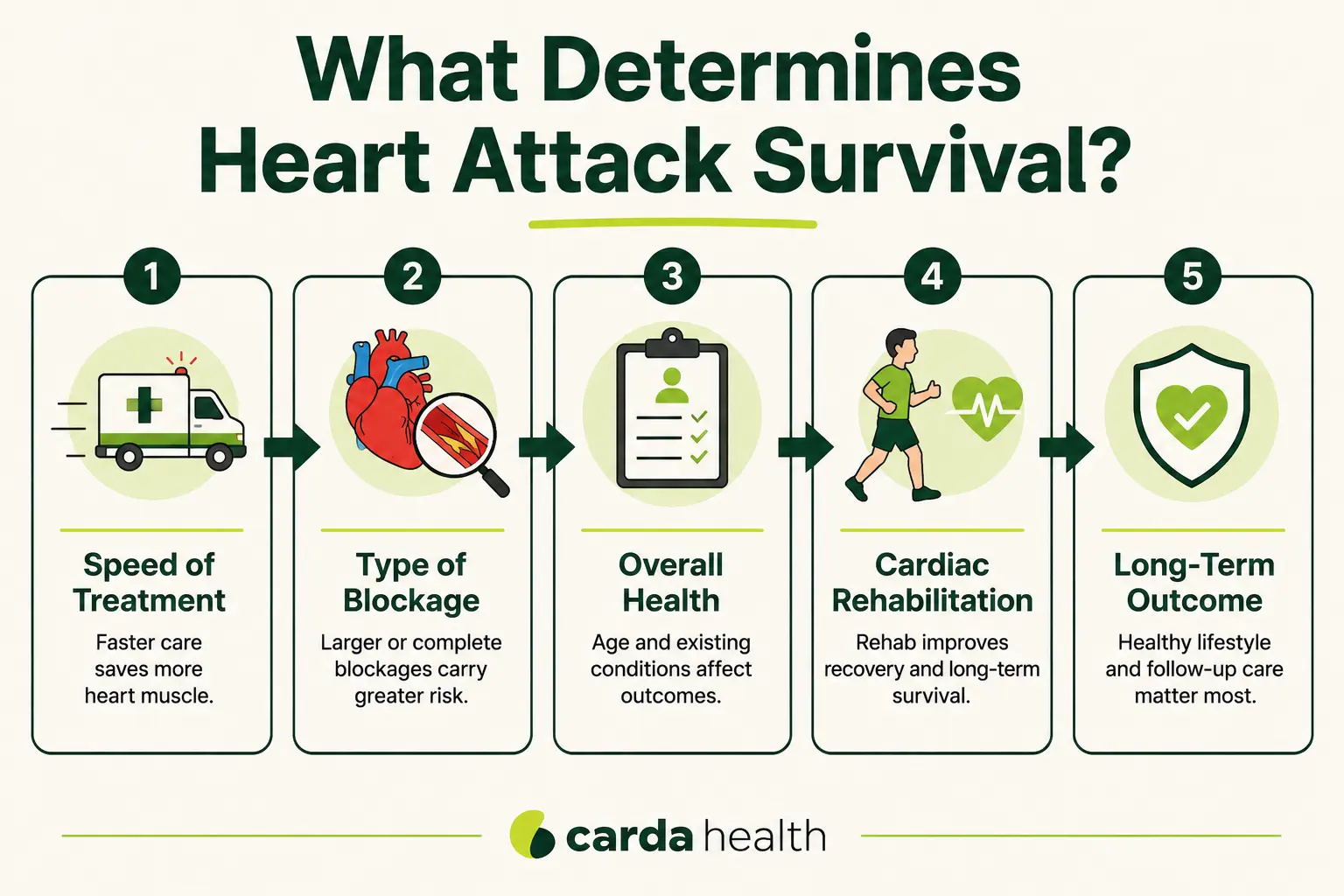
Several factors work together to determine the outcome of a heart attack. Some are within your control; others depend on circumstances and medical response.
Speed of Treatment
Speed is the most critical factor in heart attack survival. The national target for opening a blocked artery (door-to-balloon time) is 90 minutes, and many leading hospitals now aim for under 60 minutes. Every minute of delay means more heart muscle dies.
Yet research suggests that approximately 40% of heart attack victims never make it to the hospital in time to benefit from modern treatments. About 120,000 Americans die from heart attacks each year because they did not call emergency services and seek help quickly enough. Calling an ambulance rather than driving yourself is essential—paramedics can perform an EKG en route and begin treatment before you reach the emergency department.
Type and Location of Blockage
Where the blockage occurs matters. The left anterior descending (LAD) artery supplies roughly 50% of the heart's blood, making a complete LAD blockage, known as a widowmaker, the most dangerous type.
Blockages in the right coronary or circumflex arteries, while still serious, affect a smaller area of heart muscle and generally carry somewhat lower mortality.
A complete blockage (STEMI) is more immediately dangerous than a partial one (NSTEMI), though both require urgent treatment.
Overall Health Before the Event
Your health status at the time of a heart attack significantly affects your chances. Research shows that pre-event physical fitness is one of the strongest predictors of long-term survival. People who exercise regularly before a heart attack tend to have better outcomes than those who are sedentary, even if the heart attack itself is of the same severity.
Comorbidities also play a role. Diabetes, chronic kidney disease, obesity, and advanced age are all associated with worse heart attack outcomes. However, these are risk modifiers, not determinants—people with these conditions survive heart attacks every day.
Can You Survive Without Treatment?
Some people do survive heart attacks without hospital treatment—silent heart attacks, by definition, go unrecognized and untreated at the time they occur. But this is not a reassuring fact. Untreated heart attacks carry a dramatically higher risk of serious complications, including heart failure, dangerous arrhythmias, cardiogenic shock, and sudden cardiac death.
The longer a heart attack goes untreated, the more heart muscle is permanently destroyed. Complications from untreated heart attacks are the leading reason people die from cardiac events.
See our article on what happens if you have a heart attack and don't go to the hospital.
What Happens After You Survive
Surviving a heart attack is the first milestone. What happens next determines whether you thrive long-term or face a heightened risk of another event. Recovery involves three interconnected phases: acute hospital care, structured rehabilitation, and ongoing lifestyle management.
The First Days and Weeks
After emergency treatment, most heart attack patients spend two to four days in the hospital. During this time, the medical team monitors heart rhythm, manages blood pressure, and begins the medications that will protect the heart going forward—typically statins, antiplatelet drugs, beta-blockers, and ACE inhibitors.
If a stent was placed, specific medications to prevent clotting around the stent are also started.
Also Read: heart stent recovery time.
Cardiac Rehabilitation
Cardiac rehabilitation is the most underutilized and most impactful step in heart attack recovery.
Patients who complete rehab are more likely to adhere to their medications, maintain a healthy weight, and sustain the lifestyle changes that protect the heart over time. The CDC-supported Million Hearts Initiative reports that completing a cardiac rehab program reduces cardiovascular death risk by nearly 45% and hospital readmissions by approximately 30%.
Despite these powerful benefits, fewer than 15% of eligible patients in the United States actually complete cardiac rehabilitation. Transportation barriers, scheduling conflicts, limited facility access, and the physical challenge of traveling while recovering are among the most common reasons patients never start or drop out early.
Virtual cardiac rehab programs are designed to solve this problem. Carda Health's at-home program pairs each patient with a clinical exercise physiologist who monitors vital signs in real time during supervised exercise sessions. The program also covers nutrition, stress management, and ongoing education—all delivered from the patient's home.
For heart attack survivors, having an accessible rehab option can be the difference between completing the program and never starting.
Also Read: exercises after a heart attack.
Long-Term Outlook
Long-term life expectancy after a heart attack depends on several individual factors: the extent of heart muscle damage, ejection fraction, medication adherence, cardiac rehab completion, and sustained lifestyle changes. Many heart attack survivors live for decades with the right care and support.
For more detailed information on long-term prognosis after specific types of heart attacks, see our articles on life expectancy after a widowmaker heart attack and whether heart failure can be reversed.
Conclusion
Modern emergency medicine has made the immediate survival odds better than at any point in history. But surviving the event is only the first chapter. What you do in the weeks and months that follow—taking your medications, completing cardiac rehabilitation, eating well, staying active, and managing stress—is what determines whether you live a long, active life or face a heightened risk of another event.
{{get-started}}
FAQs
Can you survive a heart attack?
Yes. In-hospital survival rates range from 90% to 97% depending on the type and severity of the event.
What is the survival rate of a heart attack?
In-hospital survival rates for heart attacks generally range from 90% to 97%. Survival depends on the type of heart attack (STEMI, NSTEMI, or silent), the artery involved, how quickly treatment is received, and the patient's overall health. The widowmaker heart attack, a complete blockage of the LAD artery, has the lowest survival rate when it occurs outside a hospital (~12%), but exceeds 90% survival with prompt in-hospital treatment.
What increases your chances of surviving a heart attack?
Consistent medication adherence, a heart-healthy diet, regular exercise, smoking cessation, and management of blood pressure, cholesterol, and blood sugar can increase your chances of survival.
Can you live a normal life after a heart attack?
Yes. With proper medical care, medication, cardiac rehabilitation, and lifestyle changes, many heart attack survivors return to their normal activities and live for decades. The key is treating the heart attack as a turning point—not the end of an active life, but the beginning of a more intentional approach to heart health.
References
- American Heart Association. Heart Attack and Stroke Statistics, At-a-Glance. heart.org.
- National Heart, Lung, and Blood Institute (NHLBI). Heart Attack Recovery. nhlbi.nih.gov.
- Centers for Disease Control and Prevention. Cardiac Rehabilitation. cdc.gov.
- Thygesen K, Alpert JS, et al. Fourth Universal Definition of Myocardial Infarction. Circulation. 2018;138(20).
- Cleveland Clinic. Heart Attack: Management and Treatment. clevelandclinic.org.
- Acharya T, et al. Association of Unrecognized MI With Long-Term Outcomes: The ICELAND MI Study. JAMA Cardiol. 2018.