
If you have atrial fibrillation, you may have found yourself moving less, worried that raising your heart rate could set off an episode. It is a completely understandable fear, but it often makes things worse. A growing body of evidence shows that the right kind of exercise, delivered through cardiac rehab, can actually reduce AFib episodes and help you feel better. Here is what the research says, whether it is safe, and what to expect.
The Fear That Keeps People With AFib From Moving
AFib can cause palpitations, breathlessness, and fatigue, so it is natural to associate exertion with symptoms and to pull back from activity. The problem is that a sedentary lifestyle tends to worsen the very things that fuel AFib, including weight gain, high blood pressure, and poor fitness. In other words, avoiding exercise to protect your heart can quietly undermine it. If you want a refresher on the condition itself, our guide to what AFib is covers the basics. This article focuses on a more specific question: can structured exercise and cardiac rehab help?
Does Cardiac Rehab Actually Help AFib?
The honest answer is encouraging, with some healthy caution. The most recent evidence points clearly in a positive direction. A 2025 analysis of clinical trials reported by Harvard Health pooled more than 2,000 people with AFib and found that those who took part in cardiac rehab had about a 32 percent lower risk of AFib returning, along with less severe symptoms and better exercise capacity. This analysis was itself a Cochrane systematic review, the same rigorous standard used to evaluate other established treatments, which adds weight to the findings.
| Outcome | What the evidence shows | Confidence |
|---|---|---|
| AFib recurrence | Fewer episodes; about a third lower risk in the 2025 analysis | Promising |
| Symptom severity | Episodes tend to be less severe and less frequent | Promising |
| Exercise capacity | Improved fitness and stamina | Moderate |
| Mental well-being | Better mood and quality of life | Moderate |
| Survival (mortality) | Not yet proven; more research is needed | Unproven |
The takeaway: cardiac rehab reliably helps people with AFib have fewer, milder episodes and feel better, even though we cannot yet say it extends life. That is a meaningful benefit, and importantly, the studies found no increase in serious adverse events.
One important point of context: cardiac rehab works alongside your medical treatment, not in place of it. It does not replace the medications your doctor prescribes to manage AFib, including rate- or rhythm-control drugs and, crucially, the blood thinners (anticoagulants) used to lower your risk of stroke, which is the most serious danger of AFib. Think of rehab as adding to your care, while you continue everything your care team has prescribed.
{{get-started}}
Is Exercise Safe With AFib?
For most people with AFib, yes, exercise is not only safe but beneficial, as long as it is done at the right intensity and, ideally, with professional guidance. The reassuring finding across the research is that supervised, moderate exercise did not increase serious problems. The nuance worth understanding is about intensity.
The Sweet Spot: Why Moderate Beats Extreme
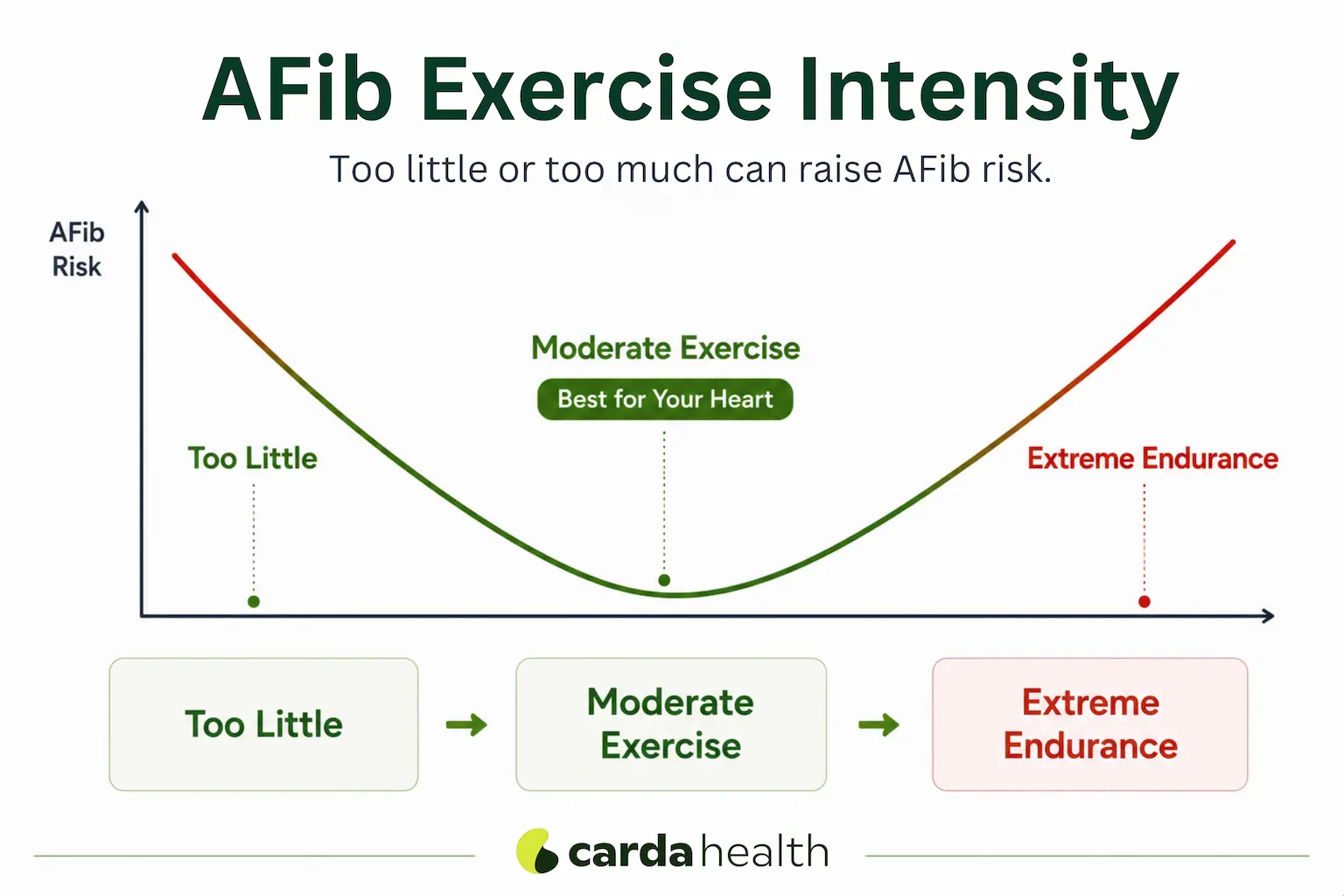
Exercise and AFib have what researchers call a U-shaped relationship. Too little activity is bad, but so is too much of the wrong kind. Moderate exercise, such as brisk walking, cycling, or swimming, tends to reduce AFib burden by improving blood pressure, weight, and fitness. At the far extreme, very intense and prolonged endurance training, the kind done by some elite athletes, can actually raise AFib risk by stressing and stretching the heart. The good news is that the sweet spot is comfortably in reach for most people: steady, moderate activity, not punishing workouts.
Why Supervision Makes the Difference
This is exactly where cardiac rehab earns its value. Rather than guessing at the right intensity, you exercise under the eye of trained professionals who set a safe, effective level for you, monitor your heart rhythm and response, and adjust as you progress. That structure removes the guesswork and, just as importantly, the fear. Knowing an expert is watching gives many people the confidence to move again.
Supervision also matters for a reason specific to AFib. During an episode, your heart rate can climb quickly and unpredictably with exertion, and how well your rate is controlled affects how safely you can exercise. A rehab team keeps an eye on this in real time, keeps your intensity in a safe range, and can flag if your rate is running too high, which is difficult to judge on your own.
More Than Exercise: The Whole-Package Approach
One of the most valuable things about cardiac rehab for AFib is that it is not just a treadmill. AFib is strongly driven by modifiable risk factors, and addressing them is where much of the benefit comes from. A good program also helps you with weight management, blood pressure control, reducing alcohol, improving sleep, and quitting smoking. Research on comprehensive lifestyle and risk-factor programs, such as trials of weight loss and alcohol reduction, shows that this combined approach reduces AFib symptoms and helps people stay in normal rhythm. Rehab packages exercise and these lifestyle changes together, with coaching and support to make them stick.

What to Expect From a Cardiac Rehab Program
If you have never done cardiac rehab, here is the general shape of it. You start with an assessment of your health, fitness, and goals. From there, you take part in supervised exercise sessions, typically a few times a week over about 12 weeks, with your heart monitored throughout. Alongside the exercise, you receive education and coaching on nutrition, medications, stress, and the risk factors above, plus support for the emotional side of living with a heart condition. The pace is tailored to you, starting gently and building as your confidence and fitness grow. To learn more about the format, see our overview of what cardiac rehab involves and its benefits.
How Carda Health Can Help
A major barrier to cardiac rehab is simply getting to a center several times a week, and AFib programs are not offered everywhere. Carda Health removes that hurdle by delivering virtual cardiac rehab from home, with live, supervised sessions and real-time heart monitoring. For someone with AFib, that means expert eyes on your rhythm and intensity, the confidence to exercise safely, and the convenience that makes it easier to finish the program.
One honest note on cost: AFib on its own is not always a covered indication for cardiac rehab under Medicare, which generally ties coverage to conditions like a recent heart attack, bypass, stent, stable angina, valve surgery, transplant, or reduced-ejection-fraction heart failure. Many people with AFib also have one of these, but not everyone does, so coverage varies.
If you are wondering whether it is a fit for you, the simplest step is to check your eligibility and talk it through with your care team.
When to Slow Down or Stop: Warning Signs
Stop exercising and rest, and contact your doctor, if you experience:
- Chest pain or pressure
- Severe shortness of breath beyond normal exertion
- Dizziness, lightheadedness, or fainting
- A racing or irregular heartbeat that does not settle with rest
If you have symptoms of a heart attack or stroke, call 911 immediately.
The Bottom Line
If AFib has made you afraid to move, the evidence offers real reassurance. Cardiac rehab, built around moderate, supervised exercise and healthy lifestyle changes, can lower your risk of AFib coming back, ease your symptoms, and help you feel stronger and calmer, safely. It is not about pushing hard; it is about moving smart, with expert support. For most people with AFib, that is one of the most effective and empowering steps they can take.
{{get-started}}
Frequently Asked Questions
Is it safe to exercise with AFib?
For most people, yes. Moderate, supervised exercise is safe and beneficial for AFib, and studies have not found it raises the risk of serious problems. The key is the right intensity and checking with your doctor first, especially if your AFib is new or your symptoms are not controlled.
Does cardiac rehab help atrial fibrillation?
The evidence says yes for symptoms and episodes. A 2025 analysis found cardiac rehab lowered AFib recurrence by about a third, reduced symptom severity, and improved fitness and well-being. A mortality benefit has not been proven, but the quality-of-life gains are meaningful.
What is the best type of exercise for AFib?
Moderate aerobic activity like brisk walking, cycling, or swimming is the sweet spot, often building toward about 150 minutes a week. A cardiac rehab team can set the right starting point and intensity for you.
Can exercise make AFib worse?
Moderate exercise generally helps. The exception is very intense, prolonged endurance training, which can increase AFib risk in some people. This U-shaped pattern is why moderate, guided exercise is recommended over extreme workouts.
Can weight loss and lifestyle changes reduce AFib episodes?
Yes. AFib is strongly linked to weight, blood pressure, alcohol, and sleep. Programs that combine exercise with these lifestyle changes, like those studied in the ACTIVE-AF trial, reduce AFib burden and help maintain normal rhythm. Cardiac rehab bundles these together.
What should I expect from a cardiac rehab program?
An initial assessment, then supervised exercise sessions a few times a week over about 12 weeks with heart monitoring, plus education and coaching on lifestyle and risk factors. The pace is tailored to you and builds gradually.
When should I stop exercising and call my doctor?
Stop and rest if you have chest pain, severe breathlessness, dizziness or fainting, or a racing, irregular heartbeat that does not settle. Call 911 for signs of a heart attack or stroke. Otherwise, report persistent or worsening symptoms to your care team.
References
- Harvard Health Publishing. Cardiac rehab appears to help people with atrial fibrillation. 2025.
- Buckley BJR, et al. Exercise-based cardiac rehabilitation for adults with atrial fibrillation. Cochrane Database of Systematic Reviews. 2024.
- ACTIVE-AF: An Exercise and Physical Activity Program in Patients With Atrial Fibrillation. JACC: Clinical Electrophysiology. 2023.
- Exercise and Atrial Fibrillation: Current Evidence, Knowledge Gaps, and Future Directions. PMC.
- AF Patients Could Benefit From Exercise-Based Cardiac Rehab. TCTMD. 2025.