Key Takeaways
A widowmaker heart attack is life-threatening, but it is not automatically a death sentence. With prompt treatment, in-hospital survival rates now exceed 90%. Five-year survival for treated patients ranges from 65% to 85%, and many survivors live for decades, especially those who complete cardiac rehabilitation, take prescribed medications, and adopt heart-healthy habits.
If you or someone you love has survived a widowmaker heart attack, one of the first questions that comes to mind is: how long can I expect to live? It's a deeply personal question, and the honest answer is that it depends on several measurable factors, most of which are within your influence.
This article walks through what current research tells us about long-term survival after a widowmaker, the specific variables that matter most, and the steps that give survivors the best chance at a long, active life.
Survival Rates: What the Data Shows
The immediate survival picture has improved dramatically over the past two decades. Data reported by the American Heart Association shows that only about 12% of people who experience a widowmaker outside of a hospital survive the event. But when patients reach the hospital quickly and undergo percutaneous coronary intervention (PCI), in-hospital survival rates now exceed 90%.
Prognosis & Life Expectancy
Beyond hospital discharge, longitudinal studies of heart attack survivors with significant LAD artery involvement paint a more nuanced picture. Five-year survival rates generally fall between 65% and 85%, depending on how much heart muscle was damaged and whether the patient has other health conditions such as diabetes or kidney disease. Patients whose heart function remained relatively preserved after the event tend to have the best long-term outcomes.
A large national registry study found that STEMI patients who received prompt PCI and maintained good medication adherence had a median survival time of over 12 years. Patients with well-preserved ejection fraction and no major comorbidities can often reach or even exceed the average life expectancy for their age group.
{{get-started}}
Factors That Shape Long-Term Prognosis
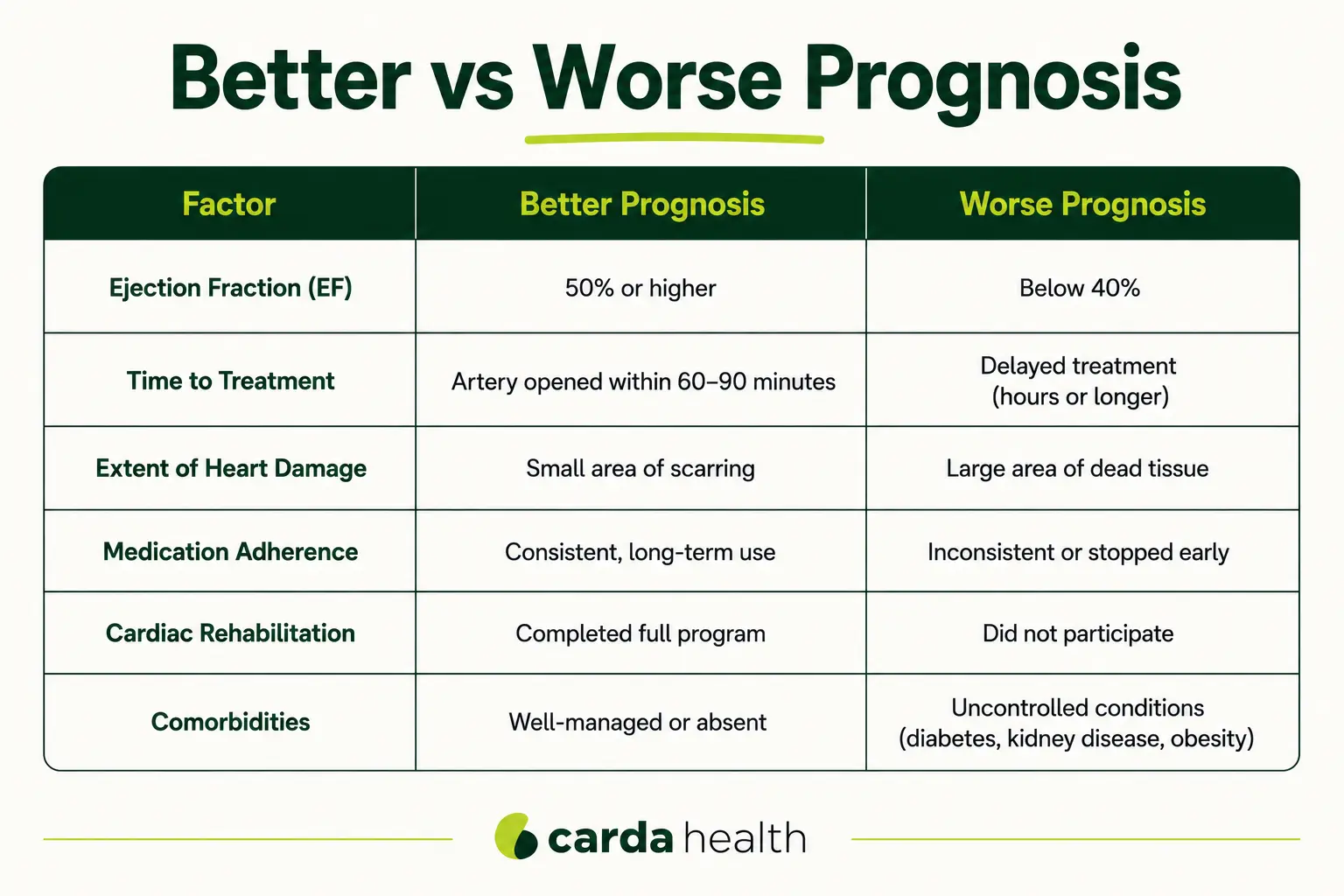
No single number can predict life expectancy after a widowmaker. Instead, doctors look at a combination of measurable factors that together create a clearer picture of long-term outlook.
Why Ejection Fraction Matters So Much
Ejection fraction (EF) is arguably the single most important number in predicting long-term outcomes after a widowmaker. EF measures the percentage of blood the left ventricle pumps out with each contraction.
A normal EF is 55% or higher.
After a widowmaker, the EF often drops because damaged heart muscle can no longer contract effectively. An EF below 40% is associated with a significantly higher risk of developing heart failure and a shorter life expectancy. However, EF is not necessarily fixed — it can improve over time with proper medical treatment, medication, and structured cardiac rehabilitation.
For a deeper look at how heart function can recover, see our article on whether heart failure can be reversed.
The Role of Cardiac Rehabilitation in Long-Term Survival
Research consistently shows that cardiac rehab is one of the strongest predictors of a good long-term outcome after a heart attack. The CDC reports that completing a cardiac rehabilitation program can reduce cardiovascular death risk by nearly 45% and hospital readmissions by approximately 30%.
This is one reason cardiac rehab is so important after a major heart attack. Supervised exercise programs have been shown to improve ejection fraction, reduce the risk of subsequent cardiac events, and lower overall mortality.
Yet fewer than 15% of eligible patients in the United States actually complete cardiac rehab. Transportation barriers, rigid scheduling, and the physical challenge of traveling to a facility while still recovering are among the most common reasons patients drop out or never start.
Virtual cardiac rehab programs are designed to remove those barriers.
Carda Health's at-home program pairs each patient with a clinical exercise physiologist who monitors vital signs in real time during supervised exercise sessions. The program also covers nutrition, stress management, and ongoing education, all from home.
Learn more in our guides to cardiac rehabilitation and exercising safely after a heart attack.
What Survivors Can Control
While no one can guarantee a specific outcome, the evidence is clear that survivors who take an active role in their recovery tend to live significantly longer than those who do not.
The most impactful steps include taking all prescribed medications consistently (particularly statins, antiplatelet agents, beta-blockers, and ACE inhibitors), completing a full cardiac rehabilitation program, adopting a heart-healthy diet such as a Mediterranean-style eating pattern, engaging in regular moderate physical activity, quitting smoking if applicable, and managing blood pressure, cholesterol, and blood sugar with ongoing medical guidance.
Equally important is addressing the emotional side of recovery. Depression and anxiety are common after a major heart attack, affecting up to one in three survivors. Speaking with a healthcare provider about mental health support is a critical and often overlooked part of long-term survival.
Conclusion
A widowmaker heart attack is a serious event, but it does not define the rest of your life. Advances in emergency medicine, interventional cardiology, and rehabilitation have given survivors more years, and better years, than at any point in history.
The factors that matter most after surviving the initial event are largely within your control: staying on your medications, completing cardiac rehab, eating well, moving your body, and working closely with your care team.
If you or a loved one is recovering from a widowmaker heart attack, check your eligibility for Carda Health's virtual cardiac rehab program.
{{get-started}}
Frequently Asked Questions
Can you live a normal lifespan after a widowmaker heart attack?
Many survivors do. Patients who receive prompt treatment, maintain a preserved ejection fraction, complete cardiac rehabilitation, and follow their medication and lifestyle plan can reach or exceed the average life expectancy for their age. Long-term outcomes depend heavily on individual factors and ongoing care.
What is the five-year survival rate after a widowmaker?
Studies show five-year survival rates between 65% and 85% for treated patients with significant LAD involvement. Patients with well-preserved heart function and few comorbidities tend to be at the higher end of this range.
Does ejection fraction improve after a widowmaker heart attack?
It can. With appropriate medications, cardiac rehabilitation, and lifestyle changes, many patients see measurable improvements in ejection fraction over weeks to months after the event. The degree of improvement depends on the extent of heart muscle damage.
How does cardiac rehab affect life expectancy?
Completing cardiac rehab has been shown to reduce cardiovascular death risk by nearly 45%. Patients who participate in rehab are also less likely to be readmitted to the hospital and report better quality of life long-term.
What increases the risk of a shorter life expectancy after a widowmaker?
The most significant risk factors for reduced life expectancy include a low ejection fraction (below 40%), delayed treatment during the initial event, uncontrolled diabetes or kidney disease, failure to take prescribed medications, not participating in cardiac rehab, and continued smoking.
References
- American Heart Association. Heart Attack and Sudden Cardiac Arrest Differences. heart.org.
- Reitan C, et al. Excess Mortality and Loss of Life Expectancy After Myocardial Infarction. Circulation. 2024;150(1).
- Anderson L, et al. Exercise-Based Cardiac Rehabilitation for Coronary Heart Disease. Cochrane Database of Systematic Reviews. 2016.
- Centers for Disease Control and Prevention. Cardiac Rehabilitation. cdc.gov.
- National Heart, Lung, and Blood Institute (NHLBI). Cardiac Rehabilitation. nhlbi.nih.gov.
- Cleveland Clinic. Widowmaker Heart Attack. my.clevelandclinic.org.
- Entezarjou A, et al. Culprit vessel: Impact on short-term and long-term prognosis in patients with STEMI. Open Heart. 2018.