

Key Takeaways: Atrial fibrillation (AFib) and atrial flutter are closely related heart rhythm disorders that start in the heart's upper chambers. The core difference is the pattern: AFib is chaotic and irregular, while flutter is organized and regular but very fast, like a signal racing around a fixed loop. They share most symptoms and treatments, and they often occur together or convert into one another. Both raise the risk of stroke, so both need proper evaluation and stroke-prevention care. Flutter is not simply the safe one, though it does tend to respond especially well to a procedure called catheter ablation.
If you have been told you have atrial fibrillation or atrial flutter, or perhaps both, the two terms can be confusing. They sound different but share a great deal, and even doctors treat them in similar ways. Here is a clear, side-by-side look at how AFib and atrial flutter compare, whether one is more serious, and what it means for treatment. For a deeper look at AFib on its own, see our full guide to what AFib is.
The Core Difference
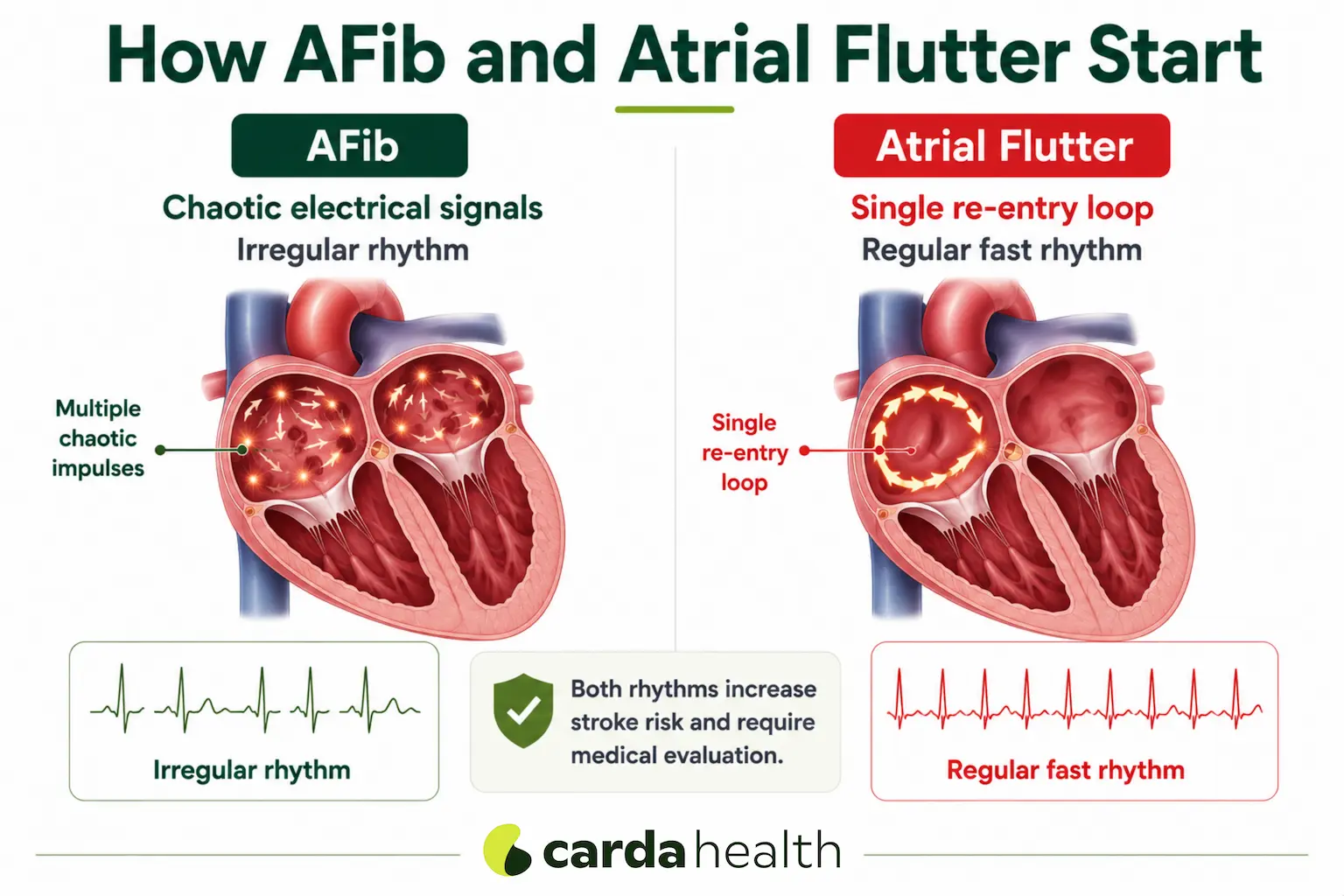
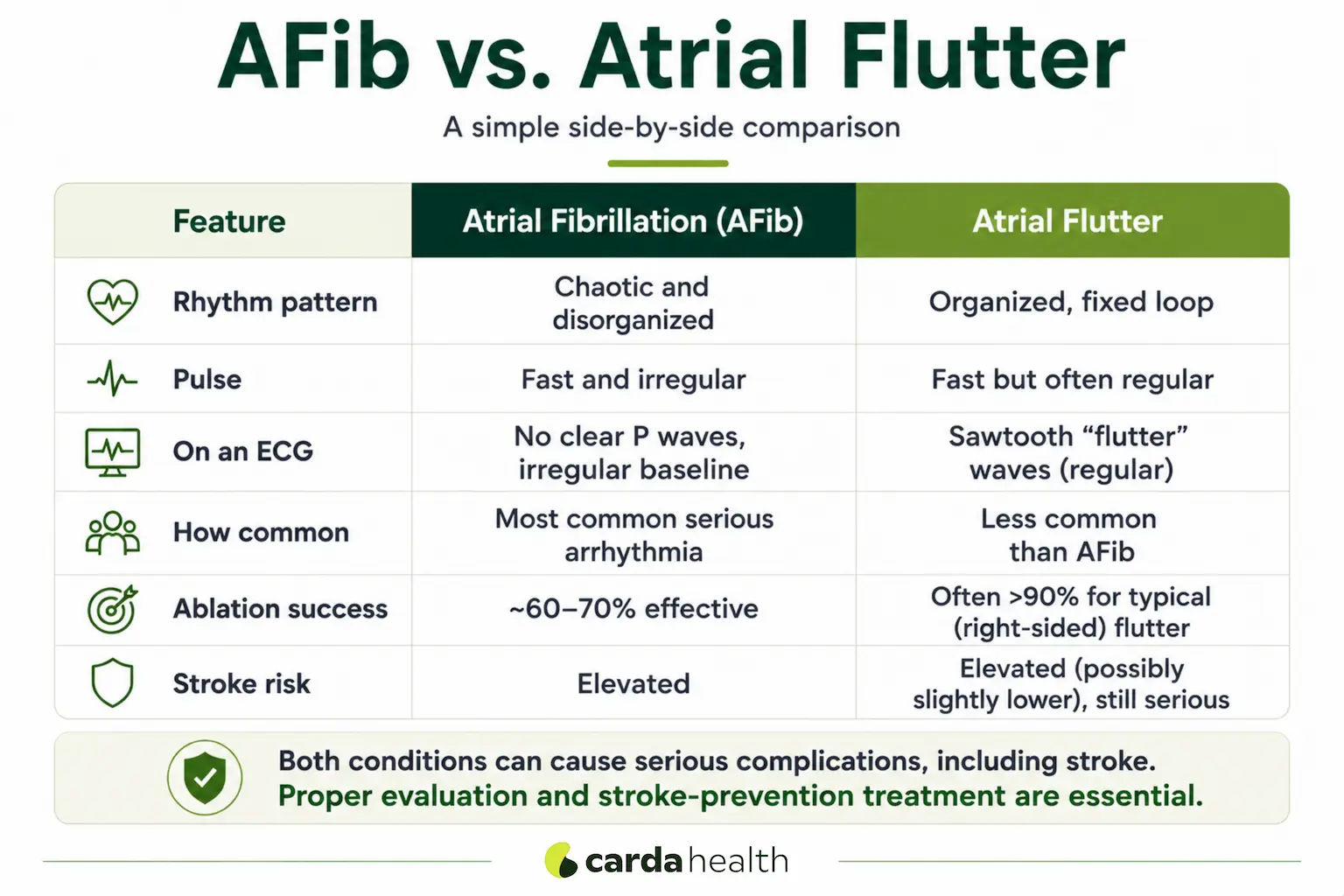
Both conditions are arrhythmias, problems with the heart's electrical signals that begin in the upper chambers, the atria. The difference is in the pattern of those signals. In atrial flutter, the electrical impulse travels in a fast but organized loop, circling the same predictable path like a car on a racetrack. This produces a rapid but regular rhythm. In AFib, the signals are fast and completely disorganized, so instead of beating in a coordinated way, the atria quiver or shake. This produces a fast and irregular rhythm. That single distinction, an organized loop versus chaotic quivering, drives most of the differences between the two.
AFib vs. Atrial Flutter at a Glance
How the Symptoms Compare
Here the two are remarkably alike. Both can cause palpitations (a racing, pounding, or fluttering feeling in the chest), along with shortness of breath, fatigue, lightheadedness, and sometimes chest discomfort. And both can be completely silent, causing no symptoms at all, which is part of why they can go undetected. In general, flutter's symptoms may feel a little less severe than AFib's, but this varies from person to person, and you cannot reliably diagnose either one by how it feels.
How Doctors Tell Them Apart
Because the symptoms overlap so much, the two are distinguished by an electrocardiogram (ECG), which records the heart's electrical activity. On an ECG, atrial flutter produces a distinctive regular "sawtooth" pattern, while AFib shows no organized atrial activity and an irregular rhythm. A rough clue is the pulse: a fast but regular pulse leans toward flutter, while a fast and irregular one leans toward AFib. Still, many people cannot tell the difference on their own, and sometimes a longer recording with a wearable monitor is needed to catch an intermittent rhythm.
Is One More Dangerous Than the Other?
This is the question most people want answered, and the honest answer is that both are serious and neither should be dismissed. Both allow blood to pool in the atria, which can form a clot that travels to the brain and causes a stroke. Some research, including a large comparison of Medicare patients, suggests the stroke risk with flutter may be somewhat lower than with AFib, but it remains clearly elevated above normal, and doctors use the same stroke-risk assessment and often the same blood-thinning approach for both. So flutter is not the "safe" arrhythmia. It simply tends to be more curable, as we will see.
Can One Turn Into the Other?
Yes, and this is one of the most important things to understand. The two frequently coexist and convert back and forth. Many people with flutter go on to develop AFib, in some studies a third or more over time, and AFib can organize into flutter as well. This close relationship is a major reason doctors take flutter seriously and often continue stroke-prevention treatment even after flutter is successfully treated, because the risk of AFib appearing later remains.
How Each Is Treated
Treatments They Share
The overall goals are the same: control the heart rate, restore a normal rhythm where possible, and prevent stroke. Shared treatments include rate- and rhythm-control medications, blood thinners (anticoagulants) to lower stroke risk, and cardioversion, a procedure that resets the rhythm using medication or a brief electrical shock. The American Heart Association broadly recommends similar management for both.
Where They Differ
The biggest practical difference is catheter ablation, a minimally invasive procedure that scars the small area of tissue driving the abnormal rhythm. Because typical atrial flutter follows one predictable loop, ablation can interrupt it with a high success rate, often over 90 percent, which is why ablation is frequently the preferred treatment for flutter. AFib is more chaotic and harder to map, so ablation is effective but less consistently curative, and medication is often the first step. In short, flutter is often the more curable of the two.
Living Well With an Irregular Rhythm
Whichever rhythm you have, the day-to-day fundamentals are similar, and they matter. Managing blood pressure, weight, alcohol, and sleep, and staying appropriately active, can reduce episodes and support your overall heart health. If you are nervous about exercising with an irregular heartbeat, that is common and understandable, and supervised programs can help you do it safely. Our guide to cardiac rehab for AFib explains the evidence, and Carda Health offers virtual cardiac rehab with live, monitored sessions from home. Always work with your care team on the plan that fits your rhythm and situation.
The Bottom Line
AFib and atrial flutter are two closely related rhythm disorders that differ mainly in their pattern: AFib is chaotic and irregular, while flutter is organized and regular but fast. They feel similar, are treated similarly, often occur together, and both raise the risk of stroke, so both deserve proper evaluation and care. The encouraging news is that these rhythms are very manageable, and flutter in particular is often curable with ablation. If you notice palpitations or an irregular heartbeat, see your doctor for an ECG rather than trying to sort it out on your own.
{{get-started}}
Frequently Asked Questions
What is the main difference between AFib and atrial flutter?
The pattern of the abnormal signal. In atrial flutter, the electrical impulse travels in an organized, fixed loop, producing a fast but regular rhythm. In AFib, the signals are chaotic, so the rhythm is fast and irregular and the atria quiver rather than beat in a coordinated way.
Is atrial flutter more or less dangerous than AFib?
Both are serious and both raise stroke risk. Some research suggests flutter's stroke risk may be somewhat lower than AFib's, but it is still clearly elevated, and doctors use the same stroke-prevention approach for both. Flutter is not simply the safe one; it just tends to be more curable.
Can atrial flutter turn into AFib?
Yes, and it often does. A significant share of people with flutter, a third or more in some studies, go on to develop AFib, and AFib can organize into flutter too. Because of this, stroke-prevention treatment is often continued even after flutter is treated.
Can you have both AFib and atrial flutter?
Yes. The two frequently coexist and can convert back and forth, which is one reason they are managed with similar strategies and why ongoing monitoring matters.
How do doctors tell AFib and flutter apart?
With an electrocardiogram (ECG). Flutter shows a regular sawtooth pattern, while AFib shows an irregular rhythm with no organized atrial waves. A fast but regular pulse suggests flutter, and a fast, irregular pulse suggests AFib, but only an ECG can confirm it.
Is the treatment different for atrial flutter?
They share most treatments (rate and rhythm control, blood thinners, and cardioversion), but they differ in ablation. Because typical flutter follows one predictable loop, catheter ablation cures it at a high rate, often over 90 percent, so it is frequently the preferred treatment for flutter.
Does atrial flutter cause a stroke risk like AFib?
Yes. Flutter allows blood to pool and clot in the heart, raising stroke risk much like AFib. That is why stroke-risk assessment and blood thinners are an important part of managing flutter, not just AFib.
References
- American Heart Association. What Is Atrial Flutter?
- UChicago Medicine. Atrial fibrillation vs. atrial flutter: understanding the difference.
- Al-Kawaz M, et al. Comparative Risks of Ischemic Stroke in Atrial Flutter versus Atrial Fibrillation. J Stroke Cerebrovasc Dis. 2018.
- Elevated Incidence of Atrial Fibrillation and Stroke in Patients With Atrial Flutter: A Population-Based Study.
- Healthline. Atrial Flutter vs. Atrial Fibrillation: What's the Difference?