
Key Takeaways
- Angina is chest pain caused by temporarily reduced blood flow to the heart.
- A heart attack occurs when blood flow is blocked long enough to damage or destroy heart muscle.
- Angina is a symptom and a warning sign -- it does not cause permanent damage.
- A heart attack is a medical emergency.
- If you are unsure which one you are experiencing, call 911 immediately.
What Is Angina?
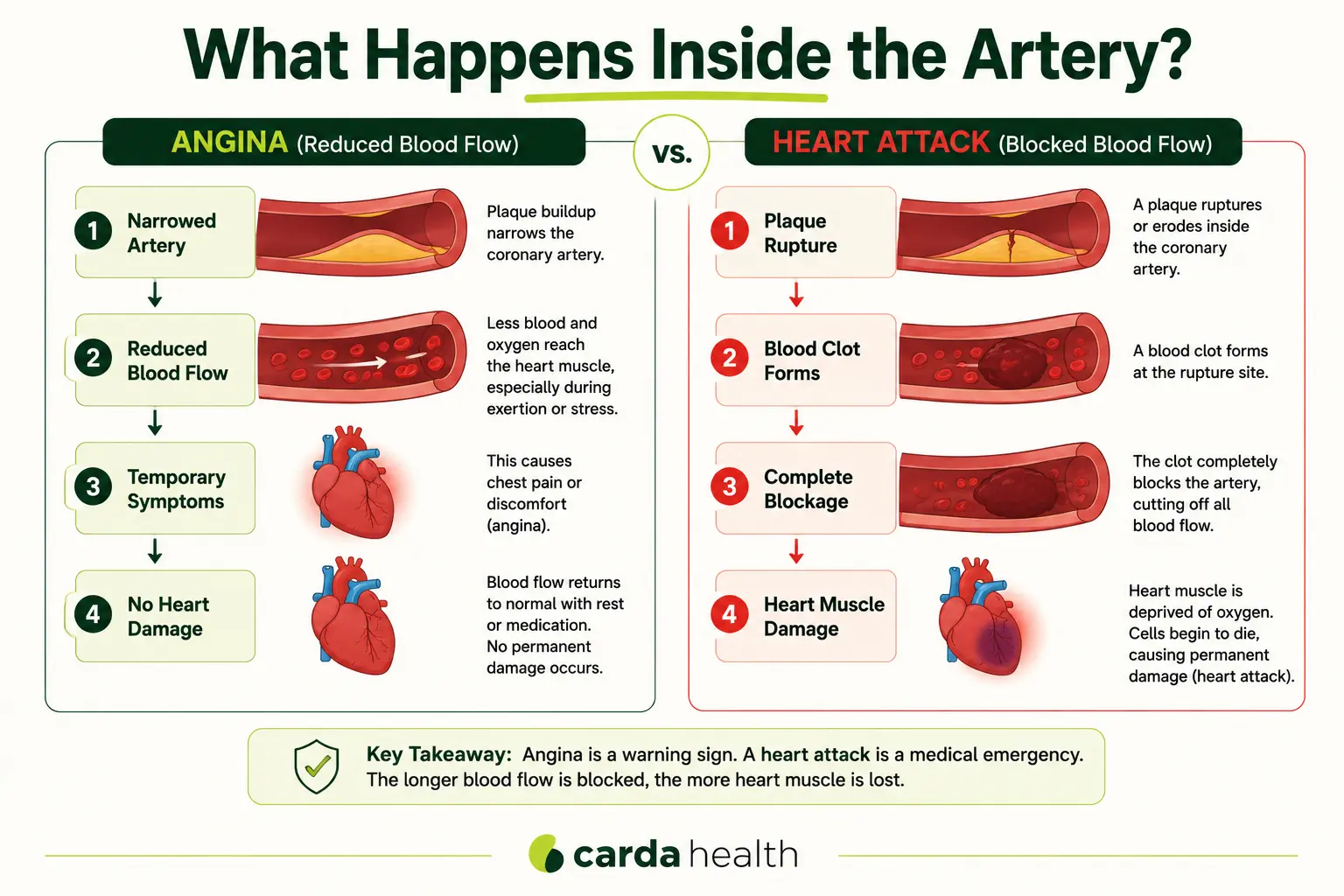
Angina is a term for chest pain or discomfort that occurs when the heart muscle is not receiving enough oxygen-rich blood. It is not a disease -- it is a symptom of an underlying condition, most commonly coronary artery disease (CAD). When the arteries that supply blood to the heart become narrowed by plaque buildup, the heart can still receive enough blood at rest, but may struggle to get adequate supply during physical exertion or emotional stress. That mismatch between supply and demand is what produces the sensation of angina.
There are different types of angina, each with different levels of risk. Stable angina follows a predictable pattern, while unstable angina is unpredictable and considered a medical emergency.
See our detailed guide on stable vs. unstable angina
What Is a Heart Attack?
A heart attack, medically known as a myocardial infarction, occurs when blood flow to part of the heart is blocked severely enough and for long enough that heart muscle cells begin to die.
Unlike angina, the damage from a heart attack is permanent and irreversible. Dead heart muscle tissue is replaced by scar tissue, which cannot contract or pump blood.
Most heart attacks occur when a plaque deposit inside a coronary artery ruptures, triggering a blood clot that completely blocks the artery. The longer the blockage persists, the more heart muscle is lost.
Also Read: what happens after a heart attack.
{{get-started}}
Key Differences Between Heart Attack and Angina
Why Symptoms Are So Easy to Confuse
One of the biggest challenges with angina and heart attacks is that they share many of the same symptoms. Both can produce chest pain or pressure (often described as squeezing, tightness, or heaviness), pain that radiates to the arms, jaw, neck, shoulders, or back, shortness of breath, nausea, sweating, and lightheadedness.
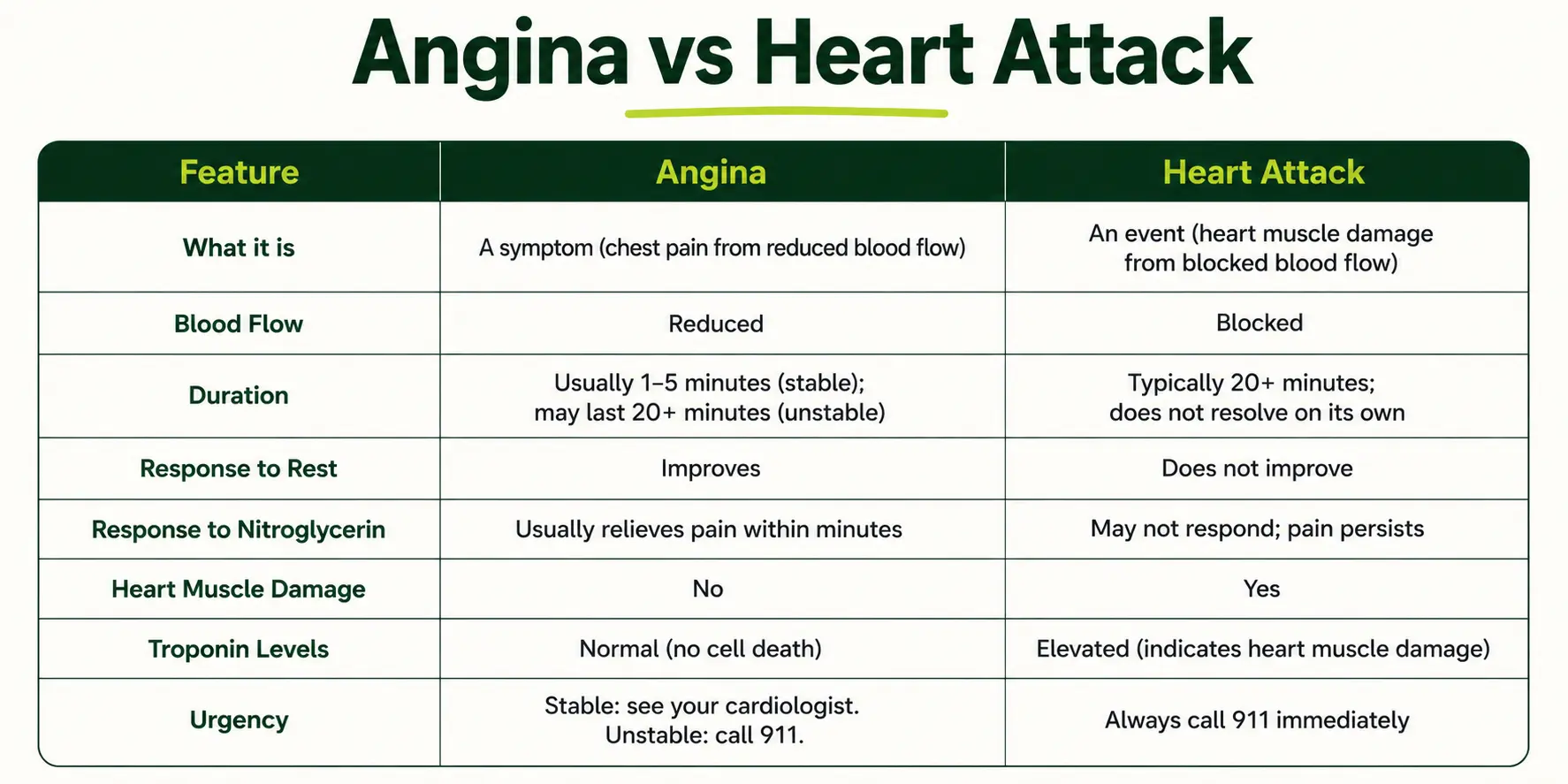
The differences are subtle and not always reliable. Angina, particularly stable angina, tends to be shorter in duration, predictably triggered by exertion, and relieved by rest or nitroglycerin. Heart attack pain tends to be more intense, lasts longer (typically more than 20 minutes), does not improve with rest, and may be accompanied by a sense of impending doom.
However, these are generalizations, not rules. Some heart attacks produce mild symptoms. Some angina episodes feel severe. Women in particular may experience atypical symptoms for both conditions, including unusual fatigue, upper back discomfort, nausea, or jaw pain without classic chest pressure.
The critical point: you cannot reliably distinguish between angina and a heart attack based on symptoms alone. Only medical testing -- specifically an EKG and troponin blood tests -- can confirm whether heart muscle damage has occurred. When in doubt, always treat chest pain as a potential heart attack and call emergency services.
When to Call 911
Call 911 immediately if:
- you experience chest pain for the first time and have never been evaluated
- your chest pain lasts longer than a few minutes
- your chest pain does not improve with rest
- nitroglycerin does not relieve the pain within five minutes (after up to three doses, spaced five minutes apart)
- your usual angina pattern has changed
- episodes are more frequent, more intense
- episodes are triggered by less activity, or occurring at rest
- you experience chest pain along with shortness of breath, sweating, nausea, lightheadedness, or pain radiating to the arm, jaw, or back
Diagnosis and Treatment
An electrocardiogram (EKG) records the heart's electrical activity and can detect patterns consistent with a heart attack (ST-segment changes). Blood tests for cardiac enzymes, particularly troponin, are the definitive test.
Troponin is a protein released by damaged heart muscle cells. If troponin is elevated, heart muscle damage has occurred, confirming a heart attack. If troponin is normal, the chest pain is more likely angina.
After Diagnosis
If the diagnosis is angina, your doctor will develop a management plan that typically includes medications (nitroglycerin for acute relief, beta-blockers, calcium channel blockers, statins, and antiplatelet therapy), lifestyle modifications (diet, exercise, smoking cessation, stress management), and ongoing monitoring.
If the narrowing is severe, a stent or bypass surgery may be recommended.
If the diagnosis is a heart attack, emergency treatment focuses on restoring blood flow as quickly as possible, typically through angioplasty with stent placement or, in some cases, bypass surgery. After the acute phase, a structured recovery program is essential.
Cardiac Rehab
Stable angina is a Medicare-covered qualifying diagnosis for cardiac rehab, and cardiac rehab is standard care after a heart attack. A comprehensive program includes supervised exercise, nutritional guidance, education, and psychosocial support, all of which reduce the risk of future cardiac events. The CDC reports that completing cardiac rehab reduces cardiovascular death risk by nearly 35%.
Conclusion
Angina is your heart's warning signal. A heart attack is the emergency that the signal is warning you about. Both conditions share common symptoms and common causes, but they require very different levels of urgency and very different responses.
Whether you are managing angina or recovering from a heart attack, cardiac rehab is one of the most impactful steps you can take to protect your heart going forward.
Carda Health's virtual cardiac rehab program makes it possible to complete a full rehabilitation program from home, supervised by a clinical exercise physiologist who monitors vital signs in real time.
{{get-started}}
FAQs
Is angina a heart attack?
No. Angina is a symptom -- chest pain caused by temporarily reduced blood flow to the heart. Angina can be a warning sign that a heart attack could happen in the future, but it is not itself a heart attack.
Can angina lead to a heart attack?
Yes. Angina signals that coronary artery disease is present, and CAD is the primary cause of heart attacks.
Does angina cause permanent heart damage?
No. Angina is caused by a temporary reduction in blood flow, not a complete blockage.
Is cardiac rehab recommended for angina?
Yes. Stable angina is a Medicare-covered qualifying diagnosis for cardiac rehabilitation. A structured rehab program helps manage the underlying coronary artery disease through supervised exercise, nutrition, and education, reducing the frequency of angina episodes and lowering the risk of future cardiac events. Cardiac rehab is also standard care after a heart attack.
References
- American Heart Association. Warning Signs of a Heart Attack. heart.org.
- National Heart, Lung, and Blood Institute (NHLBI). Angina. nhlbi.nih.gov/health/angina.
- Thygesen K, Alpert JS, et al. Fourth Universal Definition of Myocardial Infarction. Circulation. 2018;138(20).
- Amsterdam EA, et al. 2014 AHA/ACC Guideline for the Management of Patients With Non-ST-Elevation Acute Coronary Syndromes. Circulation. 2014;130(25).
- Mayo Clinic. Angina, Symptoms and Causes. mayoclinic.org.
- CDC. Cardiac Rehabilitation Treatment.