

Key Takeaways: Peripheral artery disease (PAD) happens when fatty buildup narrows the arteries that carry blood to your legs. The most common sign is leg pain when you walk that eases with rest, called claudication, and it occurs because your leg muscles cannot get enough blood during activity. PAD affects more than 8 million American adults, though up to 4 in 10 have no leg pain at all. The most important treatment may surprise you: supervised walking exercise is first-line therapy and can improve walking for many people as much as a stent. Warning signs such as leg pain at rest or sores that will not heal need prompt medical care.
If your legs cramp, ache, or tire when you walk and then feel better when you stop, it is worth paying attention. That pattern is one of the most common signs of peripheral artery disease, a condition where the arteries feeding your legs become narrowed. The good news, which catches many people off guard, is that one of the best treatments is the very thing that hurts: walking.
What Is Peripheral Artery Disease?
Peripheral artery disease, or PAD, is the narrowing of the arteries that carry blood to your limbs, most often your legs. The usual cause is atherosclerosis, the same process behind most heart disease, in which cholesterol and other substances build into plaque that narrows the artery walls. PAD is common, affecting more than 8 million adults in the United States, and the risk rises with age. Because it shares a root cause with coronary disease, PAD also signals a higher risk of heart attack and stroke, which is why it is taken seriously even when it seems like only a leg problem.
Why Walking Hurts: Understanding Claudication
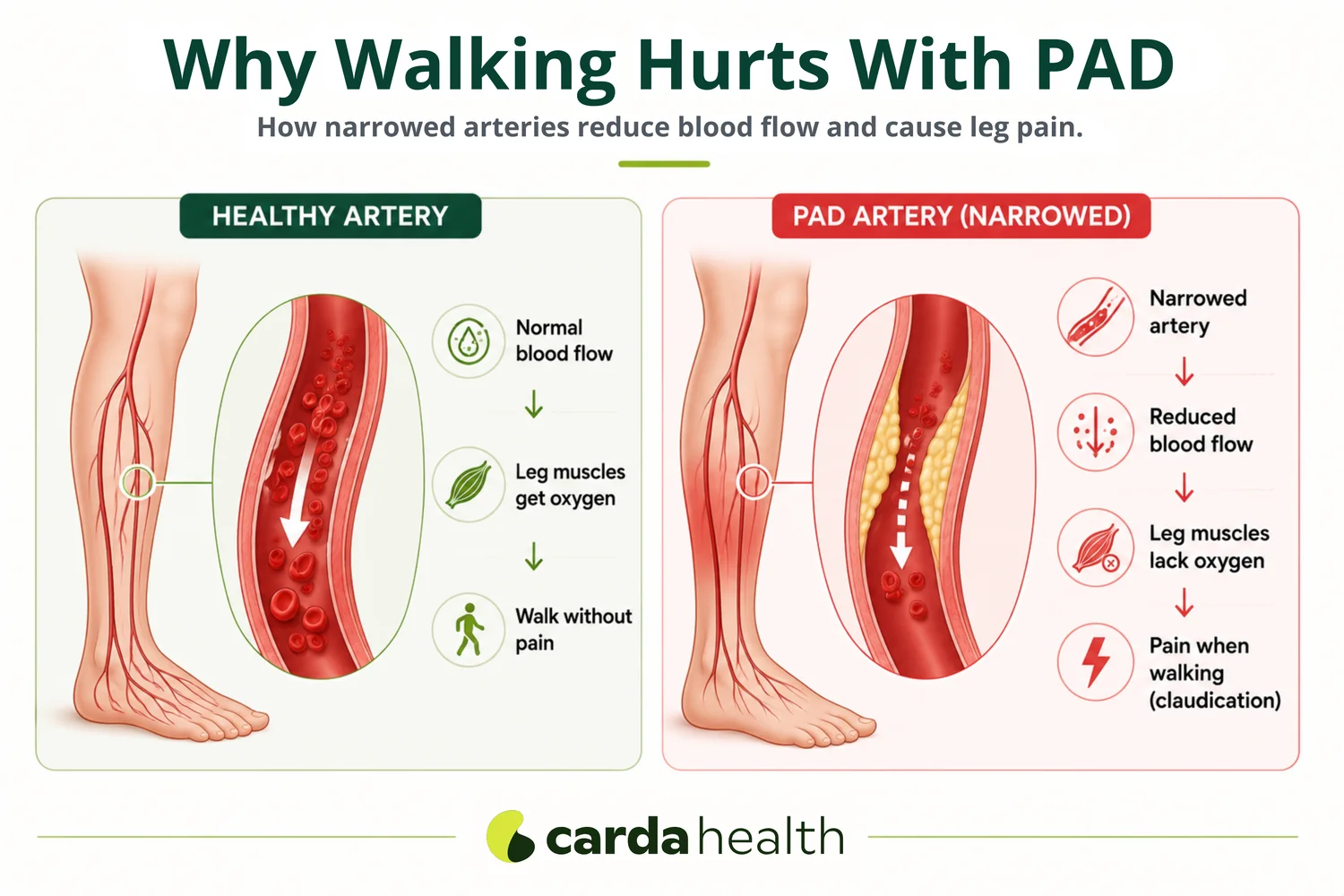
Here is the key to understanding PAD. At rest, your narrowed arteries can usually still deliver enough blood to your legs. But the moment you start walking, your leg muscles demand far more oxygen-rich blood, and the narrowed arteries cannot keep up. The muscles run short of oxygen, much as a kink in a hose starves whatever is downstream, and that shortfall produces a cramping, aching, or burning pain. As the Mayo Clinic explains, doctors call this intermittent claudication. The pain comes on with activity and fades within a few minutes of rest, once blood flow catches up. It usually appears in the calf, but can also strike the thigh, hip, or buttock, depending on where the narrowing sits.
Symptoms of PAD
Claudication is the classic symptom, but PAD shows up in several ways, and some are far more urgent than others.
When PAD Has No Symptoms
Surprisingly, many people with PAD feel no leg pain at all. The CDC notes that up to 4 in 10 people with PAD have no claudication, sometimes because they have quietly limited their walking. That is why PAD often goes undiagnosed, and why people with risk factors like smoking or diabetes should mention any leg symptoms to their doctor.
Warning Signs That Need Urgent Care
Some symptoms signal that PAD has become advanced and blood flow is dangerously low. Seek care promptly if you have leg or foot pain at rest, especially at night, or sores on your feet or toes that heal slowly or not at all. According to the American Heart Association, these can signal critical, limb-threatening ischemia, which needs urgent evaluation to protect the limb.
What Causes PAD and Who Is at Risk
PAD develops as atherosclerosis narrows the arteries over years. The biggest risk factors are smoking, the single strongest, and diabetes, along with older age, high blood pressure, high cholesterol, and a family history of vascular disease. Because the same plaque process affects arteries body-wide, managing these risk factors protects not just your legs but your heart and brain.
Why Exercise Is the Medicine (Even Though It Hurts)
Now the part that surprises most people. For PAD with claudication, the most effective first treatment is not a pill or a procedure. It is exercise. The 2024 ACC/AHA guideline for peripheral artery disease makes supervised exercise therapy a first-line treatment, with walking as the preferred form. The evidence is striking: in studies like the CLEVER trial, supervised exercise improved walking ability as much as a stent. Regular walking prompts the body to adapt, encouraging small collateral vessels, improving how efficiently the muscles use oxygen, and increasing the distance you can walk before pain sets in.
How the Walking Protocol Works
The approach runs counter to instinct: rather than avoiding the pain, you walk into it. A typical program has you walk until you feel moderate claudication pain, rest until it eases, then walk again, repeating for about 30 to 45 minutes, several times a week, over roughly 12 weeks. Over time, the distance you can cover before the pain begins gets longer. Always begin with your doctor’s guidance to confirm exercise is safe for you.
Why Supervised and Structured Beats Going It Alone
You might wonder why you cannot simply walk more on your own. You can benefit from that, but structured, supervised programs consistently work better. A trained professional sets the right intensity, keeps you in the productive pain zone without overdoing it, monitors your safety, and helps you stay consistent, the hardest part of any exercise plan. That is why the guidelines specifically recommend supervised exercise, not casual walking.
Other Treatments for PAD
Exercise works best alongside treating the conditions that drive PAD: quitting smoking, managing diabetes, blood pressure, and cholesterol (often with a statin), and usually an antiplatelet medicine such as low-dose aspirin to lower cardiovascular risk. A medication called cilostazol can modestly improve walking distance for some people. Procedures to reopen the artery (angioplasty, a stent, or bypass) are generally reserved for severe cases or when exercise and medical therapy have not done enough.
Is Supervised Exercise for PAD Covered?
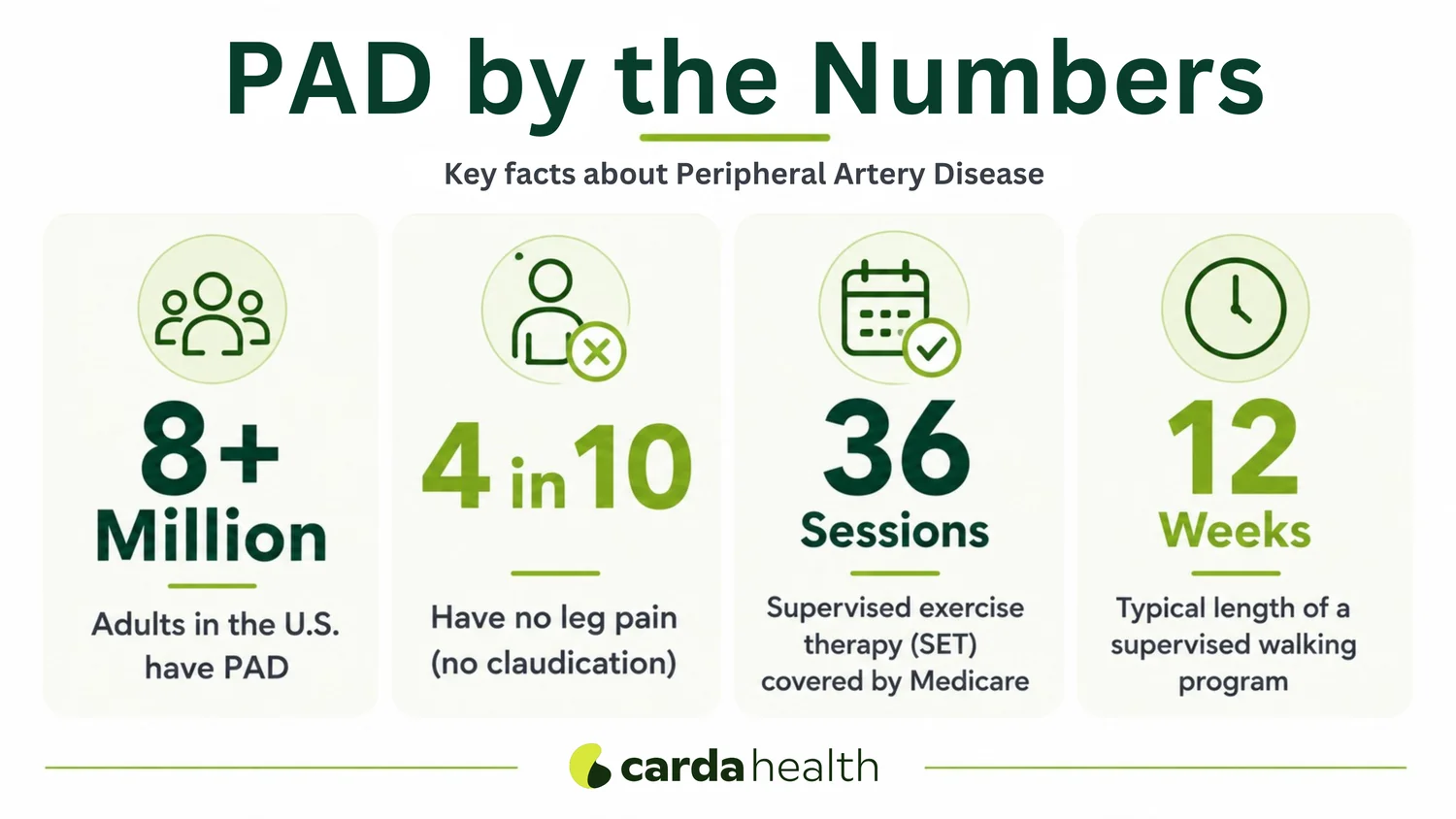
If you are on Medicare, supervised exercise therapy for PAD is covered, but under its own benefit, separate from cardiac rehab. Since 2017, Medicare has covered supervised exercise therapy (SET) for people with symptomatic PAD and claudication, generally up to 36 sessions over 12 weeks, with up to 36 more possible if you remain symptomatic and your doctor provides a second referral. The covered program runs in a hospital outpatient department or physician’s office, under qualified clinical supervision, and requires a physician referral. Costs and rules vary by plan, so confirm the specifics with your plan and care team.
How Carda Health Can Help
The biggest practical barrier to supervised exercise is access. Programs can be far away, hard to reach several times a week, or unavailable nearby, and referral rates remain low. That is the gap virtual, supervised exercise is designed to close. Carda Health delivers monitored exercise programs guided by a clinical exercise physiologist, with real-time vitals monitoring, from home (see the benefits of supervised cardiac rehabilitation and how virtual, supervised rehab works). If you have PAD and cannot easily access a supervised walking program, it is worth exploring your options, including whether you qualify for a program like Carda’s. Whether a program fits your diagnosis and plan is something to confirm directly, so the simplest next step is to check your eligibility.
The Bottom Line
PAD narrows the arteries to your legs and most often shows up as claudication, leg pain that comes with walking and eases with rest. It is common, it is a signal to protect your heart as well as your legs, and its first-line treatment is powerful and within reach: supervised walking exercise that can rival a procedure for many people. If walking has become painful, the answer is not to walk less. Talk to your doctor about supervised exercise, watch for the warning signs that need urgent care, and know that with the right plan, most people can walk farther and feel better.
{{get-started}}
Frequently Asked Questions
What are the symptoms of peripheral artery disease?
The most common is claudication: leg pain or cramping when walking that eases with rest. Other signs include pain at rest, slow-healing foot sores, and cool or shiny skin. Notably, up to 4 in 10 people with PAD have no leg pain at all.
Why do my legs hurt when I walk?
When you walk, your leg muscles need more blood, but narrowed arteries cannot deliver enough. The muscles run short of oxygen, causing a cramping or aching pain that fades within minutes of rest. This is intermittent claudication.
Is walking good for PAD, or does it make it worse?
Walking is good, and it is a core treatment. Supervised programs improve how far you can walk before pain starts: you walk into moderate pain, rest until it eases, then repeat. Always start with your doctor’s guidance to confirm exercise is safe for you.
What is the best treatment for PAD or claudication?
For claudication, supervised exercise therapy is first-line, alongside treating risk factors like smoking, diabetes, blood pressure, and cholesterol. Medications may be added, and stents or bypass are generally reserved for severe cases or when exercise and medical therapy are not enough.
Does Medicare cover exercise therapy for PAD?
Yes, but as its own benefit separate from cardiac rehab. Medicare covers supervised exercise therapy (SET) for symptomatic PAD, generally up to 36 sessions over 12 weeks, with up to 36 more possible via a second referral. It is delivered in a clinic or office setting. Confirm costs and details with your plan.
Can PAD be reversed or cured?
There is no outright cure, but PAD can be managed well. Quitting smoking, controlling risk factors, and committing to supervised exercise can ease symptoms, improve walking, and slow progression, while lowering the heart attack and stroke risk that comes with PAD.
When is PAD serious, and when should I see a doctor?
See a doctor about any leg pain with walking. Seek prompt care for leg or foot pain at rest or sores that will not heal, which can signal limb-threatening ischemia. PAD also raises heart attack and stroke risk, so it warrants attention even without severe leg symptoms.
References
- Gornik HL, Aronow HD, Goodney PP, et al. 2024 ACC/AHA/Multisociety Guideline for the Management of Lower Extremity Peripheral Artery Disease. J Am Coll Cardiol. 2024;83(24):2497–2604.
- ACC/AHA Joint Committee on Performance Measures. 2026 Clinical Performance and Quality Measures for Patients With Peripheral Artery Disease. Circulation: Population Health and Outcomes.
- Centers for Medicare & Medicaid Services. Decision Memo: Supervised Exercise Therapy (SET) for Symptomatic Peripheral Artery Disease (CAG-00449N).
- American Heart Association. Symptoms of PAD.
- Centers for Disease Control and Prevention. About Peripheral Arterial Disease (PAD).
- Murphy TP, Cutlip DE, Regensteiner JG, et al. Supervised exercise, stent revascularization, or medical therapy for claudication due to aortoiliac PAD: the CLEVER study. J Am Coll Cardiol. 2015;65:999–1009.